
Burst Pipe Repair: Emergency Response Guide
What to do when a pipe bursts — emergency shutoff steps, repair options, insurance documentation, freeze prevention, and cost. Complete guide.
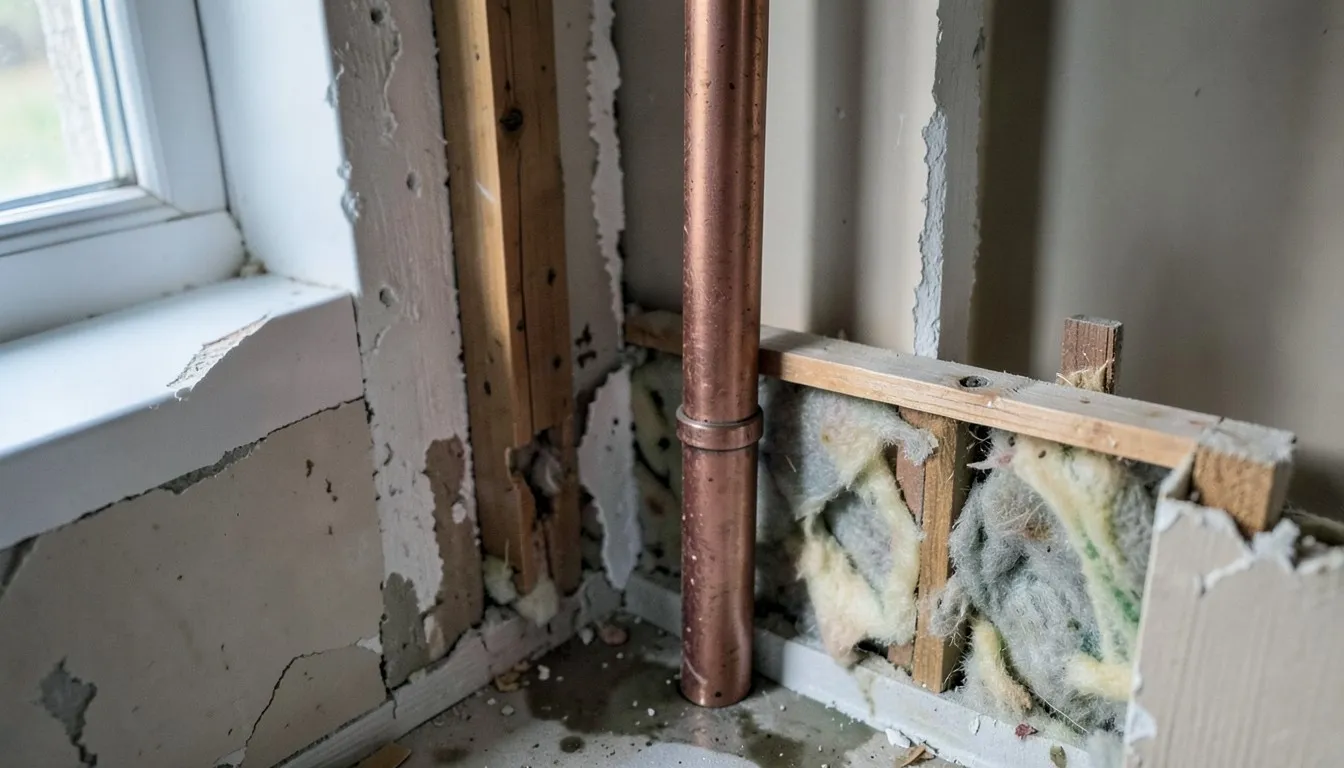
A burst pipe requires immediate action: locate and close the main water shutoff, document all damage with photos before cleanup begins, and call a licensed plumber for same-day service. Repair costs range from $300–$1,200 for a copper or PEX patch to $4,000–$15,000+ when water damage remediation is included per BuildZoom 2024 burst pipe repair cost data. Freeze bursts are the most common cause in cold climates — PEX-A pipe expands up to 8% before rupturing, substantially outperforming copper and CPVC under freeze conditions per PEX Association cold-weather testing data.
What is a burst pipe, and why is it an emergency?
A burst pipe is a sudden, complete failure of a supply or drain pipe — as opposed to a pinhole leak or slow drip, which can be managed more gradually. The defining characteristic is immediate, uncontrolled water discharge: a supply-side burst pipe (under typical residential pressure of 45–80 PSI per IPC § 604.8 water pressure) can discharge 2–8 gallons per minute into a living space until the water supply is shut off.
Why this is classified as an emergency rather than a standard repair: the water discharge rate creates structural damage in minutes, not hours. Drywall saturates and begins to soften within 1–2 hours of wet contact. Wood framing absorbs moisture that creates mold-favorable conditions within 24–48 hours per CDC indoor environmental health: water damage and mold timeline. Flooring materials (hardwood, laminate, engineered wood) begin warping within hours. A burst supply pipe discovered quickly and shut off in 5 minutes may cause minimal damage; the same burst not discovered until morning can cause $20,000–$80,000 in water damage per Insurance Information Institute water damage cost data.
The two most common burst pipe scenarios
- Freeze burst — Water in an unprotected pipe freezes and expands approximately 9% in volume per NOAA climate and freeze depth data. The expansion creates pressure between the frozen blockage and the closed fixture valve downstream. When that pressure exceeds the pipe's tensile strength, the pipe fails — typically at a fitting, at a thin section, or at any pre-existing weakness. The burst often happens during the THAW, not the freeze — when the ice blockage melts and the pipe failure suddenly releases. Freeze bursts affect supply lines, not DWV pipes (which are not under pressure).
- Corrosion and age failure — The pipe wall has thinned to the point of failure from internal corrosion (common in galvanized steel and copper with aggressive water chemistry). These bursts often occur without warning and are most common in homes 40+ years old with original metal supply pipes per US Census housing vintage data.
Drain vs. supply: what matters most
Supply-side bursts (the pressurized pipes delivering water to fixtures) are the emergency scenario. DWV (drain, waste, vent) pipe failures — while they require prompt repair and can cause sewage contamination — do not discharge water under pressure. A burst supply pipe is always a higher priority than a cracked drain pipe, though both require same-day professional attention.
What causes pipes to burst?
Understanding the cause of a burst pipe determines the correct permanent repair — and whether one pipe failure signals a system-wide risk.
1. Freeze-thaw expansion (most common in cold climates)
Water expands 9.05% in volume when it freezes. In a sealed pipe with no room for expansion, this creates 2,000–30,000 PSI of internal pressure depending on temperature drop rate and pipe diameter per NOAA climate engineering data for freeze analysis. Standard residential supply pipe (copper, CPVC, PEX) fails well below the theoretical ice pressure maximum — the burst happens at the weakest point in the system (fittings, elbows, thin walls). Pipes most vulnerable to freezing: exterior walls without insulation, unheated crawlspaces, unheated attics, and unheated garages per IRC R303.4 pipe freeze protection requirements. The IRC frost line depth requirement (minimum burial depth for outdoor supply lines) varies by climate zone — pipes above frost line in cold climates are freeze-burst candidates.
2. Internal corrosion — galvanized steel
Galvanized steel pipe (standard in US homes built before 1960 per US Census housing-vintage data) corrodes from the inside out over decades. The zinc galvanization layer protects the steel for approximately 40–70 years before depleting. Once the zinc is gone, the steel rusts progressively — narrowing internal diameter (reducing flow), creating rust particles in the water, and eventually thinning the pipe wall to failure. A galvanized system that has begun showing rust in the water (at cold taps, not just hot) is in late-stage deterioration. Burst risk is highest at elbows and fittings where corrosion is most advanced. A single galvanized burst signals that the remaining system is in the same deterioration state — repipe should be evaluated.
3. Internal corrosion — copper in aggressive water
Copper is durable in most water conditions but corrodes in two specific scenarios: (1) soft, low-pH water (pH below 7.0, common in the Pacific Northwest, parts of New England, and Florida) drives Type I pitting corrosion — pinhole leaks that eventually rupture; (2) high chloramine concentrations in municipal water drive accelerated surface corrosion. Per EPA SDWA water quality monitoring data, municipalities using chloramine disinfection (which replaced chlorine in many markets from 2000–2010) have seen increased copper corrosion rates. A copper system with its second or third corrosion failure in the same zone almost always indicates water-chemistry-driven systemic corrosion — a whole-home repipe is the durable fix. See the whole-home repipe guide for the decision framework.
4. Pressure surge and water hammer
Water hammer is a hydraulic shock wave created when a fast-closing valve (solenoid valve in a washing machine, quick-closing faucet valve) suddenly stops flowing water. The kinetic energy of the moving water column converts to pressure in a fraction of a second — peak pressure spikes can reach 10× normal operating pressure per AWWA hydraulic transient analysis guidelines. Repeatedly, these pressure spikes stress fittings and joints. A water hammer arrestor (installed at the washing machine or dishwasher supply stop) absorbs the shock. Per IPC § 604.9 water hammer arrestors, water hammer arrestors are code-required in most applications involving quick-closing solenoid valves. Homes without arrestors on washing machine and dishwasher connections are at elevated risk of joint and fitting failures over time.
5. Physical and mechanical damage
Supply pipes run through walls, floors, and ceilings — and any construction, renovation, or even aggressive picture-hanging can damage them. Nail or screw punctures are the most common mechanical damage — a screw 1–2 inches into a wall can hit a pipe running just behind the drywall. Per IPC § 305 pipe protection requirements, pipes within 1¼" of the face of a wall stud must be protected by a steel plate, but this protection is missing in many older homes. Physical damage bursts are usually discovered immediately (water visible through the wall at the time of the fastener insertion) or within hours (water seeping through the wall after building pressure resumes).
6. Polybutylene failure
Polybutylene (PB) pipe — installed in approximately 10–15 million US homes built between 1978 and 1995 — degrades under exposure to chlorine and other disinfectants in municipal water. The inner surface becomes brittle and develops micro-fractures that eventually rupture. Per the original Cox v. Shell class action settlement, polybutylene has been acknowledged as a known-failing material. PB systems do not necessarily burst catastrophically; they often develop pinhole leaks at fittings first that escalate to full failures. A plumber identifying PB in a home should recommend full repipe — not spot repair — because every section of PB is in the same deterioration state per Plastic Pipe Institute polybutylene material history.
What should you do right now if a pipe bursts?
The actions taken in the first 5–15 minutes after discovering a burst pipe determine the difference between a $500 repair and a $50,000 water damage restoration. Follow this sequence.
Step 1: Locate and close the main water shutoff — immediately
The main water shutoff is the single most important thing to find before a water emergency. In most homes, it's located at one of these points:
- Inside the home — In the utility room, near the water heater, in the basement near where the main enters the foundation, or under the kitchen sink. Typically a gate valve (round wheel) or ball valve (lever handle). Turn clockwise to close (gate valve) or rotate 90° perpendicular to the pipe (ball valve).
- Outside near the foundation — In a covered box at ground level near the foundation wall where the main enters.
- At the street meter box — Curb shutoff valve in the meter box near the property line. May require a meter key (available at hardware stores) to operate. Per AWWA residential service line shutoff guidance, the curb shutoff is city property — closing it is generally permitted in an emergency, but notify the water utility.
Do this now, before you read the rest of this guide: locate your main water shutoff and make sure every adult in the household knows where it is and how to operate it. Per EPA WaterSense emergency preparedness guidance, this single preparedness step is the most impactful burst pipe mitigation possible.
Step 2: Turn off electricity and gas to affected areas
Water and electricity are immediately lethal in combination. If the burst is near an electrical panel, outlets, light fixtures, or appliances — or if water is running down walls near electrical boxes — turn off the circuit breakers for the affected areas before entering the space. Per CPSC electrical safety in water damage scenarios, electrical shock is a documented cause of fatalities in residential flooding events where occupants walked through standing water without first disconnecting power. If water has reached the electrical panel itself, call the utility company and do not enter the space until power is confirmed off at the meter.
Step 3: Document everything before cleanup begins
Before moving or cleaning anything, document the damage thoroughly with photos and video. This documentation is critical for insurance claims. Per Insurance Information Institute water damage claim documentation guidance, claims without photographic documentation of original damage are frequently disputed or partially denied. Document:
- The burst pipe itself — location, pipe material, nature of the failure
- The extent of water on floors, walls, ceilings
- All affected personal property (furniture, electronics, clothing, rugs)
- Water stains, saturation marks on walls and flooring
- The date and time the damage was discovered (shown in phone photos' metadata)
Step 4: Begin water extraction and ventilation
Once the water supply is off and documentation is complete, begin removing standing water. Use wet/dry vacuums for smaller pools. Open windows and doors for ventilation. Run dehumidifiers if available. Per CDC water damage and mold prevention timeline, mold growth in cellulosic materials (drywall, wood framing, carpet) can begin within 24–48 hours of sustained wetness. Professional water damage remediation (a separate engagement from pipe repair) uses industrial air movers, dehumidifiers, and moisture meters to ensure materials are dried to safe levels.
Step 5: Call a licensed plumber for same-day service
A burst pipe repair itself is typically a 1–3 hour job once the plumber is on site. The challenge is having a licensed plumber available immediately. Most markets have emergency plumbing services operating 24/7 — expect an after-hours surcharge of $75–$200 per BuildZoom emergency service cost data. When calling, describe: the pipe location (which wall, floor, or ceiling), the pipe material (copper, PEX, galvanized) if known, the approximate pipe diameter, and whether you've successfully shut off the water supply.
How bad is the water damage, and how do you mitigate it?
The water damage from a burst pipe may be more significant than the pipe repair itself — both in cost and complexity. Understanding damage categories and mitigation priority helps you make better decisions in the hours immediately following the burst.
Water damage categories
Per the IICRC S500 standard (the industry standard for water damage restoration), water damage is classified in three categories:
- Category 1 (Clean water) — Water from a supply pipe burst, water heater failure, or rainwater intrusion. Does not pose a substantial health risk from contact. Most supply pipe bursts produce Category 1 water initially. If standing water has been present more than 24–48 hours, it may degrade to Category 2 or 3 as bacteria multiply per CDC water damage contamination timeline.
- Category 2 (Gray water) — Contains significant contamination and may cause discomfort or illness if contacted. Includes washing machine overflow, toilet overflow with no feces, and Category 1 water that has been sitting.
- Category 3 (Black water) — Grossly contaminated water containing pathogenic agents. Sewer line backups, floodwater, and sewage discharge. Category 3 water requires professional remediation with full PPE and biocide treatment.
Most burst supply pipe scenarios produce Category 1 water — the primary damage concern is structural and cosmetic, not contamination.
| Water Category | What It Means |
|---|---|
| Category 1 (Clean water) | From a supply pipe burst, water heater failure, or rainwater intrusion; no substantial health risk from contact |
| Category 2 (Gray water) | Contains significant contamination; includes washing machine overflow, toilet overflow with no feces, and aged Category 1 water |
| Category 3 (Black water) | Grossly contaminated with pathogenic agents; sewer backups, floodwater, sewage discharge; requires professional remediation with PPE and biocide treatment |
Structural damage timeline
- Within 1 hour — Drywall begins absorbing water, paint bubbles, hardwood flooring starts absorbing at edges.
- 1–4 hours — Drywall weakens structurally, particle board and MDF components begin to swell irreversibly, wood flooring begins to cup.
- 4–24 hours — Insulation in walls saturates (and retains moisture for weeks even after surface drying), drywall becomes structurally compromised, mold-favorable conditions established.
- 24–48 hours — Per CDC mold growth timeline in water-damaged materials, visible mold growth can begin on cellulosic materials within 24–48 hours of sustained wetness. Wood framing in walls remains at mold risk until dried to below 16% moisture content.
- 72+ hours — Widespread mold colonization, serious structural compromise of drywall, irreversible damage to hardwood flooring, subfloor risk.
| Time Since Water Exposure | What Happens |
|---|---|
| Within 1 hour | Drywall begins absorbing water, paint bubbles, hardwood flooring starts absorbing at edges |
| 1–4 hours | Drywall weakens structurally, particle board and MDF swell irreversibly, wood flooring begins to cup |
| 4–24 hours | Wall insulation saturates, drywall becomes structurally compromised, mold-favorable conditions established |
| 24–48 hours | Visible mold growth can begin on cellulosic materials; wood framing stays at risk until dried below 16% moisture content |
| 72+ hours | Widespread mold colonization, serious structural compromise of drywall, irreversible hardwood damage, subfloor risk |
Professional water damage remediation: what it involves
Water damage remediation (performed by a separate contractor from the plumber) involves:
- Moisture mapping — using thermal imaging and moisture meters to identify the full extent of saturation behind walls and under floors
- Water extraction — industrial wet vacuums and truck-mounted extraction systems
- Structural drying — industrial air movers (fans) and dehumidifiers placed to create directed air flow that dries materials from the outside surface inward
- Drywall removal — in many cases, drywall that has been wetted must be removed to allow wall cavities to dry and insulation to be replaced; drywall is not salvageable once fully saturated
- Antimicrobial treatment — application of antimicrobials to prevent mold colonization during the drying process
Restoration costs for professional remediation run $1,500–$15,000+ depending on affected area, structural impact, and contents damage per III water damage restoration cost data.
What are your burst pipe repair options?
The right repair approach depends on the pipe material, failure cause, location, and whether the failure is isolated or signals a system-wide risk.
Temporary repairs: buying time before the permanent fix
A plumber may install a temporary repair if permanent repair requires materials not immediately on hand or if the home needs to be dried before drywall can be opened for pipe access. Common temporary measures:
- Push-fit coupling (SharkBite or similar) — A push-fit fitting can be installed on most pipe materials in minutes without soldering or special tools. Per IPC § 605 listed fittings requirements, push-fit fittings are code-compliant for most residential supply applications when the fitting carries the appropriate listing for the pipe material. A SharkBite push-fit coupling is often a legitimate permanent repair for PEX or copper in accessible locations — not necessarily just a temporary fix.
- Pipe repair clamp — A steel clamp with a rubber gasket compresses over the burst location. Used for temporary emergency water restoration while materials for a proper repair are obtained. Not considered a permanent repair in most jurisdictions per IPC repair and replacement standards.
Permanent repair: what the job involves
A permanent burst pipe repair requires: cutting out the damaged section (typically 6–24 inches around the burst to ensure the repair extends to sound pipe); preparing the pipe ends; installing replacement pipe with appropriate fittings; testing the repair under normal operating pressure (verify no leaks with water flowing to all fixtures); and patching or reframing the wall opening per IPC repair standards. The plumbing repair itself is typically 1–3 hours. Wall patching (drywall, painting) is a separate trade if the homeowner wants cosmetic restoration — plumbers typically address the pipe and leave the wall opening for a general contractor or the homeowner.
Repair material selection
The replacement material must be appropriate for the location, pipe size, and local code adoption:
- PEX-A — The preferred material for most burst pipe repairs in cold-climate markets. PEX-A expands up to 8% before rupturing per PEX Association cold-weather expansion testing, providing meaningful freeze tolerance that copper and CPVC lack. Certified per NSF/ANSI 61 + 372 drinking water certifications. Most cost-effective for repairs that require routing through walls or around obstacles (flexible pipe, no elbows needed for gentle bends).
- Copper Type L — The legacy material; requires soldering skills and torch work. Appropriate for maintaining consistency in an otherwise all-copper system. Per Copper Development Association Type L specifications, Type L (medium wall) is the standard for residential supply.
- CPVC — Allowed by most codes for supply. Less freeze-tolerant than PEX — CPVC bursts at lower expansion stresses. Generally not recommended for freeze-burst repairs in cold climates.
- Push-fit fittings (SharkBite, Uponor, etc.) — Approved for most residential supply applications in accessible locations. Avoid in locations that will be permanently concealed without any access — leaks from push-fit fittings are rare but do occur with improper installation. Per IPC § 605.22 push-fit fittings, push-fit fittings must be accessible unless the fitting carries a specific listing for concealed installation.
When to repipe rather than spot-repair
A single burst pipe repair is appropriate when the failure was isolated and the remaining pipe system is sound. Repipe should be evaluated when:
- The burst occurred in polybutylene pipe — PB is a system-wide failing material. Spot repair fixes the immediate leak but leaves all other PB sections at the same risk per the Cox v. Shell settlement history.
- The burst occurred in galvanized steel in a pre-1960 home — The zinc layer has depleted across the entire system, not just at the burst point. Additional galvanized bursts are statistically likely within 2–5 years per Copper Development Association galvanized pipe failure data.
- The burst is the second or third corrosion failure in copper in the same home within 5 years — multiple corrosion failures indicate systemic water chemistry aggression, not an isolated event.
- The burst was a freeze event in copper or CPVC in a home where the pipe configuration that allowed freezing cannot be corrected (e.g., pipes through an unheatable wall section) — PEX-A repipe of that section reduces future freeze risk.
See the whole-home repipe guide for the full repipe decision framework and material comparison.
How do you prevent pipes from freezing?
Freeze burst prevention is more cost-effective than freeze burst repair. Per NOAA freeze depth and climate data, prolonged temperatures below 20°F produce the most freeze damage — the threshold where pipe freezing risk rises sharply even in reasonably insulated spaces.
Pipe insulation: the primary defense
Foam pipe insulation (polyethylene foam tubes, available in standard pipe diameter sizes) slows heat loss from pipe to ambient air. Per IRC R303.4 freeze protection for plumbing, supply pipes in unconditioned spaces (exterior walls, crawlspaces, attics, unheated garages) must have freeze protection appropriate to local climate zone. Foam insulation alone is sufficient for pipes in spaces that don't get below 20°F; below that, additional measures are needed. Cost: $0.50–$3.00 per linear foot installed — one of the lowest-cost structural protection measures available per DOE Energy Saver pipe insulation guide.
Heat tape (electric pipe heat cable)
Electric resistance heat tape wraps around pipes in cold spaces and generates heat when ambient temperature drops. Two types:
- Constant-wattage heat tape — Runs at constant power regardless of temperature. Less efficient; can overheat if left on without thermostat. Per CPSC heat tape fire safety guidance, constant-wattage heat tape is a documented fire hazard when overlapped, placed under insulation incorrectly, or left on without a thermostat.
- Self-regulating heat tape — Uses a semiconducting material that increases resistance (and decreases heat output) as temperature rises. More efficient and significantly safer per CPSC self-regulating heat tape safety data. Always specify self-regulating when installing heat tape on water supply pipes.
Per UL Listed heat cable certification requirements, only use heat tape with a UL listing — unlisted products have higher failure and fire rates.
Thermostatically-controlled heat (most reliable)
In crawlspaces and mechanical rooms adjacent to exterior walls, a thermostatically-controlled electric baseboard heater maintaining a minimum of 40°F prevents freeze conditions without requiring specific pipe-level intervention. Per DOE Energy Saver freeze prevention for crawlspaces, maintaining a 40°F minimum in a crawlspace is the most reliable freeze prevention for homes in climate zones 5–7 (upper Midwest, New England, Mountain states).
PEX-A vs. copper vs. CPVC for freeze tolerance
Material selection matters for freeze-exposed pipe sections:
- PEX-A — Expands 6–8% before rupturing per PEX Association freeze-cycle testing. Can typically survive one or two freeze events without bursting. Industry-acknowledged as the most freeze-tolerant supply pipe material in residential use.
- Copper — Has essentially zero elongation — it fractures at the burst point with minimal expansion. A frozen copper pipe of sufficient length ruptures almost certainly.
- CPVC — Brittle at low temperatures. Lower freeze tolerance than PEX; higher burst risk than copper for short pipe segments in cold conditions.
For pipes running through unheated attics, exterior walls, or garages in cold climates, specifying PEX-A at pipe replacement or repipe provides meaningful insurance against the next freeze event per PEX Association installation guidelines for cold climates.
Seasonal shutdown: pipes in vacation homes and vacant buildings
For seasonal or vacation properties left unoccupied through winter, the only reliable freeze protection is a complete draindown:
- Shut off the main water supply at the meter or curb shutoff
- Open all faucets (hot and cold) at the lowest point in the home to drain supply lines
- Flush all toilets; add RV antifreeze (propylene glycol — not automotive antifreeze, which is toxic) to toilet tanks and toilet bowls to prevent P-trap freezing
- Open the water heater drain valve briefly to drain standing water
- Consider having a plumber drain the hot water heating system if radiant heat or hydronic baseboards are present
A complete draindown eliminates freeze burst risk entirely for unoccupied properties per IRC R303.4 seasonal dwelling requirements.
Cold-weather habits for occupied homes
- Set heat to minimum 55°F even when away — don't turn the heat off entirely in cold climates per DOE Energy Saver cold weather travel guidance.
- Open cabinet doors under sinks on exterior walls during extreme cold events (below 10°F) to allow heated air to reach pipes behind the cabinets.
- Allow a trickle of water to run from the fixture at the end of a vulnerable pipe run during extreme cold — moving water freezes at lower temperatures than standing water.
- Know where your main shutoff is and verify it opens freely before winter season each year.
How does excess water pressure cause pipes to burst?
Residential supply water pressure that is too high stresses all pipe fittings and joints continuously — accelerating wear, driving pinhole leaks, and increasing burst risk. Understanding normal pressure range and the equipment that manages it can prevent a category of burst events that isn't freeze- or corrosion-related.
Normal residential water pressure range
Per IPC § 604.8 maximum water pressure, the maximum allowable residential water pressure is 80 PSI. Per UPC § 608 pressure requirements, the recommended residential range is 45–80 PSI. Most water utilities deliver water at 60–80 PSI at the meter. You can measure your home's static water pressure with an inexpensive pressure gauge ($10–$20) attached to any hose bibb.
Pressure reducing valve (PRV)
A pressure reducing valve (PRV, also called a pressure regulator) is installed where the main supply enters the home and reduces incoming street pressure to a residential-safe level. Per IPC § 604.8 PRV requirements, a PRV is required when the street supply pressure exceeds 80 PSI. PRVs typically need replacement every 10–15 years as the internal diaphragm wears — a failing PRV may deliver elevated pressure (causing stress on all downstream fittings) or reduced pressure (causing inadequate flow). Signs of a failing PRV: water pressure noticeably higher or lower than usual, water hammer sounds, T&P valve on the water heater tripping (caused by high pressure reaching the tank).
PRV replacement cost: $250–$600 installed per BuildZoom PRV replacement cost data. This is one of the most overlooked maintenance items in residential plumbing — a PRV that has been in service for 15+ years should be tested and considered for proactive replacement.
Water hammer and its long-term effects
Water hammer pressure spikes from fast-closing valves — washing machines, dishwashers, solenoid-controlled irrigation — can reach 10× the normal operating pressure per AWWA hydraulic transient guidelines. Over years, these repeated pressure spikes stress fittings and joints. Per IPC § 604.9 water hammer arrestors, water hammer arrestors (small cylinder-shaped devices that absorb the shock) are code-required at quick-closing valve applications. A home with audible water hammer (banging pipes when washing machine valves close) that doesn't have arrestors is experiencing repeated pressure stress that shortens fitting and joint lifespan. Arrestor installation cost: $75–$200 per location per BuildZoom water hammer arrestor cost.
Does homeowners insurance cover a burst pipe claim?
Burst pipe damage is one of the most common homeowner's insurance claims — and one of the most frequently disputed or partially denied. Understanding what's typically covered and what isn't helps you document correctly from the first minutes after discovering the burst.
What's typically covered
Per Insurance Information Institute homeowner's policy coverage guide, standard homeowner's insurance (HO-3 policy form) covers:
- Sudden and accidental water damage from a burst pipe (supply-side)
- Water damage to walls, floors, and ceilings from the burst
- Damaged personal property (furniture, electronics, clothing)
- Debris removal and professional water damage remediation costs
- Additional living expenses (ALE) if the home is uninhabitable during repairs
What's typically NOT covered
- The pipe repair itself — The plumbing repair is almost universally excluded. Insurance covers the damage caused by the burst, not the plumbing fix.
- Gradual leaks — A slow leak that was knowable (visible water stains, soft flooring, wet cabinet base) is typically excluded as preventable. Only sudden, accidental bursts are covered.
- Negligence — A burst caused by leaving a home without heat in winter and pipes freezing may be partially or fully denied as neglect. Insurers may require evidence that reasonable freeze prevention was in place per III claims adjustment guidance for freeze events.
- Flood — Ground-level flooding (from street flooding, storm surge, or rising groundwater) requires separate flood insurance (NFIP policy) — this is NOT covered under standard homeowner's insurance per III flood insurance vs. homeowner's insurance distinction.
Documentation protocol for a successful claim
The single most important action for a successful insurance claim is comprehensive photographic documentation BEFORE any cleanup or removal:
- Photograph the burst pipe itself — pipe material, location, and nature of the failure visible
- Photograph all affected areas — standing water, wet walls, saturated flooring, damaged contents
- Photograph all damaged personal property in place before moving it
- Create a written inventory of damaged contents with estimated replacement values
- Save all receipts for emergency mitigation expenses (wet/dry vacuum rental, emergency plumber call, hotel stay if home is uninhabitable)
- Contact your insurer by phone to open the claim within 24–48 hours of discovery per III prompt claim notification requirements
Working with the adjuster
Your insurer will assign an adjuster to evaluate the claim. The adjuster's job is to determine coverage and estimate repair costs — not necessarily to maximize your settlement. Key points per III policyholder rights in water damage claims:
- You are entitled to independent contractor estimates for the repair scope — you don't have to accept the adjuster's estimate as the only number.
- If you disagree with the adjuster's assessment, you may invoke the policy's appraisal provision (the process varies by state and policy).
- Document all communications with the insurer in writing (email confirmation of phone calls).
- Keep all plumber and remediation contractor invoices — these become part of the claim documentation.
What does burst pipe repair cost?
Burst pipe costs span a wide range because the pipe repair and the water damage remediation are two separate categories of work — each with its own contractor, timeline, and cost driver.
Pipe repair cost
- Simple spot repair, accessible location (copper or PEX patch, 6–24 inches) — $300–$800 including labor and materials per BuildZoom burst pipe repair cost data.
- Spot repair, wall access required (drywall cutting, wall patching) — $500–$1,200. Drywall patching and painting typically not included in plumbing quote — a separate cost.
- Spot repair in slab (supply line under concrete) — $1,200–$4,500 including jackhammering, repair, and concrete patch per BuildZoom slab access repair cost data. Consider this a trigger for slab reroute vs. in-slab repair evaluation — see the slab leak repair guide.
- Pipe section replacement (longer runs, multiple fittings) — $800–$2,500 depending on pipe length, access, and material.
- Partial repipe (one zone of the house) — $1,800–$5,000.
- Whole-home repipe — $4,500–$15,000 per the whole-home repipe guide.
Emergency service premium
After-hours, weekend, and holiday burst pipe service adds $75–$250 to the base repair cost per BLS emergency service wage premium data. For a burst pipe at 2am requiring a plumber called in from emergency standby, a 30–50% total cost premium above standard business-hours rates is typical and legitimate.
Water damage remediation cost
Remediation is usually the larger cost in a serious burst pipe event:
- Minor incident (1–2 rooms, caught quickly) — $500–$3,000. Water extracted, materials dried, no drywall removal required.
- Moderate incident (multiple rooms, 12–48 hours of water presence) — $3,000–$15,000. Includes drywall removal, insulation replacement, structural drying, and cosmetic restoration per III water damage restoration cost benchmarks.
- Major incident (widespread saturation, multi-day water presence) — $15,000–$80,000+. Includes structural assessment, subfloor replacement, mold remediation if present, and full cosmetic restoration.
Insurance deductible context
Most homeowner's policies have deductibles of $500–$5,000. For minor burst pipe events where the total remediation cost is $1,500–$3,000, filing a claim may not be economically advantageous once the deductible and potential premium impact are considered. For incidents exceeding $5,000 in damage, insurance claim benefit typically exceeds the cost of filing. Per III guidance on when to file homeowner claims, consult your insurer before deciding whether to file — asking for claim assessment does not automatically trigger a premium increase in most states.
When does a burst pipe mean you need a full repipe?
A burst pipe that represents a one-time event in a sound pipe system warrants spot repair. A burst pipe that is symptomatic of system-wide pipe deterioration warrants serious consideration of full or partial repipe.
Material-class triggers
Certain materials make repipe consideration non-negotiable:
- Polybutylene pipe — A single PB burst is the strongest possible signal for repipe. The material is system-wide failing; fixing one section leaves all other sections at the same risk per Plastic Pipe Institute polybutylene failure documentation. Most insurers that still cover PB pipes will revisit coverage status after a documented PB burst.
- Galvanized steel (pre-1960 home) — If a galvanized pipe has burst from corrosion, all remaining galvanized pipe in the home is in the same late-stage deterioration. Another failure within 2–5 years is statistically likely per Census vintage housing data: galvanized pipe age distribution. Repipe cost is lower than accumulated future repair costs plus water damage in most scenarios per BuildZoom repair-vs-repipe cost crossover analysis.
Failure pattern triggers
- Second or third copper corrosion failure in the same home within 5 years — Systemic water chemistry aggression, not isolated events. The copper is corroding across the system.
- Freeze burst in copper or CPVC where the pipe configuration cannot be corrected — If pipes run through an exterior wall section that cannot be practically insulated or heated, PEX-A reroute of that section is the appropriate long-term fix.
- Insurance requiring repipe as a condition of coverage continuation — Some insurers, after covering a burst event, issue a material-upgrade requirement to maintain coverage. This is increasingly common for PB and galvanized systems.
The cost-crossover threshold
Per BuildZoom repair vs. repipe 5-year cost analysis, once cumulative burst-pipe repair spending on a single supply system has crossed approximately $4,000, the economics have typically flipped — each additional repair is less cost-effective than the one-time whole-home repipe investment. For a 3-bath home in most markets, a PEX-A repipe at $6,000–$9,000 competes directly with two more repair events plus potential remediation costs on a 5-year horizon.
See the whole-home repipe guide for material comparison, permit requirements, and the full scope of what a repipe involves.
Do you need a permit for burst pipe repair?
Whether a burst pipe repair requires a permit depends on the extent of the work and local building department requirements.
When a permit is not required
Per IPC § 106.2 (work exempt from permit), minor pipe repair — replacing a section of existing supply pipe with the same pipe size and material — is typically permit-exempt in most jurisdictions as a maintenance and repair activity. A licensed plumber replacing 18 inches of copper with copper in the same wall, restoring flow and patching the wall, generally does not require a permit.
When a permit is required
- Partial or whole-home repipe (any significant portion of the supply system)
- Rerouting pipe to a new path (changing the pipe route, not just replacing in-kind)
- Changing pipe material (copper to PEX requires inspection in some jurisdictions)
- Any slab penetration or work inside a slab (always permitted)
- Adding shutoff valves, pressure reducing valves, or expansion tanks
Per City of Boston plumbing permit requirements, City of Phoenix plumbing permit requirements, and most major municipalities, any work beyond simple in-kind repair of a section of pipe requires a permit and inspection. When in doubt, ask your licensed plumber — they are required to know their jurisdiction's permit requirements and to pull the permit when required.
Licensed plumber requirement
Supply pipe repair in most states requires a licensed plumber. Key state licensing authorities:
- California: CSLB C-36 plumbing license
- Texas: Texas State Board of Plumbing Examiners
- Florida: Florida DBPR plumbing license verification
- Arizona: Arizona ROC contractor search
- Minnesota: Minnesota DLI plumber license lookup
Insurance claims for water damage from pipe failure-related events may be disputed or denied if the repair was performed by an unlicensed contractor. Always verify license status before hiring for any plumbing repair work.
Need a burst pipe repair callback?
ZIP, phone, kind of work. AlertPlumber routes to a verified plumber for an over-phone estimate.
Burst Pipe Repair by city
City-specific pricing, code references, climate-driven pathology, and frequently-asked questions for the 12 cities where AlertPlumber ships burst pipe repair pages today.
- Burst Pipe Repair in Boston, MA →
- Burst Pipe Repair in New York, NY →
- Burst Pipe Repair in Phoenix, AZ →
- Burst Pipe Repair in Minneapolis, MN →
- Burst Pipe Repair in Atlanta, GA →
- Burst Pipe Repair in Seattle, WA →
- Burst Pipe Repair in Los Angeles, CA →
- Burst Pipe Repair in Chicago, IL →
- Burst Pipe Repair in Dallas, TX →
- Burst Pipe Repair in Houston, TX →
- Burst Pipe Repair in Philadelphia, PA →
- Burst Pipe Repair in San Jose, CA →
What else do people ask about burst pipe repair?
What is the first thing I should do if a pipe bursts?
How do I know where my main water shutoff is?
Will my homeowner's insurance cover a burst pipe?
How long does burst pipe repair take?
Why do pipes burst in winter?
Can I fix a burst pipe myself?
My pipe burst during a freeze. Does it mean all my pipes are at risk?
Should I repair or repipe after a burst pipe?
How much does it cost to repair a burst pipe?
What kind of pipe is most resistant to bursting from freezing?
What is water hammer and can it cause pipes to burst?
What is the difference between a burst pipe and a slab leak?
How do I prevent pipes from bursting in cold weather?
Sources
- International Plumbing Code (IPC) — § 604.8: Maximum Water Pressure
- International Plumbing Code (IPC) — § 605: Listed Fittings Requirements
- International Plumbing Code (IPC) — § 305: Pipe Protection Requirements
- International Plumbing Code (IPC) — § 604.9: Water Hammer Arrestors
- International Plumbing Code (IPC) — § 106.2: Work Exempt from Permit
- International Plumbing Code (IPC) — Repair and Replacement Standards
- International Plumbing Code (IPC) — § 605.22: Push-Fit Fittings
- Uniform Plumbing Code (UPC) — § 608: Pressure Requirements
- International Residential Code (IRC) — R303.4: Pipe Freeze Protection
- International Residential Code (IRC) — R303.4: Seasonal Dwelling Requirements
- PEX Association — ASTM F876/F877 Cold-Weather Expansion Testing
- PEX Association — Freeze-Cycle Testing Documentation
- PEX Association — Installation Guidelines for Cold Climates
- NSF — ANSI 61 and 372 Drinking Water Certifications for PEX
- Copper Development Association — Type L Specifications
- Copper Development Association — Galvanized Pipe Failure and Corrosion Data
- Plastic Pipe Institute — Polybutylene Pipe Material History and Failure Documentation
- NOAA — Freeze Depth and Climate Data by Region
- NOAA — Climate Engineering Data: Freeze Analysis
- EPA — Safe Drinking Water Act: Water Quality and Corrosion Data
- EPA WaterSense — Emergency Preparedness: Main Shutoff Location Guidance
- EPA — Lead and Copper Rule: Corrosive Water Monitoring
- CDC — Indoor Environmental Health: Water Damage and Mold Timeline
- CDC — Mold Growth Timeline in Water-Damaged Materials
- CPSC — Electrical Safety in Water Damage Scenarios
- CPSC — Heat Tape Fire Safety Guidance
- CPSC — Self-Regulating Heat Tape Safety Data
- UL — Listed Heat Cable Certification Requirements
- Insurance Information Institute — Homeowner's Policy Coverage Guide: Water Damage
- Insurance Information Institute — Water Damage Restoration Cost Data
- Insurance Information Institute — Claims Adjustment Guidance for Freeze Events
- Insurance Information Institute — When to File a Homeowner's Claim
- Insurance Information Institute — Flood Insurance vs. Homeowner's Insurance Distinction
- AWWA — Hydraulic Transient Analysis and Water Hammer Guidelines
- AWWA — Residential Service Line Shutoff Guidance
- BLS — Occupational Employment Statistics: Plumbers
- BLS — Emergency Service Wage Premium Data
- BuildZoom — Burst Pipe Repair Cost Data 2024
- BuildZoom — Emergency Service Cost Data
- BuildZoom — PRV Replacement Cost Data
- BuildZoom — Repair vs. Repipe 5-Year Cost Analysis
- BuildZoom — Slab Access Repair Cost Data
- BuildZoom — Water Hammer Arrestor Installation Cost
- U.S. Census Bureau — Housing Vintage Data: Pre-1960 Home Distribution
- U.S. Census Bureau — Housing Characteristics: Pipe Material Age Distribution
- DOE Energy Saver — Pipe Insulation Guide
- DOE Energy Saver — Freeze Prevention for Crawlspaces and Exterior Walls
- DOE Energy Saver — Cold Weather Travel: Minimum Temperature Guidance
- City of Boston Inspectional Services — Plumbing Permit Requirements
- City of Phoenix Development Services — Plumbing Permit Requirements
- CSLB — California C-36 Plumbing License
- Texas State Board of Plumbing Examiners — License Verification
- Florida DBPR — Plumbing License Verification
- Arizona ROC — Contractor License Search
- Minnesota DLI — Plumber License Lookup
- OSHA — Trenching and Excavation: Slab Access Safety