
Sewer Line Repair: The Complete Guide
How sewer line repair works, what it costs in 2026, methods compared, and when to repair vs replace. Real per-city cost data with sources cited.
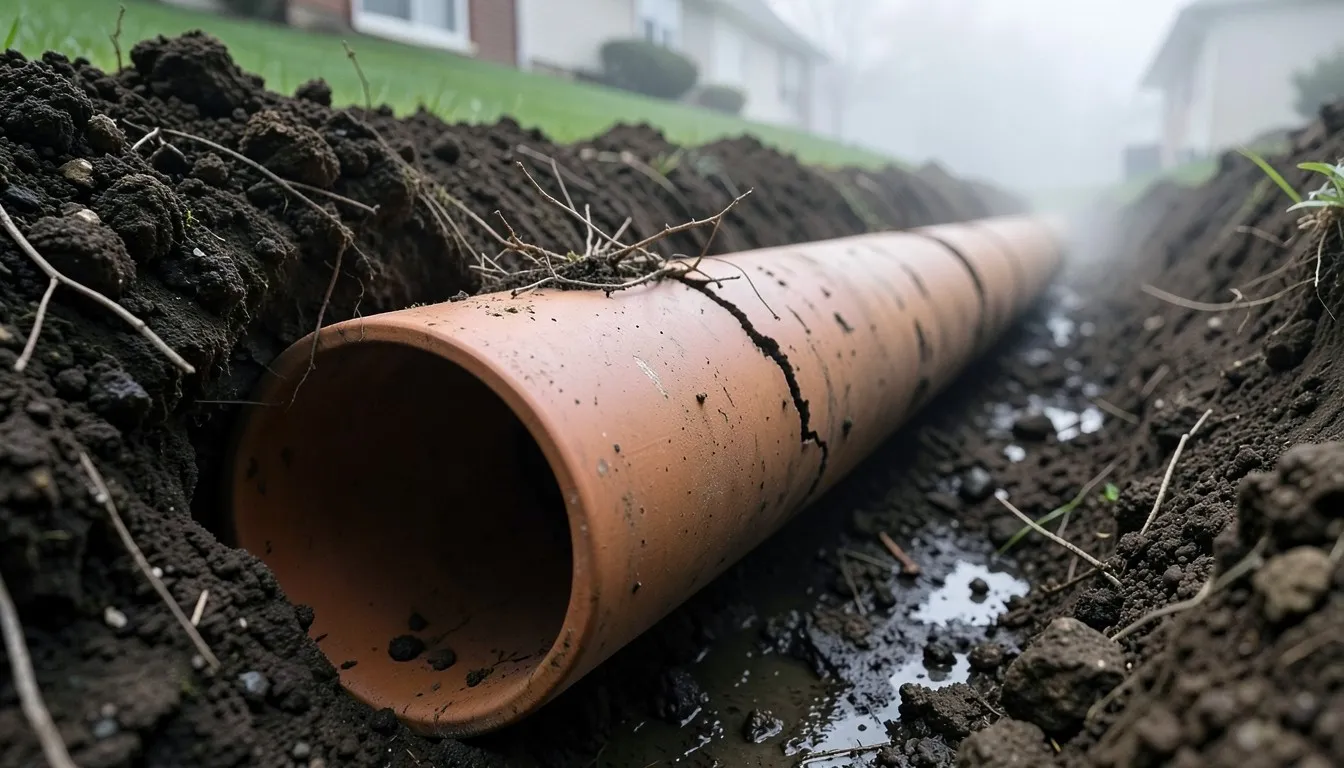
Sewer line repair costs $1,100–$4,500 in most US metros for spot repairs and pipe lining (BuildZoom 2024 permit data), and $5,500–$18,000 for full replacement (trenched or trenchless pipe bursting). Cost depends on pipe depth, length, access, and city restoration requirements. Most homes built before 1980 have either Orangeburg, clay, or cast-iron sewer laterals — all three reach end-of-life between 50 and 100 years per EPA infrastructure data.
What is sewer line repair?
Your home's sewer lateral is the underground pipe that carries waste from your house to the city sewer main under the street. Everything that drains through your sinks, toilets, washing machine, and floor drains converges into a single 4-inch (or in older homes, 6-inch) pipe that runs from your foundation, across your yard, and connects to the public sewer at the property line. You own the lateral. The city owns the main. When the lateral fails, the homeowner pays — even when the failure is under public sidewalk or street.
The boundary varies by city. In some jurisdictions the homeowner's responsibility ends at the property line; in others it extends all the way to the city main connection (sometimes 30+ feet beyond the property line). International Plumbing Code Chapter 7 sets the technical standards for the lateral itself; Uniform Plumbing Code is the West Coast equivalent. Local jurisdictions adopt one or the other (and sometimes amendments). Confirm responsibility boundaries with your city before any work — a 10-foot misjudgment can shift $5,000+ of cost.
Sewer line repair is the umbrella term for fixing this lateral. It covers a spectrum:
- Spot repair — excavating a small section (4–12 ft) and replacing just the broken segment with new PVC or HDPE. Used when damage is localized and the rest of the lateral is structurally sound.
- Pipe lining (CIPP) — Cured-In-Place Pipe. A felt liner saturated with thermosetting resin is pulled into the existing pipe and cured (with steam, hot water, or UV) to form a continuous new pipe inside the old one. Standards published by NASSCO.
- Pipe bursting — a hydraulic head fragments the old pipe outward into the surrounding soil while pulling a new HDPE pipe through behind it. Two small access pits, no full trench. HDPE specs from Plastic Pipe Institute.
- Full trenched replacement — excavating the entire lateral run (typically 30–80 ft) and laying new PVC schedule 40 from foundation to city main. Most expensive, most disruptive, most thorough.
Why so many methods? Because the underlying problem varies. A single root intrusion at one joint is best handled by spot repair or CIPP. A pipe with structural collapse needs pipe bursting or full replacement. Orangeburg pipe (a tar- wood-fiber product manufactured 1948–1972) typically needs full replacement because CIPP has nothing structurally sound to bond to. The plumber's job — before any quote — is a camera inspection that grades the existing pipe so the right method gets matched to the actual condition.
Most US homes built before 1980 have one of three legacy lateral materials, all of which are now near or past end-of-life:
- Vitrified clay tile (1900s–1970s) — bell-and-spigot joints every 24-36 inches that root systems exploit. 50-80 year design life.
- Cast iron (1920s–1980s) — corrodes from inside out; "channeling" along the bottom of the pipe is the failure pattern. 75-100 year design life.
- Orangeburg (1948–1972) — proprietary wood-fiber product that ovalizes and collapses. 30-50 year design life — most are well past failure now per EPA infrastructure aging data.
If your home was built between 1948 and 1972 and you've never had the lateral inspected, it's almost certainly Orangeburg or clay. Get a camera inspection before the lateral fails on you at 2 AM on a holiday weekend.
How does a plumber diagnose sewer line problems?
Diagnosis is the most important step in sewer line work — and the one homeowners most often skip. A plumber who quotes a repair WITHOUT first running a camera is guessing. The diagnostic process has four stages:
1. Camera inspection ($150–$350)
A waterproof camera on a flexible push rod is fed through the cleanout, traveling the full length of the lateral. The plumber records the footage and notes:
- Pipe material (clay, cast iron, Orangeburg, PVC, HDPE) — visible from internal texture and joint pattern
- Pipe diameter (4-inch is residential standard; 6-inch indicates large pre-1960 homes)
- Joint condition (separated joints leak; offset joints catch debris)
- Root intrusion location and severity
- Bellies (low spots where pipe sags below grade — water + waste pools and accelerates corrosion)
- Cracks, fractures, or full collapses
- Foreign objects (tree roots, roof shingles from past contractor work, "flushable" wipes that aren't)
Insist on getting a copy of the camera footage. A reputable plumber provides it on request as a USB drive or video file. The footage is your evidence in any future dispute and your baseline for the next inspection.
2. Locator probe ($75–$150 add-on)
If the camera finds a problem, the plumber uses a sonde (radio transmitter on the camera head) and a surface receiver to locate the EXACT spot above ground — depth and lateral position — within 6 inches. This determines whether spot repair is feasible (problem under landscape) or whether the issue is under the driveway/sidewalk (where excavation cost balloons). A locator probe should always accompany a camera inspection if any repair work is contemplated.
3. Smoke testing (when needed, $200–$500)
For diagnosing odor issues or finding hidden cracks, the plumber pumps non-toxic smoke into the lateral and watches where it surfaces. Smoke escaping through a lawn 30 feet from the house = cracked pipe at that location. Smoke coming up through a basement floor drain that's supposed to have a water-sealed P-trap = dry trap (a different fix). Smoke testing is rarely needed for routine repair scoping but is essential for diagnosing intermittent symptoms.
4. Hydrostatic pressure testing (rare, $400–$800)
For new construction or post-repair verification, the plumber caps both ends of the lateral and pressurizes it with water for a sustained period (typically 15 psi for 15 minutes per IPC § 312). Any pressure drop indicates a leak. Most homeowners never need this; it's a contractor-side acceptance test.
What "no inspection needed" looks like
Every plumber who walks onto your property and quotes a "$8,000 sewer line replacement" without running a camera is misleading you. Get a second opinion. The proper sequence is:
- Camera inspection + locator probe (~$200–$500 total)
- Plumber walks through the camera footage with you, identifies the problem, recommends ONE primary method + a fallback
- Written quote with: scope, method, materials, permit costs, restoration costs, timeline, warranty terms
- Optional: get a second quote from a different verified plumbers using the SAME camera footage. The diagnosis should match; the price may not.
Per BLS Plumbing-Pipefitting wage statistics 2024, the median plumber labor rate nationally is $89/hr. A camera inspection (3 hours typical) at that rate puts the labor floor at $267 — anything materially below $150 either skips steps or is a loss-leader to get the bigger sale. Anything above $400 is overcharging unless deep access work is involved.
What are the signs your sewer line needs repair?
Most sewer-lateral failures don't announce themselves — they progress for months or years before fully backing up the house. Catching them early lets you choose your method (and your plumber) instead of having no choice at 2 AM. Watch for these signs:
- Multiple drains slow at once. A single slow sink is a local clog. Multiple fixtures backing up simultaneously means the problem is downstream of all of them — i.e., the main lateral. The lowest drain in the house (basement floor drain, ground-floor toilet) typically backs up first because it's the path of least resistance. Per IPC § 710, all branch drains converge into the lateral; a restriction at the lateral chokes everything above it.
- Gurgling toilets when you run another fixture. Air being pulled through traps (toilet, sink, floor drain) means the main vent is partially blocked OR the lateral is restricted enough that water draining elsewhere is creating negative pressure. Gurgling is one of the earliest warning signs.
- Sewer smell in the yard or basement. A hairline crack in the lateral lets methane (sewer gas) escape into the soil, where it can travel laterally and surface 10-30 feet from the actual crack. Yard smell on calm days, basement smell after heavy rain, or smell that comes and goes with humidity all point to lateral compromise. Sewer gas is a known health hazard per CDC sewage exposure guidance.
- Recurring main-line clogs. If you've had a plumber snake the main twice in 18 months, the cause is structural, not a one-time blockage. A snake clears a blockage but doesn't fix what's CAUSING the blockage (root intrusion, belly, joint offset). After two snake calls, get a camera inspection — it's the same money as a third snake but tells you what's actually wrong.
- Wet patches in the lawn over the lateral path. Sewage (or just supply-line water from a pinhole) seeping out of a broken pipe creates a wet patch over the leak that doesn't dry between rains. The grass over the wet patch is often LUSHER and greener than surrounding lawn — sewage is fertilizer. A 4-foot-diameter dark green patch with consistent dampness is a classic lateral failure sign.
- Insect or rodent activity around drains. A breach in the lateral is an entry point for rats, cockroaches, and drain flies. New rodent activity in a basement that hasn't seen rodents before is a strong signal.
- Sinkholes or dips in the lawn. A bellied (sagging) section of pipe over time can wash out the soil under it, creating a sinkhole that suddenly drops 6-12 inches. This is the "you're now in emergency territory" symptom — call 811 (USA Dig Safety) before walking on it; sinkholes can keep collapsing.
- Toilet that flushes slowly with no apparent clog. If a single toilet plunges clear but starts flushing slowly again within days, the problem isn't in the toilet — it's downstream in the branch drain or lateral. Have a plumber camera the line before you replace the toilet (a common waste-of-money "fix").
Symptoms that MEAN call now (not next week):
- Sewage backing up into a basement floor drain or a ground-floor shower/tub
- Sewage smell strong enough to be noticeable from outside the house
- Multiple drains backed up simultaneously with no other plumbing work happening
- Visible water surfacing from the yard over the lateral path during dry weather
- Sinkhole or significant ground depression over the lateral path
Each of these can become a four-figure restoration claim if untreated. The matched plumber gives you a over-phone diagnostic frame on the call back; from there it's a camera inspection within 24-48 hours.
Repair methods compared: spot, CIPP, bursting, trenched
Once the camera inspection identifies the problem, the plumber recommends ONE primary method based on pipe condition, length, depth, and access. Here's the honest comparison across the four common methods:
Spot repair (point repair)
How it works: Excavate a small pit (typically 4×6 ft) at the location of the damage, cut out the broken section (4–12 ft), splice in new PVC schedule 40 with rubber couplings (or compression fittings if mixing materials), backfill, restore.
When it's right: Single localized failure (one root intrusion, one cracked section), rest of lateral structurally sound on camera footage. Pipe under landscape (not driveway, sidewalk, or street). Homeowner has 5-15 years of remaining ownership intent.
Cost: $1,100–$2,800 typical per BuildZoom 2024. Add 50-100% if excavation is under concrete/asphalt.
Lifespan: The repaired section gets ~50 years of new pipe; the rest of the lateral is unchanged from its current condition.
Disruption: 1 day on-site. Lawn restoration straightforward (re-sod, re-seed). Driveway concrete cut requires a separate concrete contractor for $800–$2,500 restoration.
Limitations: Doesn't address rest-of-lateral issues. If the camera shows multiple problem areas, spot repair is patching a system that needs full replacement; the operator will be back inside 2 years.
CIPP lining (Cured-In-Place Pipe)
How it works: A felt liner saturated with thermosetting epoxy resin is pulled or inverted into the existing pipe through the cleanout. The liner is inflated against the pipe walls and cured (with hot water, steam, or UV light) to harden the resin. Result: a continuous new pipe (technically a "host- composite") inside the old one. Per NASSCO standards.
When it's right: Pipe is structurally sound enough to host a liner — joint separations, cracks, light root intrusion, surface corrosion. Diameter is consistent (CIPP requires the host pipe to maintain diameter; severe ovalization or collapse means CIPP can't fire).
Cost: $4,500–$12,000 for a typical residential lateral (30-60 ft). Cost driven primarily by length and access.
Lifespan: CIPP epoxy liners are rated 50+ years per NASSCO life-cycle data. The host pipe doesn't matter once the liner is cured — it's the new pipe.
Disruption: 1-2 days on-site. No excavation through landscape or hardscape. Single access point at the cleanout. Restoration requirements: minimal.
Limitations: Reduces internal diameter slightly (about 5-10% loss). Cannot fix a fully collapsed pipe. Cannot fix Orangeburg (the wood-fiber substrate dissolves under the curing temperature). Requires the lateral to have a continuous unobstructed path — sharp bends or offset joints may need pre-treatment.
Pipe bursting
How it works: Two small entry/exit pits are excavated (typically 4×6 ft each — one at the house cleanout, one at the city main connection). A conical bursting head with a new HDPE pipe attached behind it is pulled through the old pipe by a hydraulic winch. The bursting head fragments the old pipe outward into the surrounding soil while the new pipe takes its place. Specs per Plastic Pipe Institute.
When it's right: Pipe is too damaged for CIPP (fully collapsed sections, severe ovalization, Orangeburg material). Soil conditions allow fragmented pipe to be pushed outward (most residential soils work; very rocky or clay-heavy soils sometimes don't). Lateral is not within 18 inches of other utilities (gas, water, telecom — fragmenting could damage them).
Cost: $5,500–$13,500 typical per BuildZoom. Higher than CIPP because of the two excavation pits and the equipment rental.
Lifespan: HDPE pipe is rated 50-100 years per PPI TR-3. The new pipe replaces the old entirely; no host pipe issues remain.
Disruption: 1-2 days on-site. Two pits to backfill and restore. No trenching across the full lateral path. Lawn restoration is two patches, not a 30-foot scar.
Limitations: Can upsize the lateral (replace 4" with 6") which is a structural improvement, but requires permission per local code. Doesn't work under streets with reinforced concrete (the bursting head can't displace rebar). Requires soil "give" — limited use in dense urban areas with utility congestion.
Full trenched replacement
How it works: Excavate the entire lateral run from house foundation to city main. Remove the old pipe entirely. Lay new PVC schedule 40 (or HDPE if local code allows) with new bedding sand, proper slope (1/4 inch per foot per IPC § 708), and new joints. Pressure-test, inspect, backfill, restore.
When it's right: Pipe is fully collapsed across multiple sections. Slope or grade needs correction. Diameter needs upsizing. Local code requires full replacement (some cities mandate it for any lateral work over a certain age). Homeowner is selling and wants a clean replacement record on disclosure.
Cost: $7,500–$18,000+ depending on length, depth, and city restoration requirements. Restoration costs (sidewalk, curb, street paving) can equal or exceed the plumbing labor.
Lifespan: 100-year design life on PVC schedule 40 per PPI. This is the "final fix" — done once, lasts longer than the house.
Disruption: 3-7 days on-site. Full trench across yard (and potentially driveway, sidewalk, street). Major restoration work after pipe install completes — plumber typically subcontracts the concrete + landscaping restoration.
Limitations: Most expensive option. Most disruptive. Cannot proceed if utility lines (gas, water, electric, telecom) are within 18 inches of the lateral path without permitting them moved first.
Side-by-side comparison
| Method | Cost | Lifespan | Disruption | Best for |
|---|---|---|---|---|
| Spot repair | $1,100–$2,800 | 50 yr (section only) | Low (1 day) | Single localized issue, sound rest |
| CIPP lining | $4,500–$12,000 | 50+ years | Very low (no trench) | Joint failures, root intrusion, light damage |
| Pipe bursting | $5,500–$13,500 | 50-100 years | Low (2 small pits) | Collapsed sections, Orangeburg, upsizing |
| Full trenched | $7,500–$18,000+ | 100 years | High (full trench, 3-7 days) | Full collapse, slope correction, code mandate |
The matched plumber's job is to recommend ONE of these based on what the camera shows — not to upsell to the most expensive option. If the recommendation is "full replacement" and the camera shows only a single root intrusion, get a second opinion. If the recommendation is "spot repair" and the camera shows two separated sections plus a belly, that's also wrong (it's underestimating the work).
What does sewer line repair cost in 2026?
National cost ranges (per BuildZoom 2024 permit data + BLS plumber wages OES 47-2152 + NASSCO method standards):
- Camera inspection + locator probe: $150–$500 (always do this BEFORE any repair work)
- Spot repair (4–12 ft): $1,100–$2,800
- CIPP lining (full lateral, 30–60 ft): $4,500–$12,000
- Pipe bursting (full lateral): $5,500–$13,500
- Full trenched replacement: $7,500–$18,000+
- Permit fees: $75–$400 (varies by city — see "Cost by city" below)
- Concrete / asphalt restoration (when work crosses driveway/sidewalk): $800–$3,500 add-on
- Landscaping restoration (lawn, plantings): $300–$1,500 typical
- After-hours / weekend service: +15–30% premium on labor
What drives the variance
Two homes the same age in the same city can get quotes that differ by 3-5x. The factors:
- Lateral length. A 25-ft lateral (small lot, house close to street) costs roughly half what a 75-ft lateral (big lot, house set back) costs. Most cost calculators assume 40-50 ft.
- Lateral depth. Cold-climate cities require deeper laterals (Minneapolis: 60+ inches per NOAA NCEI frost depth; Phoenix: 12-18 inches). Deeper = more excavation = more cost.
- Surface above the lateral. Lateral under landscape: lowest-cost. Under driveway concrete: +$1,500-$3,500. Under sidewalk: +$2,000-$5,000 (city restoration spec). Under street: +$5,000-$15,000+ (city traffic management + paving).
- Permit + inspection fees. Per the cost-by-city table below — varies $75 to $400+ across major US metros.
- City restoration requirements. Some cities require full-width sidewalk replacement (not just a patch) when any sidewalk is disturbed. Adds $1,500-$4,000.
- Material choice. PVC schedule 40 is standard ($3-5 per linear foot). HDPE for pipe bursting ($5-9/ft). CIPP liner materials run $40-80/ft installed.
- Time-of-year. In cold climates, frozen ground November–March doubles excavation time. Plumbers either decline winter trench work or charge ~25% more.
Budget realistically: for a typical 40-ft lateral on a residential lot, in a major US metro, expect $4,500–$8,000 for CIPP, $5,500–$10,000 for pipe bursting, or $8,000–$15,000 for full trenched replacement (including permits and basic restoration). Anything materially above those ranges deserves a second-opinion quote.
What does sewer line repair cost by city in 2026?
Permit fees, labor rates, and restoration requirements vary materially across US metros. Here's the picture in 7 major markets where AlertPlumber has scraped per-city data:
| City | Permit fee | CIPP typical | Pipe bursting | Source |
|---|---|---|---|---|
| Phoenix, AZ | $185 | $4,500–$10,500 | $5,200–$11,000 | Phoenix Development Services |
| Boston, MA | $95 | $5,400–$12,800 | $6,200–$14,500 | Boston ISD |
| Minneapolis, MN | $75 | $5,500–$13,200 | $6,500–$15,000 | Minneapolis Regulatory Services |
| Atlanta, GA | $110 | $4,200–$10,000 | $5,000–$11,500 | Atlanta City Planning |
| Seattle, WA | $165 | $5,800–$13,500 | $6,800–$15,800 | Seattle SDCI |
| Dallas, TX | $145 | $4,400–$10,800 | $5,300–$12,200 | Dallas SDC |
| Chicago, IL | $200 | $5,200–$12,500 | $6,000–$14,000 | Chicago Buildings Dept |
Why cold-climate cities cost more
Boston ($95 permit, but ~$1,500-3,000 higher trench cost), Minneapolis ($75 permit, similar trench premium), and Chicago ($200 permit + winter access issues) all push final costs higher despite reasonable permit fees. The driver is excavation depth — frost lines of 48-60 inches per NOAA NCEI require the lateral to sit deeper, which means more soil to remove and replace, more shoring, and more time in the trench.
Why Sun Belt cities trend lower
Phoenix, Atlanta, Dallas, and other Southern metros benefit from minimal frost requirements (often zero in Phoenix per NOAA NCEI Phoenix), so laterals can sit at shallower depths. Year-round work means no winter shutdown. The trade-off: aggressive root systems (live oaks in Atlanta, mesquite in Phoenix) make root-intrusion issues more frequent, so spot repairs and CIPP are common.
Where to get a city-specific quote
The matched plumber on the AlertPlumber call back has access to per-city permit fees and labor rates and gives you a written estimate before any work. You can also use the cost calculator for a ZIP-localized estimate before the call.
Repair or replace — how do you decide?
The matched plumber's recommendation should fall out of the camera footage cleanly. But when you have two plumbers giving conflicting recommendations (one says "spot repair $2,500", one says "full replacement $11,000"), use this decision framework to break the tie:
Repair (CIPP lining or spot repair) makes sense when:
- Pipe is structurally intact (no major collapse, no severe ovalization)
- Damage is localized to one or two sections
- Pipe diameter and slope are still adequate for current household demand
- You expect to own the home 5–10 more years
- Material is clay or cast iron in good condition (NOT Orangeburg — that needs replacement)
- Camera shows root intrusion at one or two joints, not throughout the run
- No significant bellies (low spots) on the camera footage
Replacement (pipe bursting or trenched) makes sense when:
- Pipe is collapsed or has multiple breaks
- Pipe is Orangeburg (1948-1972 vintage; degrades into a gummy mass per EPA infrastructure aging study)
- Diameter is too small for current household demand (4-inch in a home with multiple bathrooms + rental ADU; should be 6-inch)
- Repeated repairs would cost more than replacement (rule of thumb: if the spot-repair quote is >40% of the full-replacement quote and there are multiple problem areas, replace)
- You're selling the home (a clean replacement is a marketing asset on disclosure)
- Camera shows multiple bellies, multiple separated joints, OR continuous root intrusion across the run
- Local code MANDATES replacement (some cities require it when any portion of the lateral is over a certain age — check with your city development services)
The "rule of 50" shortcut
If the home is 50+ years old AND has its original lateral AND the camera shows ANY of: multiple problem areas, Orangeburg material, multiple bellies, or continuous root intrusion — full replacement is almost always the right answer. The math is straightforward: $5,000 in spot repairs every 3-5 years = $25,000-50,000 over a decade. Full replacement at $10,000-15,000 is lower-cost PLUS gives you 100 years of design life.
If the home is under 50 and the lateral has no obvious failure pattern, lean toward CIPP or spot repair until the camera says otherwise. Modern PVC laterals (post-1980 construction) rarely need replacement — they need maintenance.
When to get a second opinion (always)
- Quote is over $10,000 with no camera footage shown to you
- Plumber recommends full replacement after a 15-minute on-site visit
- Quote varies by more than 50% between two verified plumbers looking at the same camera footage
- Recommended method doesn't match what the camera shows (e.g., "full trench" recommended for what looks like a single root intrusion)
A second opinion is free (any plumber will quote a job they want). The cost of the wrong method can be the difference between a $3,000 fix and a $12,000 fix — and either could be wrong for your situation.
What permits and codes apply to sewer line repair?
Sewer-lateral work always requires a city plumbing permit and a verified plumber. Code adoption varies by region — most US cities follow International Plumbing Code (IPC); West Coast and Mountain states largely follow Uniform Plumbing Code (UPC). Single-family residential work also references International Residential Code (IRC) Chapter 30-32.
What a permit does for you
- Inspection at completion — a city inspector verifies the work meets code (proper bedding sand, correct slope, code-compliant materials, pressure test passes)
- Insurance + warranty defense — un-permitted work voids many homeowners insurance claims related to sewer damage and is grounds for the plumber's warranty being denied
- Resale disclosure record — closed-out permits show up on title searches and provide proof to buyers that the work was done correctly
- Future-claim documentation — if the lateral fails again in 5 years and you need warranty work, the original permit is the foundation of that claim
Examples of local requirements
- Boston, MA: $95 permit + inspection through Boston Inspectional Services Division; lateral must be PVC schedule 40 with bedding sand minimum 4" depth, slope 1/4 inch per foot minimum.
- Phoenix, AZ: $185 permit + inspection through Phoenix Development Services; cleanout required at property line for any new lateral install. Plumber must hold active C-37 license verified through AZ ROC license database.
- Minneapolis, MN: $75 permit through Minneapolis Regulatory Services. Plumber must hold active state license verified through Minnesota DLI license database; lateral burial depth must clear 60" frost line.
- Atlanta, GA: $110 permit through Atlanta City Planning; cleanouts required at maximum 100 ft intervals along the lateral.
- Seattle, WA: $165 permit through Seattle SDCI; environmental review may be required if work is within 50 ft of a waterway.
Always call 811 before any excavation
811 (USA Dig Safety) is the federally-mandated free service that marks underground utility lines (gas, water, electric, telecom, sewer) before excavation. Calling 811 triggers utility-line marking 2–3 business days ahead of work. The plumber will not start excavation without an 811 ticket — and shouldn't. Hitting an unmarked gas line is a fatal-accident-level event.
If your plumber suggests skipping 811 ("it's a small job, we know where the lines are"), find a different plumber. Per OSHA confined-space and excavation safety standards, the plumber's contractor liability insurance requires 811 compliance.
What to ask before signing the quote
- "What permit are you pulling, and what's the fee?" (should match published city rates)
- "What's the inspection schedule?" (typically pre-backfill + final)
- "What materials are you using?" (PVC sched 40 + bedding sand + cleanouts at code-required spacing)
- "What's the warranty?" (industry standard: 2-5 years on workmanship, 10+ years on pipe materials per manufacturer)
- "Do you carry contractor liability insurance? Can I see the certificate?" ($1M minimum standard)
- "Are you ?" (state-required for verified contractors above a project-value threshold)
- "Will you handle restoration of concrete/landscaping, or do I subcontract that separately?"
A plumber who can't answer these in 30 seconds is the wrong plumber. A plumber who answers all of them with documentation in hand is the right one.
What should you expect from a plumber on repair day?
An experienced sewer-lateral plumber follows roughly this sequence on the day of repair work:
- Arrival + 811 verification (15-30 min). Plumber confirms 811 marks are present and accurate. Reviews the property layout, identifies the cleanout, confirms access for equipment.
- Camera re-confirmation (30-60 min). Even if you've already had a diagnostic camera run, the plumber typically runs the camera again on the day of work to confirm the problem hasn't changed and to identify anything new.
- Setup (30-60 min). Tarps protect floors, plumbing equipment is staged, excavator (for trench work) or pulling equipment (for pipe bursting) gets positioned. Permit + 811 paperwork goes on the door.
- The actual repair — varies by method:
- Spot repair: dig the pit (~2 hours), cut and replace the section (~1 hour), pressure test (15 min), backfill with proper bedding sand and tamping (~1 hour). Total: 4-6 hours on site.
- CIPP lining: insert the saturated liner (~1 hour), invert/inflate (~30 min), cure with steam or hot water (~2-4 hours depending on resin chemistry), reinstate any branch connections (~1-2 hours), final inspection. Total: 6-9 hours on site.
- Pipe bursting: excavate two pits (~3 hours), set up the hydraulic puller, pull through the new HDPE (~30-60 min for a 40-ft lateral), connect at both ends (~1-2 hours), pressure test, backfill. Total: 6-10 hours, sometimes spread across 2 days.
- Full trenched replacement: excavate the full lateral path (~1 day), remove the old pipe, lay bedding sand + new pipe + couplings (~1 day), pressure test + city inspection (~1 day), backfill + initial restoration (~1-2 days). Total: 3-7 days on site.
City inspection typically happens before backfill (so the inspector can see the new pipe in place) and again at final completion. Schedule with the city varies; some cities offer same-day inspections, others require 24-48 hours notice. The matched plumber coordinates this — it's not your job to call the inspector.
Restoration (concrete, sidewalk, lawn) typically follows over the next 3-14 days depending on materials and contractors. Some plumbers handle this in-house; most subcontract. Get the restoration scope and cost in the original quote so you don't get surprised by a separate landscaping or concrete bill.
Verify the plumber's license with the appropriate state board — CSLB (California), TSBPE (Texas), AZ ROC (Arizona), DBPR (Florida), MA Board, MN DLI — BEFORE signing the work agreement. Per BLS, there are roughly 458,000 licensed plumbers in the US; verifying takes 30 seconds and protects you from contractor fraud.
How do you prevent future sewer-lateral failures?
Once you've had a lateral repair done, the goal is to delay (or avoid) the next one. Maintenance practices that meaningfully extend lateral life:
What NOT to flush
Per EPA wastewater infrastructure guidance, the only items safe to flush are: human waste and toilet paper. Common items that cause lateral problems:
- "Flushable" wipes. They're not flushable. They don't break down. They snag on rough joint surfaces and create the nucleus of a clog. The wipes industry has been sued multiple times for misleading "flushable" labeling.
- Cooking grease and oil. Liquid going down hot, solid by the time it reaches the cool lateral. Coats pipe walls, narrowing internal diameter over years. The "fatberg" phenomenon is grease + wipes + paper towels.
- Coffee grounds. Don't break down; settle in low spots and accelerate belly formation.
- Feminine hygiene products, condoms, dental floss — none of these dissolve.
- Cat litter (even "flushable" varieties).
- Paper towels + napkins — designed to NOT dissolve quickly. Toilet paper is engineered to break apart in seconds; paper towels don't.
Manage tree root intrusion
If you have trees within 30 ft of the lateral path, root intrusion is a permanent risk. Two strategies:
- Annual root inhibitor treatment — copper sulfate (RootX, K-77, similar) flushed down the lowest drain twice a year. Kills root tips that have already entered the lateral without harming the tree above ground.
- Annual camera inspection — a camera inspection every 12-18 months catches root intrusion at "snake-able" stage before it becomes a structural failure. $200-400 a year vs $5,000+ to remediate after a backup.
Annual main-line preventative service
Reputable plumbers offer annual maintenance contracts ($150-$300/year) that include: camera inspection, hydro-jet cleaning, root inhibitor treatment, and priority emergency response. For homes with known lateral issues or aggressive tree systems nearby, this typically pays for itself by preventing one emergency call (~$500-$1,500).
What about enzymes + bacterial treatments?
Bacterial drain treatments (Roebic, Bio-Clean, similar) work for slow drains caused by organic buildup (grease, hair, food). They do NOT clear root intrusion, structural blockages, or pipe collapses. Use them as preventative monthly maintenance for kitchen drains; do not rely on them for lateral problems.
What happens after the repair — restoration and warranty?
The plumbing work is half the project. Restoration and ongoing service are the other half:
Restoration timeline
Day-of backfill: the trench gets filled with proper bedding sand around the pipe (4 inches minimum per IPC § 306), then native soil tamped in lifts. Topsoil goes on last.
Within 1-2 weeks: ground settles. Plumber comes back to top off any settling and plant grass seed. Concrete restoration (driveway, sidewalk) typically schedules within this window.
Within 2-4 weeks: grass germination + landscape recovery. Hardscape (concrete) is fully cured.
Warranty terms (industry standard)
- Workmanship warranty: 2-5 years on the plumber's labor (joints, slope, bedding). If a joint leaks within the warranty window, plumber returns at no charge.
- Material warranty: manufacturer-direct on the pipe itself. PVC schedule 40: 50-year manufacturer warranty per Plastic Pipe Institute. CIPP epoxy: typically 50-year warranty per NASSCO standards from the resin manufacturer (passed through by the plumber).
- Restoration warranty: if a subcontractor handled concrete or landscape, their warranty (usually 1-2 years) applies separately.
What's NOT covered by warranty
- Damage from new tree roots that establish AFTER the repair (warranty doesn't cover acts of nature)
- Damage from "flushable" wipes or other items the homeowner introduces
- City main-line failures upstream of your lateral connection
- Restoration of items the plumber didn't disturb (e.g., a perennial garden you replanted yourself after the trench)
If something goes wrong after the job
First step: contact the plumber who did the install. Most legitimate issues are warranty work and the plumber returns at no charge. Most reputable plumbers respond within 24-48 hours for warranty calls.
Second step (if the plumber refuses warranty work or has gone out of business): file a complaint with the appropriate state contractor licensing board. Boards have authority to mediate disputes, order remediation, and revoke licenses. Examples: CSLB (California), TSBPE (Texas), AZ ROC (Arizona), DBPR (Florida), MA Board (Massachusetts).
Third step: insurance claim. If the failure caused water damage to your home (mold, drywall, flooring), your homeowners insurance may cover the damage even though it doesn't cover the lateral itself. Sewer-backup endorsements are sold separately and recommended for homes with aging infrastructure per Insurance Information Institute guidance.
Need a sewer line repair callback?
ZIP, phone, kind of work. AlertPlumber routes to a verified plumber for an over-phone estimate.
Sewer Line Repair by city
City-specific pricing, code references, climate-driven pathology, and frequently-asked questions for the 12 cities where AlertPlumber ships sewer line repair pages today.
- Sewer Line Repair in Minneapolis, MN →
- Sewer Line Repair in Chicago, IL →
- Sewer Line Repair in Phoenix, AZ →
- Sewer Line Repair in Boston, MA →
- Sewer Line Repair in Atlanta, GA →
- Sewer Line Repair in Seattle, WA →
- Sewer Line Repair in New York, NY →
- Sewer Line Repair in Los Angeles, CA →
- Sewer Line Repair in Dallas, TX →
- Sewer Line Repair in Houston, TX →
- Sewer Line Repair in Philadelphia, PA →
- Sewer Line Repair in San Jose, CA →
What else do people ask about sewer line repair?
How long does sewer line repair take?
Spot repair: 1 day on site. CIPP lining: 1-2 days. Pipe bursting: 1-2 days. Full trenched replacement: 3-7 days, depending on length and city restoration requirements. Add 1-2 weeks for full landscape and concrete restoration to settle and complete.
Is sewer line repair covered by homeowners insurance?
Standard policies typically don't cover sewer-lateral failure (it's "wear and tear"). Sewer-line backup endorsements are sold separately for $40-$120/year and are recommended for homes built before 1980 with original laterals per Insurance Information Institute. Note that even with the endorsement, the policy covers WATER DAMAGE caused by the failure (mold, flooring, drywall) — not the lateral repair itself.
Do I need a permit for sewer line repair?
Yes. Every US city requires a plumbing permit for sewer-lateral work. Permit fees range $75-$400 depending on the city. Your matched plumber pulls the permit. See Boston ISD ($95), Phoenix Development Services ($185), or your local city development services for examples.
Can I do sewer line repair myself?
Strongly inadvisable. Cities require verified plumbers for sewer-lateral work; DIY voids insurance and is grounds for code violations. Trenching also involves serious safety risk — call 811 (USA Dig Safety) before any excavation. Per OSHA confined-space rules, trenches over 5 ft deep require shoring; a collapsing trench is among the top causes of construction fatality. Hire a verified plumber.
Will the city fix the lateral if it's under the street?
No, in most jurisdictions. The portion of the lateral from your house to the city main is YOUR responsibility, even where it crosses public sidewalk or street. The city handles the main itself, but everything between your home and the main is on you. A few cities (Memphis, Chicago in some neighborhoods) have municipal lateral ownership programs; check with your local water authority before assuming.
What's the difference between spot repair and pipe lining?
Spot repair excavates and replaces a small section of pipe (typically 4-12 ft). Pipe lining (CIPP) inserts an epoxy-saturated felt liner inside the existing pipe and cures it in place — no excavation required. Lining is more expensive but less disruptive and addresses the FULL length of the lateral, not just one section. Spot repair is right when the rest of the lateral is sound; lining is right when the lateral has joint issues throughout.
How long does a new sewer lateral last?
Modern PVC schedule 40 has a 100-year design life per Plastic Pipe Institute. CIPP epoxy liners are rated 50+ years per NASSCO standards. HDPE (used in pipe bursting) is rated 50-100 years. All three significantly outlast the original Orangeburg, clay, or cast iron most homes started with.
Will tree roots come back after repair?
Roots can re-intrude any joint or crack. CIPP lining and pipe bursting both create a continuous pipe with no joints in the lined section, dramatically reducing root re-intrusion risk (root entry requires either a joint or a crack — neither exists in continuous pipe). Trenched replacement with sealed PVC schedule 40 also greatly reduces re-intrusion. Annual root-inhibitor treatment ($30-50/year for copper sulfate) further reduces risk for properties with adjacent mature trees.
How disruptive is trenchless pipe bursting?
Two pits — one at the house cleanout, one at the city main. Roughly 4×6 feet each. Lawn restoration after is straightforward (re-sod or re-seed). Compare to full trenching, which excavates the entire 30-80 ft run. Pipe bursting is "trenchless" in the sense that no continuous trench is dug — it's the lowest-disruption replacement option that can handle a fully collapsed pipe.
Can I get financing for sewer line repair?
Most plumbers offer financing for jobs over $1,500 through partner lenders (typically Synchrony, GreenSky, Acima, or similar). Rates vary 0% (promotional 12-18 months) to 19.99% (open-ended). Always ask about same-as-cash promotional terms — paid in full within the promo window means no interest. Sewer-lateral work over $5,000 is also a candidate for HELOC financing if you have available equity (typically much lower interest rate than retail plumber financing).
Does my home's age matter for sewer line condition?
Yes. Per US Census ACS housing-vintage data, homes built before 1980 have a much higher chance of Orangeburg, clay, or cast-iron laterals — all at or near end-of-life. Homes built between 1948-1972 are highest-risk for Orangeburg specifically (the worst-aging material). Homes built post-2000 typically have PVC laterals with another 50+ years of design life. If you don't know what your lateral is made of, the camera inspection tells you in 30 seconds.
Are lead service lines a concern in sewer work?
Lead service lines are on the SUPPLY side (drinking water coming INTO the house), not sewer side. But while a plumber is excavating in your yard for sewer work, ask whether your home has any lead supply lines flagged in your local utility's EPA Lead and Copper Rule (LCRR) 2024 inventory. Bundling lead supply line replacement with sewer trench work saves restoration cost — both are accessed from the same trench area.
What's "Orangeburg" pipe and why is it a problem?
Orangeburg was a proprietary sewer pipe manufactured 1948-1972 from layered wood pulp and pitch (tar). It was low-cost and lightweight — made post-WWII when steel and clay were in short supply. The problem: it absorbs moisture and ovalizes (collapses inward) over 30-50 years. Most original Orangeburg laterals are now well past failure. CIPP lining doesn't work on Orangeburg (the substrate dissolves under cure temperature); pipe bursting or trenched replacement is required. Camera inspection identifies it instantly. Per EPA infrastructure aging studies, Orangeburg replacement is one of the most common large-claim plumbing events in 1948-1972-vintage neighborhoods.
How often should I have my sewer lateral inspected?
If your home is under 25 years old with PVC lateral: every 5-7 years if no symptoms. If 25-50 years old with cast-iron or clay lateral: every 2-3 years. If 50+ years old with original lateral: annually, or any time you have ANY of the warning signs above. Plumbers offer annual maintenance contracts ($150-$300/year) that include camera inspection plus hydro-jet preventative cleaning — typically pays for itself by catching one issue early.
My neighbor had their sewer fixed for $3,500. Why is my quote $11,000?
Lateral length, depth, and surface above the lateral are the three biggest cost drivers. Your neighbor likely had a shorter run (smaller lot), a shallower lateral (warmer climate or pre-frost-line code), or work entirely under landscape (no concrete restoration). If your house is set back further from the street, has a deeper lateral, or has the run crossing your driveway/sidewalk, the cost can double or triple even though the actual plumbing work looks similar. Get a quote breakdown by line item — most of the variance is excavation + restoration, not plumbing labor.
What if my plumber recommends "preventative" full replacement on a working lateral?
Get a second opinion. Preventative replacement of a still-functional lateral is rarely the right answer unless: (1) you're selling and want a clean disclosure, (2) the camera shows multiple imminent failure points, OR (3) the home is being substantially renovated and access to the lateral path is convenient now. Otherwise, lateral failures rarely come without warning — wait for the camera inspection to show a real problem before spending $10,000+.
Will my insurance cover sewage backup damage to my basement?
Only if you have a sewer backup endorsement (sometimes called "water backup" coverage) on your homeowners policy. Standard policies exclude sewer backup. Endorsements typically run $40-$120/year and cover $5,000-$50,000 in cleanup + property damage. Per Insurance Information Institute, this endorsement is one of the most cost-effective add-ons for any home with finished basement space — basement sewage cleanup runs $4,000-$12,000 typical.
Can I sell my house with a known sewer lateral problem?
Yes, but you must disclose it. Most state real-estate disclosure laws require notification of any known plumbing defects. Buyers typically either request the seller fix the issue before closing, or negotiate a credit equal to the repair cost. Failing to disclose can result in post-sale lawsuits. Alternatively, get the lateral repaired before listing — closed-out permits + camera footage of the new pipe become marketing assets and can support higher list price.
What happens if I just keep snaking the line and don't do the repair?
Each snake call clears the immediate blockage but doesn't address the structural cause (root intrusion, belly, joint failure). Costs add up: $250-$500 per snake call, typically needed every 6-18 months on a failing lateral. Over 5 years that's $2,000-$5,000 in band-aid spending — for the same money you could have paid for a permanent fix. Worse: each backup risks sewage damage to your home, and each snake event slightly weakens the existing pipe (the snake cable abrades joint surfaces). Camera + permanent fix is almost always lower-cost over a 5-year horizon.
How do I find a reputable plumber for sewer line work?
Three filters: (1) state-license verified — look up the plumber on your state contractor board (CSLB CA, TSBPE TX, AZ ROC AZ, DBPR FL, MA Board, etc.); (2) carries $1M+ contractor liability insurance with proof on request; (3) provides camera footage with their quote and walks you through what they're seeing. AlertPlumber matches you with plumbers who pass all three filters — the matched plumber will give you a no-cost over-phone diagnostic and arrange a camera inspection. Request a callback or estimate cost in your ZIP.
Sources
- EPA Sewer System Infrastructure Report
- EPA Lead and Copper Rule (2024 inventory)
- EPA Combined Sewer Overflows (CSOs)
- EPA Safe Drinking Water Act
- BuildZoom 2024 sewer-line repair permit data
- BLS Plumbing/Pipefitting wage statistics 2024 (OES 47-2152)
- BLS CPI for housing/utilities
- NASSCO trenchless / CIPP standards
- ASSE plumbing standards
- International Plumbing Code (IPC) 2024
- Uniform Plumbing Code (UPC) 2024
- International Residential Code (IRC) Chapter 30-32
- NOAA NCEI frost-depth dataset
- NOAA NWS local forecast offices
- 811 USA Dig Safety
- Plastic Pipe Institute (PPI) — HDPE / PVC standards
- Copper Development Association — plumbing applications
- AWWA — American Water Works Association
- US Census ACS housing-vintage data
- US Census American Community Survey
- Insurance Information Institute — sewer backup coverage
- CDC sewage exposure health guidance
- OSHA confined-space + excavation safety
- Boston Inspectional Services Division
- Phoenix Development Services
- Minneapolis Regulatory Services
- Atlanta City Planning
- Seattle SDCI
- Dallas Sustainable Development
- Chicago Buildings Department
- Arizona Registrar of Contractors (AZ ROC)
- California Contractors State License Board (CSLB)
- Texas State Board of Plumbing Examiners (TSBPE)
- Massachusetts Board of Examiners of Plumbers + Gas Fitters
- Minnesota DLI plumbing license database
- Florida DBPR plumbing license search