
Slab Leak Repair: The Complete Guide
How slab leak repair works, what it costs in 2026, detection methods compared, and when to spot-repair vs full repipe. Per-city cost data + sources.
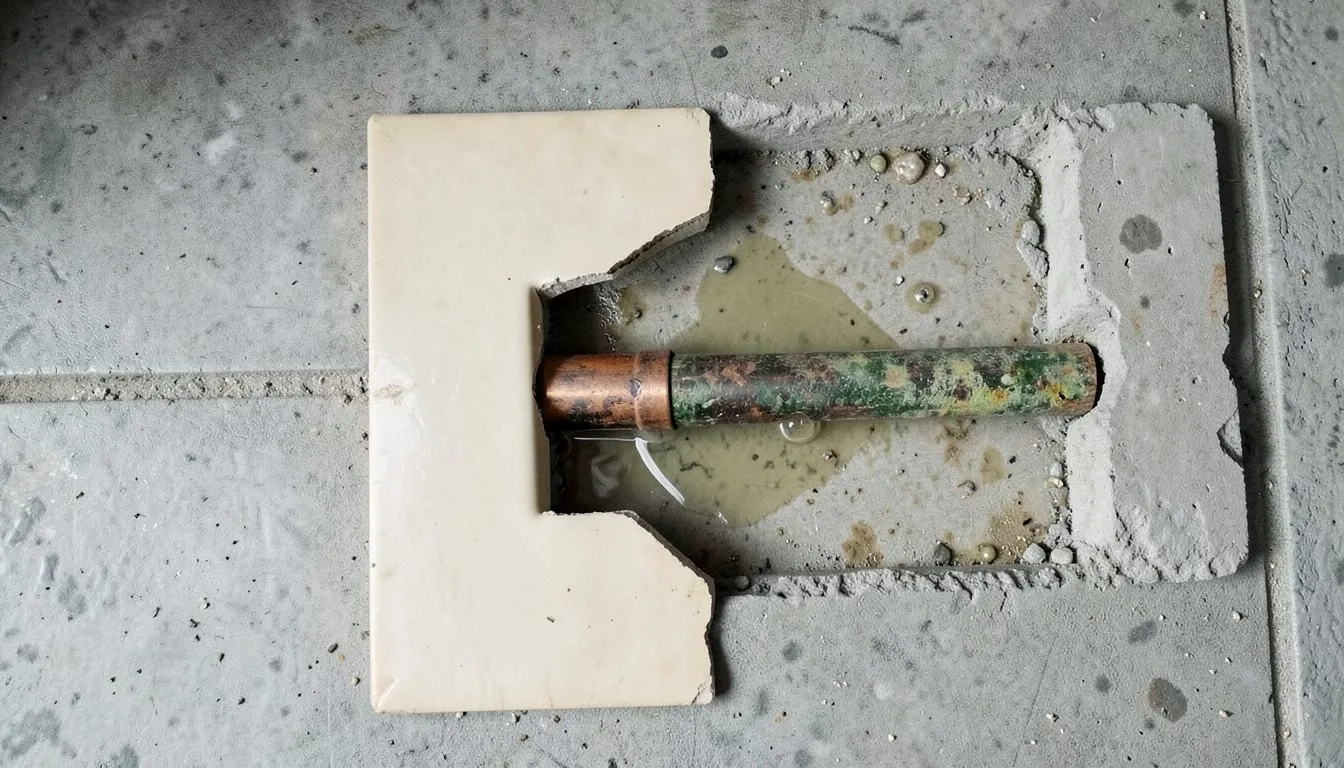
Slab leak repair costs $800–$2,500 for a single spot repair (jackhammer the slab, replace the failed section), $1,500–$4,500 for a reroute through walls or attic, and $4,500–$15,000 for a full repipe — the durable fix when more than one leak has surfaced (BuildZoom 2024 permit data). Most slab leaks happen in Sun Belt homes built 1960–1995 with copper supply lines run through the slab, where pinhole corrosion is accelerated by hard water and hot-water-side thermal stress per Copper Development Association and USGS water-hardness data.
What is a slab leak?
A slab leak is a water leak in the pressurized supply lines that run under or through your home's concrete slab foundation. It is not a sewer or drain leak (those are gravity-fed below the slab and called "under-slab drain leaks") — a slab leak is on the supply side, meaning treated water under 50–80 psi is escaping into the soil beneath your living area, hour after hour, until detected.
The supply pipes typically involved are either copper (Type L or Type M) or, in some 1990s-era homes, polybutylene (now obsolete and class-action-settled). Both hot and cold lines run through the slab, but the hot-water side fails far more often because heated water accelerates internal copper corrosion per Copper Development Association corrosion data. A slab leak on the hot line also warms the concrete above it, producing the classic warm-spot-on-the-floor symptom homeowners often notice first.
Why supply lines were ever buried in concrete in the first place: from roughly 1960 through the late 1990s, builders in the Sun Belt (Phoenix, Tucson, Las Vegas, Houston, Dallas, San Antonio, Austin, Atlanta, Tampa, Orlando, Jacksonville, much of Southern California) routinely ran hot- and cold-water supply pipes through the concrete slab during pour rather than overhead through the attic. The technique was faster, lower-cost, and protected from freezing — a non-issue in warm climates. Per US Census housing-vintage data, millions of homes built in this window have copper-in-slab plumbing. Today, all of those installations are 30–65 years old and entering peak failure age.
The supply pipe is encased in concrete with no access hatch, no inspection sleeve, and often no isolation valves between the meter and the fixtures. When a pinhole develops, the only way to verify the leak's location is non-destructive detection (covered in the diagnostics section below); the only way to repair it is to either jackhammer the slab open at the leak point, reroute around the failed line through the walls or attic, or repipe the entire system per International Plumbing Code Chapter 6.
The materials timeline matters because it predicts your risk:
- Type M copper (1960s–1990s) — thinner-walled copper used widely under slabs in Sun Belt construction. Most failure-prone material in this category. 30–50 year practical service life in hard water per Copper Development Association service-life data.
- Type L copper (1970s–present) — thicker-walled, more corrosion-resistant. Still vulnerable to pinhole formation in aggressive water chemistries; 50–70 year typical service life.
- Polybutylene (1978–1995) — gray plastic supply pipe that became brittle from chlorinated water exposure. Class-action settled 1995. Still present in millions of homes, frequently in slabs in the Sun Belt and Pacific Northwest. Replacement (not repair) is the standard remediation.
- PEX (2000s–present) — cross-linked polyethylene, flexible, rated for in-slab use per PEX Association and NSF/ANSI 14. The standard repipe material for any slab-leak remediation today, run overhead through walls and attic rather than back through the slab.
If your home was built 1960–1995 in any of the Sun Belt metros above and you have NEVER had your supply lines inspected or repiped, the question is not "if" the slab leak comes — it is "when." The matched plumber on the AlertPlumber call back can review your home's age and water-heater connection routing in five minutes over the phone and tell you whether you have copper-in-slab construction.
What are the signs you have a slab leak?
Slab leaks rarely announce themselves with dramatic flooding. Treated municipal water at 60 psi escaping a pinhole produces only a small visible flow at the surface, if any — most of the water saturates the soil under the slab, evaporates upward through the concrete, or migrates out through expansion joints. The warning signs are subtle and easy to misattribute to other causes. Watch for these:
- A warm spot on the floor. The single most diagnostic symptom. A leak on the hot-water supply line warms the concrete directly above it, producing a noticeably warm patch (sometimes only a few square feet) on tile, vinyl, or thin carpet. Walk barefoot through the house — the warm spot is unmistakable. This is the classic "I knew something was wrong" moment for most slab-leak homeowners. Per Copper Development Association, hot-line failures account for roughly 80% of detected slab leaks.
- Sound of running water with all fixtures off. Stand still in the quietest part of the house, with every faucet, toilet, dishwasher, washing machine, irrigation valve, and water heater shut off. If you hear a faint hiss, trickle, or rushing sound — that is water escaping a pressurized line somewhere in the system per EPA WaterSense leak detection. The sound carries through the slab and is loudest near the leak. A trained ear can localize within a few feet just by listening at floor vents and baseboards.
- Unexplained spike in the water bill. Even a tiny pinhole loses 50–250 gallons per day; a larger crack can lose 1,000+ gallons daily. Per EPA WaterSense leak data, a 1/32-inch pinhole at 60 psi loses about 200 gallons per day — enough to spike a typical residential bill by $40–$120 per month and trigger conservation-rate surcharges in drought-region utilities.
- Water meter spinning with all fixtures off. Locate your municipal water meter (usually at the curb in a concrete box). Confirm every fixture in the house is off, then watch the meter for two minutes. If the leak-detection dial (a small triangle or wheel separate from the gallon dial) is spinning, water is leaving the meter and going somewhere it should not per AWWA water meter standards. This is the single most reliable confirmation that you have an active leak — but it does not tell you where.
- Cracks in the slab, walls, or floor tile. Sustained water under the slab erodes the supporting soil. The slab settles, foundation walls crack, ceramic floor tile pops loose, drywall develops diagonal cracks above doorways. By the time these symptoms appear, the leak has typically been running for months or years per Insurance Information Institute foundation claim data.
- Mold or mildew smell near the floor. Moisture wicking up through the concrete saturates carpet padding, drywall bottom plates, and baseboards. Mold colonizes within 48–72 hours of sustained dampness per EPA indoor air quality guidance. A musty smell that is strongest at floor level — especially in a closet, hallway, or under a built-in cabinet — points to a slab leak directly underneath.
- Visibly damp or stained flooring. Carpet that feels damp under bare feet, vinyl tile that is lifting at the edges, hardwood that is cupping or warping — all are late-stage slab-leak symptoms. By this point, water has been escaping for an extended period and the flooring restoration cost rivals the plumbing repair itself per BuildZoom restoration cost data.
- Reduced water pressure. A large leak diverts pressure away from fixtures. Showers feel weaker than they used to; two fixtures running simultaneously cause a noticeable drop. This symptom develops gradually and is often blamed on the water heater or the city — until the meter test reveals the truth. Per IPC § 604.6, residential supply pressure should be 40-80 psi at the highest fixture.
- Hot water heater running constantly. If the hot-water-side leak is significant, the water heater never gets a chance to maintain temperature. Gas units cycle continuously; electric units run their elements nearly nonstop. Energy bill goes up alongside water bill — per DOE residential water heating guidance, water heating is typically 18% of household energy use, so even a 30% efficiency drop is materially visible on the gas or electric bill.
- Foundation movement. The most expensive late-stage symptom. Soil washout under the slab causes differential settlement; doors stop closing properly, windows crack, the slab itself develops visible heaves or depressions. Per Insurance Information Institute water damage data, undetected slab leaks rank among the top causes of residential foundation claims in Sun Belt markets.
Symptoms that mean call now (not next week):
- Warm spot on the floor PLUS visible mold or dampness
- Water meter spinning with all fixtures off (active confirmed leak)
- Water bill more than doubled with no change in household use
- Visible cracking in the slab or foundation walls
- Doors or windows suddenly sticking (foundation shift in progress)
Each of these can become a five-figure restoration claim if untreated. The matched plumber gives you a over-phone diagnostic frame on the call back; the on-site detection visit follows within 24–48 hours.
How does a plumber pinpoint a slab leak?
Detection is the most important — and most often skipped — step in slab-leak work. A plumber who quotes a repair without first pinpointing the leak location is guessing, and a guessed jackhammer location can cost you $1,500 in unnecessary slab destruction. Reputable plumbers use four overlapping non-destructive methods to triangulate the exact leak location within inches before any concrete is cut.
1. Pressure isolation testing ($75–$200)
The first step in any slab-leak workup. The plumber isolates the supply system by closing the main shutoff at the meter, then pressurizes the system with air or holds residual line pressure. Hot-side and cold-side are isolated separately (typically at the water heater) so the plumber can determine WHICH leg is leaking. A pressure drop on one leg but not the other identifies the failed line; equal pressure loss on both points to a failure on a shared upstream segment. Per IPC § 312 pressure-test standards, sustained pressure must hold within 1 psi over 15 minutes for a passing system.
2. Acoustic listening ($150–$400)
Pressurized water escaping a pinhole produces a high-frequency hiss that travels through the slab and is detectable at the floor surface with a sensitive ground microphone. The plumber works a grid pattern across the room, headphones on, listening for the loudest signal. Modern acoustic units use digital frequency filtering to separate leak noise from HVAC, refrigerator compressors, and street traffic per ASSE plumbing standards. Skilled operators can localize a leak to within 12 inches of true position purely by sound. Acoustic listening is the workhorse method for cold-water leaks (which lack a thermal signature) and works through tile, vinyl, hardwood, and carpet.
3. Thermal imaging ($150–$350)
A FLIR or equivalent thermal-imaging camera reads surface temperature differentials across the floor per UL infrared imaging certifications. Hot-water leaks create a warm thermal halo above the leak point; cold-water leaks create a cool spot (because soil saturated with cold supply water draws heat from the slab above). Thermal imaging is fast, non-contact, and produces a documented image the plumber can show on the spot. It is the fastest method for hot-line leaks but is less sensitive in well-insulated slabs or thick-carpet rooms.
4. Electronic line tracing ($75–$150 add-on)
For larger leaks or when acoustic and thermal methods give ambiguous results, the plumber traces the actual pipe path under the slab using an electronic line tracer per Copper Development Association installation guide. A signal generator clamps onto the supply line at an accessible point (water heater, shutoff valve); a surface receiver follows the signal across the floor and marks the pipe route in chalk or paint. Combined with acoustic localization, this confirms the leak is on the traced line and not on a branch.
5. Helium / tracer gas detection ($300–$700, rare)
Used for elusive leaks that resist acoustic and thermal methods. The plumber drains the suspect line, pressurizes it with a helium-air mixture (or hydrogen-nitrogen mix), then uses a sensitive surface sniffer to detect gas escaping through the leak point. Helium permeates concrete readily and is detectable in parts-per-million concentrations. Reserve for situations where the first three methods cannot confirm a leak's existence — typically slow leaks under 50 gallons per day per EPA WaterSense leak loss thresholds.
What "no detection needed" looks like
Every plumber who walks into your house and quotes a "$3,500 slab leak repair" without first using at least two of the methods above is misleading you. Get a second opinion. The proper sequence is:
- Pressure isolation test to confirm the leak exists and identify hot vs cold leg (~$100, 30 minutes)
- Acoustic listening + thermal imaging to localize within inches (~$300, 1-2 hours)
- Electronic line trace to confirm the leak point is on the suspected pipe (~$100, 30 minutes)
- Written quote with: detection report, repair method recommended, materials, permit costs, restoration scope, warranty
Per BLS Plumbing-Pipefitting wage statistics, the median plumber labor rate nationally is $89/hr. A full detection workup (3-4 hours typical) at that rate puts the labor floor near $300 — anything materially below $200 either skips steps or is a loss-leader to land the bigger repair sale. Anything above $700 for detection alone is overcharging unless you have a confirmed multi-leak system requiring extensive isolation work.
Insist on getting the detection report (acoustic charts, thermal images, marked-floor diagrams) as part of the deliverable. The report is your evidence in any future insurance claim and your baseline for verifying the repair location was correct.
Slab leak repair methods compared
Once the leak is localized, the plumber recommends ONE of four repair strategies based on the home's age, the number of confirmed leaks, the supply-line material, and the homeowner's ownership horizon. Here is the honest comparison.
Spot repair (jackhammer + replace)
How it works: The plumber cuts a 2x2 ft to 4x4 ft access hole in the slab directly above the localized leak, jackhammers down to the failed pipe (typically 4-8 inches through concrete plus 6-12 inches of soil), excavates around the failure, cuts out the bad section, and splices in new copper Type L or PEX with ProPress, soldered, or compression fittings per Copper Development Association joint standards. Pressure-tests, backfills with sand and concrete patch, restores flooring above.
When it is right: First slab leak the home has ever experienced. Single localized leak, clearly identified. Pipe material is otherwise sound (Type L copper less than 30 years old, no other failures detected). Homeowner has 5-15 years of remaining ownership intent.
Cost: $800–$2,500 typical per BuildZoom 2024. Add $500–$1,500 if the leak is under finished tile, hardwood, or built-in cabinetry.
Lifespan: The repaired joint gets ~50 years of new pipe per Copper Development Association service-life data. The rest of the in-slab supply system is unchanged from its current condition — if it is 40-year-old Type M copper, the next leak is statistically a year or two away.
Disruption: 1 day on site for plumbing. 1-3 weeks for full flooring restoration depending on materials.
Limitations: Does not address the rest of the supply system. If your home is over 30 years old with original copper, spot repair is patching a system that statistically needs full repipe; the plumber will likely be back inside 18 months for the next leak.
Reroute (abandon and reroute around)
How it works: Instead of cutting the slab to access the failed line, the plumber abandons the in-slab section entirely. New PEX or copper line is run overhead through the attic, down a wall, or through an unfinished basement to bypass the slab segment per IPC § 605.1 supply piping. The failed line is capped at both ends and left in place. New connections tie into the existing system at the nearest accessible joints.
When it is right: Single leak, but the leak is in a location where slab access would destroy expensive finished flooring (marble, custom hardwood, built-in cabinetry, decorative tile). Or the slab is post-tensioned and cutting it requires specialized engineering review (common in 1980s+ Sun Belt construction). Reroute avoids slab destruction at the cost of running visible or attic-routed pipe.
Cost: $1,500–$4,500 typical per BuildZoom. Higher than spot repair because of the longer pipe run and the wall/ceiling restoration needed to hide the new line.
Lifespan: 50+ years for new PEX per PEX Association or Type L copper run overhead. The abandoned slab section never matters again.
Disruption: 1-2 days on site for plumbing. 1-2 weeks for drywall and paint restoration. Lower flooring impact than spot repair.
Limitations: Only addresses ONE line. If the home is at the age where multiple leaks are imminent, you are paying for a series of reroutes when a single full repipe would be lower-cost. Also adds complexity to the plumbing layout — future plumbers need accurate as-built documentation per UPC § 301 documentation.
Partial repipe (replace just the failed line, full length)
How it works: The plumber abandons the entire failed supply line (e.g., the whole hot-water line from heater to the farthest fixture) and re-runs that line in PEX overhead through the attic and walls per PEX Association installation guide. Cold-side is left alone if it is in good condition. Existing in-slab line is capped and abandoned; new line ties in at the water heater output and at each fixture branch.
When it is right: Two or more leaks have developed on the same leg (typically hot side) within a year or two. Cold side is younger, made of better material, or has not yet failed. Homeowner wants to address the imminent-failure leg without paying for a full system replacement.
Cost: $2,500–$5,500 typical per BuildZoom. Less than full repipe because only half the system is being replaced.
Lifespan: 50+ years on the replaced leg per PEX Association service-life data. The non-replaced leg continues on its existing trajectory.
Disruption: 2-3 days on site for plumbing. 1-3 weeks for drywall and paint restoration. Minimal flooring impact.
Limitations: Partial-system replacement leaves you exposed to failure on the non-replaced leg. Most homes that have failed once on the hot side will fail on the cold side within 5-10 years per Copper Development Association corrosion lifecycle, often making partial repipe an interim solution.
Full repipe (replace ALL supply lines)
How it works: The plumber abandons every supply line in the slab. New PEX is run from the meter, through the attic, down through walls to each fixture. The water heater connections are renewed, every shutoff valve is upgraded, every branch tee is re-made. Old in-slab copper is capped at both ends and left in place. PEX is rated for in-slab use per PEX Association and NSF/ANSI 14, but overhead routing is the modern standard because it is accessible for future repair.
When it is right: Two or more confirmed slab leaks in the same home. Original supply lines are 30+ years old and made of Type M copper or polybutylene. Homeowner has 5+ years of ownership intent. Insurance is starting to push back on repeat claims (some carriers will non-renew after multiple slab-leak claims per Insurance Information Institute carrier guidelines). Selling the home in 2-3 years and a clean repipe disclosure is a marketing asset.
Cost: $4,500–$15,000 depending on home size, fixture count, and access difficulty per BuildZoom 2024. A typical 2,000 sq ft single-story Sun Belt home runs $7,500–$11,000.
Lifespan: 50-100 years on PEX per PEX Association and Plastic Pipe Institute. This is the durable fix — done once, lasts longer than the home.
Disruption: 3-5 days on site for plumbing. 1-3 weeks for drywall, paint, and minor flooring restoration around access points. Major disruption during the work itself (water shut off intermittently, openings cut in walls and ceilings throughout the home), but no slab destruction.
Limitations: Highest upfront cost. Requires the homeowner to relocate or work around water shutoffs for several days. Drywall patches throughout the home need to be painted to match — most plumbers handle the patches; final paint matching may need a separate painter.
Side-by-side comparison
| Method | Cost | Lifespan | Disruption | Best for |
|---|---|---|---|---|
| Spot repair | $800–$2,500 | ~50 yr (one joint) | Low (1 day plumbing) | First leak, sound system, short ownership horizon |
| Reroute | $1,500–$4,500 | 50+ yr (one line) | Low-medium | Single leak under expensive flooring or post-tensioned slab |
| Partial repipe | $2,500–$5,500 | 50+ yr (one leg) | Medium (2-3 days) | Two leaks same leg, other leg still sound |
| Full repipe | $4,500–$15,000 | 50-100 yr | High (3-5 days) | 2+ leaks in home, original copper 30+ yr old |
The matched plumber's job is to recommend ONE of these based on the detection report and the home's history — not to upsell to the most expensive option. If the recommendation is "full repipe" on a first-ever leak in an otherwise sound system, get a second opinion. If the recommendation is "spot repair" on a home with a history of three leaks in the past four years, that is also wrong (it is underestimating the failure trajectory). The decision framework section below covers the 2-leak threshold in detail. Per BLS plumber labor statistics, recommended-method variance between honest plumbers should be small; recommended-method variance of 2-3x usually indicates one of the quotes is dishonest.
What does slab leak repair cost in 2026?
National cost ranges (per BuildZoom 2024 permit data + BLS plumber wages OES 47-2152 + PEX Association material standards):
- Leak detection workup (acoustic + thermal + line trace): $200–$700 (always do this BEFORE any repair work)
- Spot repair (jackhammer + replace single section): $800–$2,500
- Reroute (abandon + overhead reroute): $1,500–$4,500
- Partial repipe (one leg, full length): $2,500–$5,500
- Full repipe (entire supply system in PEX): $4,500–$15,000
- Permit fees: $50–$350 (varies by city — see "Cost by city" below)
- Concrete restoration (slab patching after spot repair): $200–$700 per access opening
- Flooring restoration (tile, hardwood, carpet): $300–$3,500 per access opening, depending on materials
- Drywall restoration (after reroute / repipe): $400–$2,500 total for typical home
- Mold remediation (if present): $1,500–$8,000 separate line item
- After-hours / weekend service: +15–30% premium on labor
What drives the variance
Two homes the same age in the same Sun Belt city can get quotes that differ by 4-6x. The factors:
- Number of confirmed leaks. One leak: spot repair territory. Two leaks: reroute or partial repipe. Three or more leaks: full repipe is now the right answer regardless of any other factor per Copper Development Association failure-clustering data.
- Slab thickness and rebar. Standard residential slab is 4 inches per IRC Section R506; post-tensioned slabs (common in 1980s+ Sun Belt construction) are typically 5-8 inches with steel cables under tension. Cutting a post-tensioned slab requires engineering review and specialized cutting to avoid cable damage. Adds $1,000-$3,000 to any spot-repair scope.
- Access difficulty. Leak in the middle of an open living room with vinyl flooring: easy. Leak under a built-in granite kitchen island with subway-tile backsplash that wraps to the floor: hard. Restoration cost can exceed the plumbing cost on premium finishes.
- Hot side vs cold side. Hot-side leaks are more common (roughly 80% of slab-leak claims per Copper Development Association) but cost about the same to repair. Cold-side leaks are slightly lower-cost to detect (acoustic only — no thermal signature) but the same to repair.
- Pipe material. Type L copper splices: standard. Polybutylene: code-required full replacement (no spot repair allowed in most jurisdictions per IRC P2906). Mixed materials (Type M to PEX transition): requires dielectric or compatible fittings.
- Permit + inspection fees. Per the cost-by-city table below — varies $50 to $350+ across major Sun Belt metros.
- Mold remediation. If the leak has been running for months, mold is almost certainly present. Remediation is its own scope — covered by separate restoration contractors, not the plumber. Industry standard $1,500-$8,000 depending on extent per EPA mold remediation guidance.
- Insurance treatment. Most homeowners policies cover SUDDEN water damage caused by the leak (flooring, drywall, mold) but NOT the plumbing repair itself or the slab cutting per Insurance Information Institute water damage coverage guidance. Confirm with carrier before signing the work order. See the insurance section below.
Budget realistically: for a typical 2,000 sq ft Sun Belt home with one confirmed leak, expect $1,500-$3,500 all-in for a spot repair (including detection, repair, slab patch, and basic flooring restoration). For two leaks, expect $4,000-$7,500 for a partial repipe. For a full repipe, expect $7,500-$11,000 all-in. Anything materially above those ranges deserves a second-opinion quote. Estimate your specific scenario in the cost calculator.
What does slab leak repair cost by city in 2026?
Slab leak prevalence is heavily concentrated in Sun Belt metros where copper-in-slab construction was the standard from 1960 through the 1990s. Permit fees, labor rates, and detection-equipment availability vary by market. Here is the picture in eight major markets where AlertPlumber has scraped per-city data:
| City | Permit fee | Spot repair typical | Full repipe typical | Source |
|---|---|---|---|---|
| Phoenix, AZ | $165 | $1,400–$3,200 | $7,200–$12,500 | Phoenix Development Services |
| Houston, TX | $140 | $1,300–$3,000 | $6,800–$11,800 | Houston Public Works |
| Dallas, TX | $135 | $1,300–$2,900 | $6,500–$11,500 | Dallas Sustainable Development |
| Atlanta, GA | $110 | $1,200–$2,800 | $6,400–$11,200 | Atlanta City Planning |
| Boston, MA | $95 | $1,800–$4,200 | $8,500–$14,500 | Boston ISD |
| Minneapolis, MN | $75 | $1,900–$4,400 | $8,800–$15,000 | Minneapolis Regulatory Services |
| Seattle, WA | $165 | $1,800–$4,000 | $8,200–$14,000 | Seattle SDCI |
| Chicago, IL | $200 | $1,700–$3,800 | $7,800–$13,500 | Chicago Buildings Dept |
Why Sun Belt cities dominate slab-leak volume
Phoenix, Houston, Dallas, Atlanta, Tampa, Orlando, Las Vegas, Tucson, San Antonio, Austin, and Southern California metros all share a common construction history: from roughly 1960 through 1995, the dominant single-family-home construction style was a slab-on-grade foundation with copper supply lines run through the slab during pour per IRC R403 foundation standards. Per US Census ACS housing-vintage data and US Census ACS housing characteristics, these metros saw enormous population and housing growth during this window — the very same period when copper-in-slab was the lowest-cost install method. Today those homes are 30-65 years old, the copper has reached statistical end-of-life per Copper Development Association, and slab leaks are a near-weekly occurrence per neighborhood.
The water-chemistry layer makes it worse. USGS water-hardness data shows Phoenix, Las Vegas, Houston, San Antonio, and parts of Dallas/Fort Worth among the hardest municipal water in the country (>250 mg/L CaCO3). Hard water accelerates copper pinhole corrosion through electrochemical pitting. Combine 50-year-old Type M copper with 300+ ppm hardness and 80 psi line pressure and you have the textbook recipe for early failure.
Why cold-climate cities cost more per repair
Boston, Minneapolis, Seattle, and Chicago all have lower slab-leak prevalence (most homes there have basements, not slabs, and supply lines are accessible) but higher per-repair cost when slab leaks do occur. Drivers: higher labor rates (union markets per BLS regional plumber wage data), older housing stock with more mixed-material complications, and harsher restoration requirements for the rare slab leak that does happen.
Where to get a city-specific quote
The matched plumber on the AlertPlumber call back has access to per-city permit fees and labor rates and gives a written estimate before any work. You can also use the cost calculator for a ZIP-localized estimate before the call, or visit the slab leak service hub for matched-plumber callbacks in your metro.
Spot repair or full repipe — how do you decide?
The single most common question after the detection report comes back: is it worth fixing this one leak, or should the whole supply system get replaced now? The matched plumber's recommendation should fall out of the leak history and the system age cleanly, but when the recommendation feels uncertain, use this framework.
The 2-leak rule
If your home has had two or more confirmed slab leaks in any 24-month window, full repipe is almost always the right answer. The math is straightforward: the same factors that caused leak #1 (system age, water chemistry per USGS water hardness data, original install quality, line pressure) are still present and still acting on every other foot of in-slab copper. Statistical clustering means leak #2 is a strong predictor for leak #3, #4, and #5 — typically within 3-5 years per Copper Development Association corrosion lifecycle. Spot-repairing each one as it surfaces costs $1,500-$3,500 every time, plus mounting flooring restoration costs, plus the cumulative inconvenience of being without water repeatedly. Three spot repairs over five years totals $5,000-$10,000, often equal to or greater than a single full repipe that ends the problem permanently per BuildZoom permit cost data.
Insurance carriers know this too. Many homeowners policies non-renew after two slab-leak claims, leaving the homeowner to either self-insure or shop a less-favorable carrier per Insurance Information Institute. The repipe is the underwriter-approved fix; the spot repair is not.
Spot repair (or reroute) makes sense when:
- This is the home's FIRST confirmed slab leak
- Pipe material is Type L copper less than 30 years old
- Detection report shows ONE clearly localized failure with no secondary anomalies
- You expect to own the home 5-10 more years (and would rather defer the repipe cost)
- Water chemistry is moderate (hardness under 200 mg/L per USGS)
- No history of pinhole leaks elsewhere in the system (e.g., in fixtures or visible piping)
Full repipe makes sense when:
- Two or more confirmed slab leaks in the same home (any time period)
- Original supply lines are Type M copper installed 1960-1995 (30+ years old)
- Pipe material is polybutylene (no exceptions; full replacement required per IRC P2906)
- Water chemistry is aggressive (hardness over 250 mg/L AND/OR low pH AND/OR chloramine-disinfected)
- You have visible pinhole leaks elsewhere (water heater connections, exposed copper in attic or crawlspace) — confirms system-wide failure
- You are selling within 2-3 years (clean repipe is a marketing asset on disclosure)
- Insurance carrier has indicated they will non-renew after one more slab-leak claim
- Repeated spot repairs would cost more than the repipe (calculate: typical spot repair $2,500 × frequency you expect = repipe pays for itself in 2-3 events)
The "rule of 30 + 2" shortcut
If the home is 30+ years old AND has its original supply lines AND has had 2+ slab leaks — full repipe is not a question, it is the only durable answer. Spending $2,500 to spot-repair leak #3 in this scenario is throwing money at a system that statistically will not survive another five years. Spending $9,000 for the repipe ends the problem and adds 50+ years of design life per PEX Association.
If the home is under 30 with Type L copper and the leak is isolated, spot repair or reroute is the right answer. Modern copper installations (post-1995) rarely fail prematurely unless water chemistry is extreme.
When to get a second opinion (always)
- Quote is over $5,000 with no detection report shown to you
- Plumber recommends full repipe after a 15-minute on-site visit and no detection workup
- Quote varies by more than 50% between two verified plumbers looking at the same detection report
- Recommended method does not match what the detection shows (e.g., "full repipe" recommended for what looks like a single first-time leak in 25-year-old Type L copper)
- Plumber refuses to provide written detection report or warranty terms in writing
A second opinion costs nothing (any plumber will quote a job they want). The cost of the wrong method is the difference between a $2,500 fix and a $12,000 fix — and either could be wrong for your specific situation.
What permits and codes apply to slab leak repair?
Slab-leak work involves cutting structural concrete and modifying potable water supply lines — both regulated under municipal building and plumbing codes. Most US jurisdictions follow International Plumbing Code (IPC) Chapter 6 for water supply piping, with single-family residential work also covered under International Residential Code (IRC) Section P2906. West Coast and Mountain states largely follow Uniform Plumbing Code (UPC).
What a permit does for you
- Inspection at completion — a city inspector verifies the new pipe was installed to code (correct material, proper joints, pressure-tested per IPC § 312, slab patch poured to specification)
- Insurance + warranty defense — un-permitted slab work voids many homeowners insurance claims related to water damage and is grounds for the plumber's warranty being denied
- Resale disclosure record — closed-out permits show up on title searches and provide proof to buyers that the work was done correctly. Critical for repipes — a buyer asking "are the original supply lines still in the slab?" gets a documented answer
- Code-current materials — permitted work requires modern materials (PEX rated to NSF/ANSI 14, lead-free brass per Safe Drinking Water Act). Un-permitted work commonly cuts corners
Examples of local requirements
- Phoenix, AZ: $165 permit + inspection through Phoenix Development Services; in-slab supply lines must be Type L copper or PEX with manifold layout. Plumber must hold active C-37 license verified through AZ ROC license database.
- Houston, TX: $140 permit through Houston Public Works; post-tensioned slab work requires structural engineering review. Plumber must hold active state license verified through TSBPE license database.
- Dallas, TX: $135 permit through Dallas Sustainable Development; full repipe requires water-line abandonment documentation showing capped-and-pressure-tested old lines.
- Atlanta, GA: $110 permit through Atlanta City Planning; PEX must be NSF-certified for potable use; brass fittings must be lead-free per Safe Drinking Water Act.
- Boston, MA: $95 permit through Boston Inspectional Services; plumber must hold MA state plumbing license verified through MA Board of Examiners of Plumbers.
- Tampa / Orlando / Jacksonville, FL: Permit through local AHJ; plumber must hold active FL CFC license verified through DBPR license search.
Post-tensioned slabs — the special case
From the early 1980s onward, many Sun Belt single-family homes were built on post-tensioned slabs — concrete slabs with high-strength steel cables under tension running through them. These slabs are stronger and crack-resistant but cannot be cut without engineering review. Cutting through a tensioned cable releases stored energy that can injure workers and compromise the slab. Most jurisdictions require a structural engineer to mark cable locations before any slab cut, and the plumber may need to use specialized x-ray or GPR scanning to verify cable positions. Post-tensioned slab repair adds $1,000-$3,000 to any spot-repair scope.
If your home is in a Sun Belt metro and was built 1980 or later, ASK whether it has a post-tensioned slab before authorizing any cut. The plumber should know how to find out (developer records, original blueprints, slab edge inspection for cable end caps).
Always call 811 before exterior excavation
Most slab leaks are interior, but reroutes and full repipes sometimes involve exterior trenching (e.g., new line from meter to house). 811 (USA Dig Safety) is the federally-mandated free service that marks underground utility lines before any excavation. The plumber will not start exterior digging without an 811 ticket — and should not. Per OSHA trenching and excavation safety, hitting an unmarked gas line is a fatal-accident-level event.
What to ask before signing the quote
- "What permit are you pulling, and what's the fee?" (should match published city rates)
- "What's the inspection schedule?" (typically pre-cover for new pipe, final after slab patch)
- "What materials are you using?" (PEX with NSF-14 certification + lead-free brass fittings)
- "What's the warranty?" (industry standard: 5-10 years on workmanship, 25-50 years on PEX from manufacturer)
- "Do you carry contractor liability insurance? Can I see the certificate?" ($1M minimum standard)
- "Are you ?" (state-required for verified contractors above a project-value threshold)
- "Will you handle drywall and flooring restoration, or do I subcontract that separately?"
- "For post-tensioned slabs: will you scan before cutting?" (must be yes if applicable)
A plumber who cannot answer these in 30 seconds is the wrong plumber. A plumber who answers all of them with documentation in hand is the right one.
Does insurance cover slab leaks, foundation damage, and mold?
Slab leaks have three downstream consequences that often cost more than the plumbing repair itself: insurance treatment, foundation movement, and mold contamination. Each deserves explicit planning before the work begins.
What homeowners insurance covers (and does not)
Standard HO-3 homeowners policies typically cover SUDDEN, ACCIDENTAL water damage caused by a slab leak — meaning the damage to flooring, drywall, cabinetry, and personal property is usually claimable. What is generally NOT covered:
- The plumbing repair itself. The cost of detecting the leak, jackhammering the slab, replacing the pipe, and patching the slab is "wear and tear" excluded under most policies.
- The slab tear-out (tear out access, also called "access cost"). Some policies include a small tear-out allowance (typically $500-$2,500); others exclude it entirely. Read the policy.
- Damage from gradual or long-term leaks. If the carrier determines the leak was running for months and the damage was preventable, they may deny the claim under the "constant or repeated seepage" exclusion. This is a common denial reason and a frequent litigation trigger per Insurance Information Institute water damage data.
- Mold remediation. Standard policies typically cap mold coverage at $5,000-$10,000 (separate sublimit), often inadequate for serious slab-leak mold cases.
Practical advice: take photos and video of all damage IMMEDIATELY upon detection, file the claim within 48 hours of discovery, get the plumber's detection report in writing (proves SUDDEN discovery, not gradual neglect), and request a public adjuster if the carrier's first offer feels low. Policy language varies enormously between carriers — some California and Texas carriers explicitly exclude slab leak ACCESS (the tear-out), making the homeowner pay for the slab cut even when they cover the water damage.
Foundation impact
An undetected slab leak running for months or years saturates the soil under the slab. In expansive clay soils (common in Houston, Dallas, San Antonio, Austin, and parts of California), this causes the soil to swell upward, then shrink as it dries — leading to differential settlement of the slab per IRC R403 foundation requirements. Symptoms: doors that suddenly will not close, hairline cracks running diagonally from corners of doors and windows, ceramic tile popping loose from the slab, exterior brick veneer cracking along mortar joints.
Once foundation movement begins, the cost trajectory steepens dramatically. Per Insurance Information Institute, foundation repair typically runs $4,000-$15,000 for minor leveling and $15,000-$45,000+ for piers and underpinning. The leak repair itself may be $2,500; the resulting foundation work can be $25,000. This is the strongest argument for early detection — the warm-spot or water-bill-spike symptom should trigger same-week action, not "we'll deal with it next month."
If foundation symptoms are already visible at the time the slab leak is identified, the matched plumber's job is to STOP the active leak first; structural engineering review and foundation repair follow as separate scopes with separate contractors.
Mold remediation
Mold colonizes within 48-72 hours of sustained dampness per EPA indoor air quality guidance. A slab leak that has been running for weeks or months has almost certainly produced mold in: carpet padding, drywall bottom plates, baseboards, hardwood subfloor, and any cabinetry sitting on the slab. Severity ranges from "moisten and dry, no visible growth" to "tear out and replace finished walls and flooring across multiple rooms."
Mold remediation is its own scope handled by certified restoration contractors, not the plumber. Industry standard scope:
- Initial moisture mapping (thermal + moisture meter on every wall and floor surface near the leak)
- Containment (plastic sheeting + negative-air HEPA filtration to prevent cross-contamination)
- Removal of moldy materials (drywall to 2 ft above water line, carpet + padding, contaminated cabinetry)
- Antimicrobial treatment of remaining surfaces
- Drying with industrial dehumidifiers + air movers (typically 3-7 days)
- Post-remediation verification testing (air sample + surface sample, lab analysis)
- Reconstruction (drywall, paint, flooring, cabinetry replacement)
Cost: $1,500-$8,000 typical for moderate slab-leak mold remediation per BuildZoom restoration data; $10,000-$30,000+ for severe multi-room contamination. Insurance coverage varies — confirm with carrier before authorizing per Insurance Information Institute mold sublimit guidance.
Order of operations
The right sequence when a slab leak is confirmed: (1) stop the active leak (shut main, schedule plumber detection within 24-48 hours), (2) document everything with photos and video for insurance per III water-damage claim documentation guide, (3) plumber detection + repair, (4) restoration scope (drying, mold remediation, flooring, drywall), (5) closeout (permit signoff, restoration contractor signoff, insurance reimbursement). Doing these out of order — e.g., starting flooring restoration before the leak is fully repaired — leads to redo costs and insurance disputes.
What should you expect from a plumber on repair day?
An experienced slab-leak plumber follows roughly this sequence on the day of repair work. Preparation matters — clear the work area, identify the main shutoff in advance, and arrange alternate water access (cooler, neighbor, hotel) for the duration if work will run more than a few hours.
- Arrival + walk-through (15-30 min). Plumber confirms detection report, walks through the property, identifies the main shutoff, locates the work area, confirms access for equipment (jackhammer for spot repair, drill and PEX coil for repipe).
- Detection re-confirmation (30-60 min). Even if you have already had a diagnostic detection workup, the plumber typically re-scans the area to confirm the leak point has not migrated and to mark the exact cut location.
- Setup (30-60 min). Tarps and dust containment plastic protect surrounding area; furniture moves; equipment stages. Permit + insurance certificates posted.
- Water shutoff + system depressurization (15-30 min). Main valve closed, residual pressure bled off at a low fixture, water heater isolated.
- The actual repair — varies by method:
- Spot repair: Cut flooring above the leak point (~30 min), jackhammer the slab to expose the pipe (~1-2 hours, dusty and loud), excavate around the failure (~30 min), cut and replace the failed section with new copper or PEX (~1 hour), pressure-test per IPC § 312 (~15 min), backfill with sand (~15 min), patch the slab with rapid-set concrete (~30 min, plus cure time). Total: 5-8 hours on site, slab patch fully cures over 24-48 hours.
- Reroute: Run new PEX from the nearest accessible joint up through the wall, across the attic, down to the bypassed connection point (~3-5 hours). Cap the abandoned in-slab section at both ends per UPC abandoned-line standards (~30 min). Pressure-test (~15 min). Patch any wall openings (~1-2 hours). Total: 6-10 hours on site, drywall patches need paint within the week.
- Partial repipe: Run new PEX for the entire failed leg from water heater out to each fixture on that line (~6-10 hours). Cap and abandon old in-slab line (~1 hour). Pressure-test the new system (~30 min). Patch all wall openings (~2-4 hours). Total: 1-2 days on site.
- Full repipe: Day 1: Run PEX manifold and main lines from meter to attic distribution point (~8 hours). Day 2: Run individual branch lines to each fixture (~6 hours). Day 3: Tie in at each fixture, pressure-test the system, cap and abandon all old in-slab lines (~6 hours). Day 4-5: Drywall patching at all wall openings, paint touch-up. Total: 3-5 days on site, 1-2 weeks for all restoration.
City inspection typically happens before slab patch (so the inspector can see the new pipe in the trench) and again at final completion per IPC § 107 inspection requirements. Schedule with the city varies; some cities offer same-day inspections, others require 24-48 hours notice. The matched plumber coordinates this — it is not your job to call the inspector.
Restoration (flooring above slab patch, drywall, paint) follows over the next 1-3 weeks depending on materials and contractors. Some plumbers handle drywall patching in-house; flooring matching almost always needs a separate flooring contractor. Get the restoration scope and cost in the original quote so you do not get surprised by a separate flooring bill.
Verify the plumber's license with the appropriate state board — CSLB (California), TSBPE (Texas), AZ ROC (Arizona), DBPR (Florida), MA Board, MN DLI — BEFORE signing the work agreement. Per BLS, there are roughly 458,000 licensed plumbers in the US; verifying takes 30 seconds and protects from contractor fraud.
AlertPlumber matched-plumber vs DIY workup
| Element | AlertPlumber matched plumber | DIY / un-vetted plumber |
|---|---|---|
| License verification | Pre-verified state license + insurance | Homeowner verifies (or skips) |
| Detection workup | Acoustic + thermal + line trace standard | Often skipped — guess and cut |
| Quote transparency | Itemized: detection, repair, slab patch, restoration | Lump-sum, hidden change orders |
| Permit handling | Plumber pulls permit + coordinates inspection | Permit often skipped (voids insurance) |
| Warranty | 5-10 years on workmanship + 25-50 years on PEX | Verbal, hard to enforce |
| Restoration coordination | Drywall + flooring subcontractors lined up | Homeowner finds contractors after the fact |
| Insurance documentation | Detection report + permit + invoices for claim | Documentation incomplete, claims often denied |
How do you prevent future slab leaks?
If you have just had a slab leak repaired without a full repipe, the next leak is statistically likely within 1-3 years. Prevention strategies that meaningfully extend remaining-life on the in-slab system:
Reduce line pressure
Per IPC § 604.8, residential supply pressure should not exceed 80 psi. Many municipal systems deliver 90-120 psi at the meter per AWWA distribution pressure standards, requiring a pressure-reducing valve (PRV) at the home's incoming line. A failing or absent PRV is one of the biggest accelerators of pinhole corrosion — high pressure causes water to scour the inside of copper pipes, exposing fresh metal to corrosive attack per Copper Development Association. PRV install or replacement: $300-$600. Worth doing on any home with confirmed pressure over 80 psi.
Treat the water
Hard water is the single biggest accelerant of copper pinhole corrosion in Sun Belt metros per USGS water-hardness data. Hardness in Phoenix, Las Vegas, Houston, and parts of Dallas exceeds 250 mg/L CaCO3 — three times the threshold for "hard water." Two mitigation options:
- Whole-house water softener ($1,200-$2,500 installed). Removes calcium and magnesium ions through ion-exchange resin. Greatly reduces scale formation and slows electrochemical corrosion.
- Dielectric isolators at the water heater ($75-$150 part + $200 install). Prevents galvanic corrosion at copper-to-steel transitions. Standard on modern installs but often missing on 1960s-1990s connections.
Install a leak-detection system
Whole-house automatic shutoff systems (Flo by Moen, Phyn Plus, StreamLabs, similar) monitor flow at the meter and detect anomalies (continuous low flow indicating a leak, no flow during typical use indicating a valve failure). When a leak is detected, the system either alerts the homeowner via app or auto-closes the main valve. Cost: $500-$2,000 installed. Critical for homes with known in-slab supply lines that have not yet been repiped — early auto-detection of leak #2 prevents the cascade into mold and foundation damage per EPA mold prevention guidance. Some homeowners insurance carriers offer 5-10% premium discounts for documented installation per Insurance Information Institute.
Annual visual inspection
Once a year, inspect every visible copper line (water heater connections, exposed lines in attic, garage, or crawlspace) for green oxidation patches, white salt buildup, or visible water stains. These are the surface-visible cousins of in-slab pinhole corrosion — if they appear, the in-slab system is also affected. Also check the meter at low-use periods (3 AM, after running the dishwasher, etc.) for unexpected flow.
Plan the repipe before it is forced
For homes 30+ years old in Sun Belt metros, planned repipe before forced repipe is significantly lower-cost. Planned: choose timing, get multiple quotes per BLS pricing variance data, finance through low-interest HELOC, schedule around vacation. Forced: emergency rates, restoration adders for water-damaged finishes, mold remediation, insurance hassle. The differential easily exceeds $3,000-$5,000. The matched plumber on the AlertPlumber call back can give a over-phone repipe quote based on home age, square footage, and fixture count — useful for planning even if the work is 2-3 years out.
What about epoxy pipe restoration (ePIPE)?
Some plumbing contractors offer epoxy pipe restoration — an internal coating applied to existing in-slab copper lines to seal pinholes and prevent further corrosion. The technology is real (similar in concept to CIPP for sewers per NASSCO standards) but adoption for residential supply lines is limited. Pros: avoids slab destruction. Cons: cost is comparable to a PEX repipe ($6,000-$12,000), application requires the home's water to be off for 48-72 hours, and the long-term durability data is thinner than for PEX. For most homeowners, PEX repipe is the better-documented choice; epoxy restoration is a niche option for specific structural-access situations.
Need a slab leak repair callback?
ZIP, phone, kind of work. AlertPlumber routes to a verified plumber for an over-phone estimate.
Slab Leak Repair by city
City-specific pricing, code references, climate-driven pathology, and frequently-asked questions for the 12 cities where AlertPlumber ships slab leak repair pages today.
- Slab Leak Repair in Los Angeles, CA →
- Slab Leak Repair in Dallas, TX →
- Slab Leak Repair in Phoenix, AZ →
- Slab Leak Repair in Boston, MA →
- Slab Leak Repair in Minneapolis, MN →
- Slab Leak Repair in Atlanta, GA →
- Slab Leak Repair in Seattle, WA →
- Slab Leak Repair in New York, NY →
- Slab Leak Repair in Chicago, IL →
- Slab Leak Repair in Houston, TX →
- Slab Leak Repair in Philadelphia, PA →
- Slab Leak Repair in San Jose, CA →
What else do people ask about slab leak repair?
How long does slab leak repair take?
Spot repair: 5-8 hours on site for plumbing, plus 1-3 weeks for flooring restoration. Reroute: 6-10 hours on site, 1-2 weeks for drywall and paint. Partial repipe: 1-2 days on site, 1-2 weeks for full restoration. Full repipe: 3-5 days on site, 1-3 weeks for full restoration. Mold remediation, if needed, adds 1-2 weeks as a separate scope.
Is slab leak repair covered by homeowners insurance?
Standard HO-3 policies typically cover SUDDEN water damage from a slab leak (flooring, drywall, mold up to a sublimit) but NOT the plumbing repair itself or the slab cutting. Some policies include a small "tear-out access" allowance ($500-$2,500); read the policy. Damage from a leak that was running for months may be denied under the "constant or repeated seepage" exclusion per Insurance Information Institute. Document everything and file within 48 hours of discovery.
Do I need a permit for slab leak repair?
Yes for any slab cutting or supply-line work. Permit fees range $50-$350 depending on the city. The matched plumber pulls the permit. See Phoenix Development Services ($165), Houston Public Works ($140), Atlanta City Planning ($110), or your local city development services for examples. Un-permitted slab work voids most homeowners insurance claims.
Can I do slab leak repair myself?
Strongly inadvisable. Cities require verified plumbers for in-slab supply work; DIY voids insurance and is grounds for code violations per IPC Chapter 6. Cutting concrete also involves significant safety risk — post-tensioned slabs (common in 1980s+ Sun Belt construction) can release stored cable energy if cut without proper scanning, causing serious injury. Detection equipment alone (acoustic + thermal) costs $5,000-$15,000 for the gear a pro uses. Hire a verified plumber.
How much does slab leak detection cost?
$200-$700 for a full workup (pressure isolation + acoustic listening + thermal imaging + electronic line trace). Anything materially below $200 either skips steps or is a loss-leader to land the bigger repair sale. Anything above $700 for detection alone is overcharging unless multiple leaks are suspected. Per BLS plumber wage data, a 3-4 hour detection workup at typical rates costs around $300 in labor alone.
What's the difference between a slab leak and a sewer line leak?
A slab leak is on the SUPPLY (pressurized) side — fresh treated water under 50-80 psi escaping a copper or polybutylene line under or through the slab. A sewer leak is on the DRAIN (gravity) side — wastewater leaking from the cast-iron, clay, or PVC pipes that run under the slab to the city sewer main. Both are below the slab but are distinct systems with different repair methods and different cost ranges (see IPC Chapter 7 for the code distinction between supply and drainage piping, and EPA wastewater infrastructure for sewer-side aging data).
Why are slab leaks so common in Phoenix and Houston?
Three factors converge: (1) housing-stock vintage — millions of homes built 1960-1995 with copper supply lines run through the slab during pour, per US Census housing-vintage data; (2) hard water — Phoenix, Houston, San Antonio, and Las Vegas all exceed 250 mg/L CaCO3 hardness per USGS water-hardness data, which accelerates copper pinhole corrosion; (3) high line pressure — many Sun Belt municipal systems deliver 90-120 psi, scouring the inside of pipes. The combination puts these markets at the statistical center of slab-leak claims nationally.
Will my floor or carpet be ruined by the repair?
Some restoration is unavoidable for spot repair (the access hole is typically 2x2 ft to 4x4 ft). For tile or vinyl, replacing the cut section is straightforward — keep extra tiles from the original install if possible. For carpet, a clean cut and re-stretch is usually invisible. For premium hardwood or stone, restoration cost can rival the plumbing cost — in which case reroute (no slab cut) becomes the better economic choice. The matched plumber walks through restoration trade-offs before any cutting begins.
How long does new PEX last in a repipe?
50-100 years per PEX Association service-life data and NSF/ANSI 14 certification testing. Modern PEX (PEX-A, PEX-B, PEX-C) is rated for both potable water and in-slab use. Manufacturer warranties run 25-50 years from install. The repipe is a once-per-house investment — properly installed, it outlasts the home itself.
Should I get a leak-detection device after a slab leak?
Yes if you have not done a full repipe. Whole-house automatic shutoff systems (Flo by Moen, Phyn Plus, StreamLabs, similar) monitor flow at the meter and either alert the homeowner via app or auto-close the main valve when a leak is detected. Cost: $500-$2,000 installed. For homes with known aging in-slab copper that have not been fully repiped, this is the single highest-ROI prevention investment — early auto-detection of the next leak prevents thousands in mold and foundation damage. Some insurance carriers offer 5-10% premium discounts for documented installation.
My home has polybutylene supply lines. What do I do?
Full repipe is the standard remediation, no exceptions. Polybutylene (gray plastic supply pipe manufactured 1978-1995) becomes brittle from chlorinated water exposure and is not eligible for spot repair under most jurisdictions per IRC P2906. The 1995 class-action settlement specifically funded replacement, not repair. Cost: $4,500-$15,000 for full PEX repipe depending on home size. Polybutylene also affects insurability and resale — most carriers price it as a high-risk material and many buyers' inspectors flag it during sale.
What is a post-tensioned slab and why does it matter?
From the early 1980s onward, many Sun Belt single-family homes were built on post-tensioned slabs — concrete slabs reinforced with high-strength steel cables under tension running through them. They are stronger and crack-resistant but cannot be cut without engineering review. Cutting through a tensioned cable releases stored energy that can injure workers and compromise the slab. Most jurisdictions require a structural engineer to mark cable locations before any slab cut, and the plumber may need to use specialized x-ray or GPR scanning to verify cable positions. Post-tensioned slab repair adds $1,000-$3,000 to any spot-repair scope. If your Sun Belt home was built 1980 or later, ASK whether the slab is post-tensioned before any cutting.
How do I find a reputable plumber for slab leak work?
Three filters: (1) state-license verified — look up the plumber on your state contractor board (CSLB CA, TSBPE TX, AZ ROC AZ, DBPR FL, MA Board); (2) carries $1M+ contractor liability insurance with proof on request; (3) provides a written detection report (acoustic, thermal, line trace) BEFORE any quote and walks through what the report shows. AlertPlumber matches you with plumbers who pass all three filters — the matched plumber gives a over-phone diagnostic and arranges a detection visit. Visit the slab leak service hub or estimate cost in your ZIP.
Can I get financing for a full repipe?
Most plumbers offer financing for jobs over $1,500 through partner lenders (typically Synchrony, GreenSky, Acima, or similar). Rates vary 0% (promotional 12-18 months) to 19.99% (open-ended). Always ask about same-as-cash promotional terms — paid in full within the promo window means no interest. A full repipe at $7,500-$11,000 is also a strong candidate for HELOC financing if home equity is available — typically much lower interest rate than retail plumber financing. Insurance is rarely a financing source for the plumbing repair itself (covers water damage, not the repair).
What if the leak is under a wall, kitchen island, or built-in cabinet?
Reroute is usually the right answer. Cutting the slab under built-in cabinetry or a granite island would require removing and reinstalling the cabinetry — typically $2,000-$5,000 in restoration cost on top of the plumbing repair. Routing the new line overhead through the wall and ceiling avoids that entirely, at the cost of patching one or two wall openings. For kitchen islands specifically, the matched plumber will almost always recommend reroute over slab cut.
Can I sell my house with a known slab leak history?
Yes, but you must disclose it. Most state real-estate disclosure laws require notification of any known plumbing defects and any past insurance claims. Buyers typically either request the seller fix the issue before closing, or negotiate a credit equal to the repair cost. A clean repipe with closed-out permits is often a marketing asset — eliminates buyer concern and supports a higher list price. Failing to disclose can result in post-sale lawsuits.
How fast does mold grow after a slab leak starts?
Per EPA indoor air quality guidance, mold colonizes within 48-72 hours of sustained dampness. A slab leak that has been running for weeks or months has almost certainly produced mold in carpet padding, drywall bottom plates, baseboards, and any cabinetry sitting on the slab. This is the strongest argument for early detection — same-week response after the warm-spot or water-bill-spike symptom appears, not "we'll deal with it next month." Mold remediation runs $1,500-$8,000 typical, $10,000-$30,000+ for severe multi-room contamination.
My home is from 1968 in Phoenix. Is a preventative repipe smart?
Strong case yes. A 1968 Phoenix home almost certainly has Type M copper supply lines run through the slab — past the 30-50 year statistical service life per Copper Development Association, in a market with 250+ mg/L hard water per USGS, with typically 80+ psi line pressure. The next slab leak is likely within 2-5 years. Planned repipe ($7,500-$11,000 for typical 2,000 sq ft single-story) before forced repipe ($10,000-$18,000 with restoration and mold) is 25-40% lower-cost, with no insurance hassle. The matched plumber gives a phone-quoted repipe pricing based on home age, square footage, and fixture count.
What if my insurance denies the slab leak claim?
Common denial reasons: (1) "wear and tear" exclusion (the plumbing repair itself), (2) "constant or repeated seepage" exclusion (claim says the leak was preventable and ongoing), (3) lack of permit (un-permitted work voids coverage), (4) policy excludes "tear-out access" specifically. Options after denial: hire a public adjuster to negotiate (typical fee 10-15% of additional recovery), request the carrier's denial in writing and forward to your state Department of Insurance, or escalate via small claims court if the policy language is ambiguous. Per Insurance Information Institute, slab-leak claim denials are among the most-disputed water-damage claim categories.
How does the AlertPlumber callback work for slab leaks?
You request a callback through the form. A verified local plumber calls within minutes. On the call, the plumber asks about symptoms (warm spots, water bill, meter reading), home age, and approximate location. The plumber then gives a over-phone diagnostic frame and schedules an on-site detection visit (typically within 24-48 hours). On site, the plumber runs the full detection workup (acoustic + thermal + line trace + pressure isolation), provides a written detection report, and quotes the recommended repair method. No work begins without your written approval and a signed permit-in-hand quote. AlertPlumber pre-verifies state license and insurance for every plumber in the network.
Sources
- EPA Sustainable Water Infrastructure
- EPA WaterSense leak data
- EPA Safe Drinking Water Act (SDWA)
- EPA Indoor Air Quality / mold guidance
- BuildZoom 2024 plumbing repair permit data
- BLS Plumbing/Pipefitting wage statistics 2024 (OES 47-2152)
- International Plumbing Code (IPC) 2024
- Uniform Plumbing Code (UPC) 2024
- International Residential Code (IRC) Section P2906
- Copper Development Association — plumbing service-life data
- Plastic Pipe Institute (PPI) — PEX/HDPE standards
- PEX Association — service life and certifications
- NSF/ANSI 14 — water-distribution components
- USGS water-hardness map and data
- US Census ACS housing-vintage data
- Insurance Information Institute — water damage coverage
- Insurance Information Institute — sewer/water claim guidance
- CDC water exposure health guidance
- NASSCO trenchless rehabilitation standards
- 811 USA Dig Safety
- OSHA trenching and excavation safety
- OSHA confined-space safety
- Phoenix Development Services Department
- Houston Public Works and Engineering
- Dallas Sustainable Development
- Atlanta City Planning
- Boston Inspectional Services Division
- Minneapolis Regulatory Services
- Seattle SDCI
- Chicago Buildings Department
- Arizona Registrar of Contractors (AZ ROC)
- California Contractors State License Board (CSLB)
- Texas State Board of Plumbing Examiners (TSBPE)
- Massachusetts Board of Examiners of Plumbers + Gas Fitters
- Minnesota DLI plumbing license database
- Florida DBPR plumbing license search