Emergency Frozen Pipe Repair services
Thaws and repairs frozen pipes before they burst — winter emergency.
What does frozen pipe repair cover?
Thaws and repairs frozen pipes before they burst — winter emergency.
Most homeowners encounter frozen pipe repair when something fails suddenly — unexpected shutdown, active leak, or total loss of pressure. AlertPlumber connects the request with an independent plumber who handles frozen pipe repair in your ZIP code.
Who do I call for frozen pipes?
A plumber when you cannot find the frozen section, cannot reach it, or cannot thaw it: that is the American Red Cross’s own threshold, quoted in the how-to section below. If a pipe has already split, it is a burst pipe. If there is no water at any tap, ask your water utility whether the supply is off. AlertPlumber’s 24/7 line connects your call with an independent local plumber in our partner’s network.
Source: American Red Cross (read 2026-09-30).
What does frozen pipe repair cost in your ZIP?
Enter your ZIP for a localized estimate. Calls connect you with a local plumber who can quote the job — calculator output is for planning only.
Which warning signs mean you need a plumber for frozen pipe repair?
- Faucet that won't produce water on a cold morning.
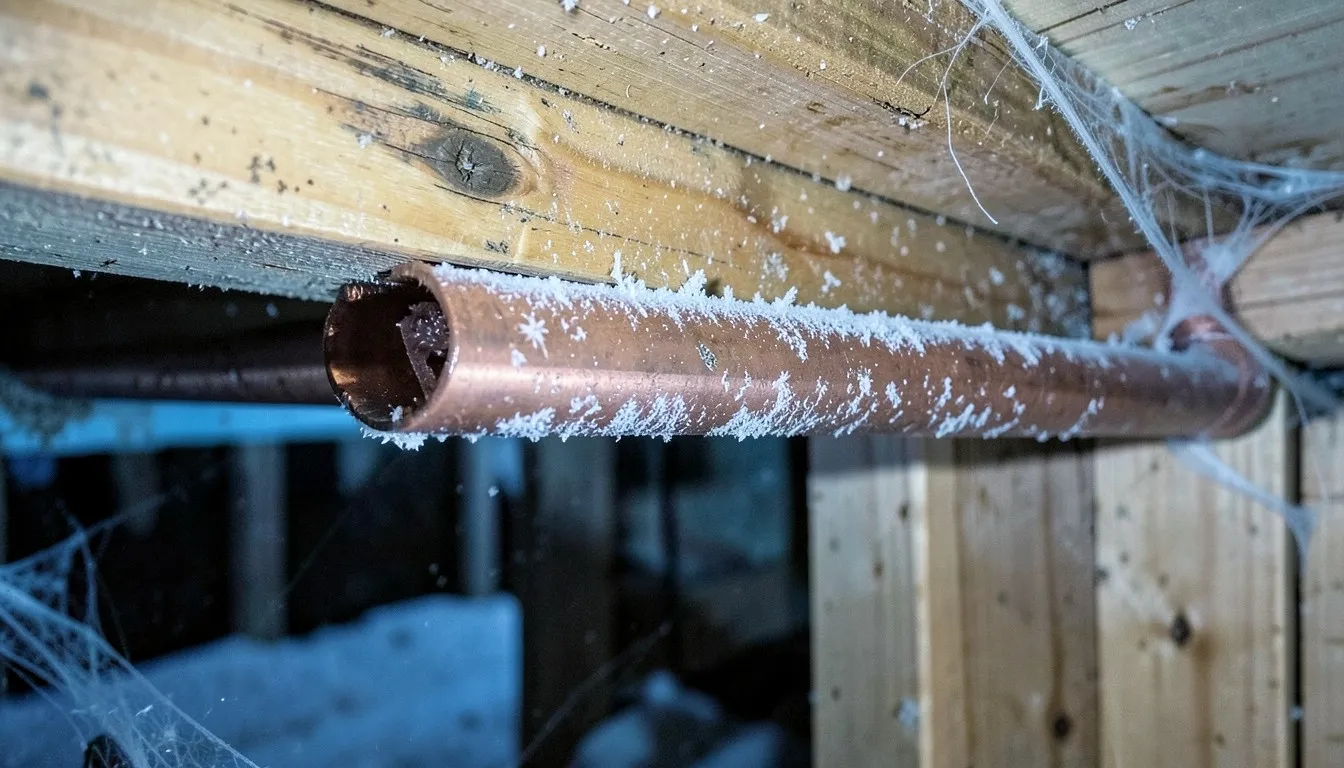
- Frost or ice visible on an exposed pipe.
- Bulging or distorted pipe (pre-burst warning).
- Hissing or whistling sound from a pipe wall.
- No water from a fixture located on an exterior wall.
Plumbing emergencies escalate within 24–48 hours. Active water contact inside walls and flooring compounds structural damage and mold risk — two consequences that cost far more than the original repair. Ask the plumber for a written estimate before any work begins.
How do you thaw a frozen pipe, according to the American Red Cross?
Each step below is quoted word for word from the American Red Cross page on frozen pipes. AlertPlumber has not added to or changed its wording.
- Suspect a frozen pipe
“If you turn on a faucet and only a trickle comes out, suspect a frozen pipe. Likely places for frozen pipes include against exterior walls or where your water service enters your home through the foundation.”
— American Red Cross , read 2026-09-30 - Keep the faucet open.
“Keep the faucet open. As you treat the frozen pipe and the frozen area begins to melt, water will begin to flow through the frozen area. Running water through the pipe will help melt ice in the pipe.”
— American Red Cross , read 2026-09-29 - Apply heat to the section of pipe
“Apply heat to the section of pipe using an electric heating pad wrapped around the pipe, an electric hair dryer, a portable space heater (kept away from flammable materials), or by wrapping pipes with towels soaked in hot water. Do not use a blowtorch, kerosene or propane heater, charcoal stove, or other open flame device.”
— American Red Cross , read 2026-09-29 - Apply heat until full water pressure is restored.
“Apply heat until full water pressure is restored. If you are unable to locate the frozen area, if the frozen area is not accessible, or if you can not thaw the pipe, call a licensed plumber.”
— American Red Cross , read 2026-09-29 - Check all other faucets in your home
“Check all other faucets in your home to find out if you have additional frozen pipes. If one pipe freezes, others may freeze, too.”
— American Red Cross , read 2026-09-30
If a pipe has already split, see burst pipe repair. To check freeze risk for your ZIP code, use the frozen pipe risk checker.
What is at stake with frozen pipe repair?
Diagnosis requires equipment
Finding the source of a frozen pipe repair problem requires professional-grade tools — acoustic detectors, pressure gauges, or cameras. Guessing costs more than a proper diagnosis.
Permits and code compliance
Repairs that replace pipe sections, open walls, or alter the drain or supply system require a city permit. Unpermitted work can void your homeowners insurance and create liabilities at resale.
Damage escalates fast
Active water contact causes mold within 24 hours and structural damage within 48. Every hour between problem and professional response adds to total remediation cost — typically far exceeding the original repair.
How do you get connected with a local plumber?
Call or submit your request
Call the number above or fill out the form with your ZIP code. AlertPlumber passes emergency calls and requests to our routing partner, which connects them with an independent plumber serving your area — ask for an arrival time.
A local plumber talks it through
A state-licensed plumber asks about symptoms and timing. Ask for their state license number, and ask for a written estimate before work begins. There is no obligation to proceed.
Get the repair confirmed in writing first
When the plumber arrives, ask them to confirm the diagnosis on-site and put the repair price in writing. Approve it before any work begins, and ask whether your jurisdiction requires a permit.
Frequently asked questions
What affects the cost of frozen pipe repair?
Cost depends on pipe location, whether the pipe has burst, access difficulty, and whether insulation or heat tape installation is included. The national cost range depends on scope and location and is in the frozen pipe repair cost guide. Ask the plumber for a written estimate covering price, scope, and permit requirements before any work begins — there is no obligation.
How does a plumber thaw a frozen pipe?
The standard method is an electric pipe-thaw machine — a transformer that passes current through the pipe wall, generating resistance heat that thaws ice from the inside out. This is faster and more precise than space heaters or heat guns. For PEX pipe (which cannot be thawed electrically because it doesn’t conduct), the plumber uses warm-air tools or controlled hot-water application at accessible sections. Controlled gradual thawing is the goal — rapid external heat can create steam pressure that ruptures the pipe before the ice clears.
A pipe is frozen but hasn’t burst yet — can the burst be prevented?
Yes, if you act before the pipe wall yields. Early warning signs of impending burst: visible frost on an exposed pipe, bulging or distorted pipe shape, water beginning to drip from a fitting. Call a plumber immediately and ask whether to shut off the main supply valve before it bursts. Do not attempt to thaw with an open flame — flame thawing has caused house fires and pipe explosions. The plumber can assess wall integrity during controlled thawing and repair on the spot if a failure is found.
Which pipes are most at risk of freezing?
Highest-risk locations: pipes on exterior walls without insulation, pipes in unheated spaces (attic, crawl space, garage), outdoor hose bibs and irrigation supply lines, and pipe runs in cabinet bays under sinks on exterior walls. Copper is more vulnerable than PEX-A (PEX-A expands approximately 3% before bursting, copper splits). Small-diameter 1/2″ branch lines freeze faster than larger mains. In markets with frost lines deeper than 48 inches, the risk extends to any pipe that isn’t buried below the local frost depth.
After thawing, what should the plumber check?
The plumber pressure-tests the thawed line to confirm no burst occurred during the freeze event. If the pipe wall is intact, they identify the root cause of the freeze — typically missing insulation, an exterior air gap, or a thermostat set too low — and advise on remediation. If a burst is found during thawing, they repair it during the same visit. Insulation recommendations are part of the service call, not an upsell.
What does a frozen pipe repair service include?
A frozen pipe call covers four things: locating the frozen section, controlled thawing with a pipe-thaw machine or warm-air tooling, a pressure test to confirm the pipe wall survived, and repair of any split found during thawing. The plumber also identifies why that run froze — missing insulation, an exterior air gap, an unheated cavity — so the same pipe doesn’t fail again next cold snap.
When should you call a plumber for frozen pipes?
Call as soon as a fixture stops producing water in freezing weather — that is a frozen line, and the window before the pipe wall yields is short. Call immediately, before doing anything else, if you see frost on the pipe, a bulge or distortion in its shape, or water weeping from a fitting. Ask on the call whether to shut off the main supply valve while you wait.
Do frozen water lines ever need replacing instead of thawing?
Yes. Thawing restores flow, but it does not undo damage the ice already did. Replacement is the right call when the pipe split during the freeze, when a run has frozen repeatedly across seasons, or when the line is aging galvanized or polybutylene that freeze cycles have already weakened. The plumber determines this from the pressure test, not from appearance alone.
How can I tell whether a pipe is frozen?
The American Red Cross says that if you turn on a faucet and only a trickle comes out, suspect a frozen pipe. It names places against exterior walls, or where the water service enters the home through the foundation, as likely spots.
Source: American Red Cross (read 2026-09-30).
If one pipe is frozen, could others be frozen too?
Yes. The American Red Cross suggests checking all other faucets in the home for additional frozen pipes, because if one pipe freezes, others may freeze too.
Source: American Red Cross (read 2026-09-30).
What does the American Red Cross suggest to keep pipes from freezing again?
The American Red Cross suggests letting cold water drip from a faucet served by exposed pipes when the weather is very cold, keeping the thermostat at the same temperature day and night, and, when you are away in cold weather, leaving the heat set no lower than 55°F. It also suggests adding insulation to attics, basements and crawl spaces.
Source: American Red Cross (read 2026-09-30).
Are AlertPlumber-matched plumbers actually verified?
Not by AlertPlumber, which does not license or verify plumbers; calls go to independent plumbers in our routing partner’s network. Ask the plumber for their license number and check it on your state board’s public lookup.
Does AlertPlumber charge a fee?
AlertPlumber does not charge homeowners. AlertPlumber is a referral service that earns a fee from its routing partner when a call or request connects you with a participating plumber. You pay only the plumber you choose to hire, for work you agree to.
Can I get a written estimate before work starts?
Ask for one. AlertPlumber cannot promise what an independent plumber provides, so ask for a written estimate — price, scope, and timeline — before any work begins, and ask how change orders for unexpected discoveries will be documented.
What if the quote is too high?
You’re under no obligation. Decline the quote and get a second opinion — call again or send a new request through AlertPlumber to reach another participating plumber, or compare with any plumber you choose.
Need a frozen pipe repair callback?
In a meeting, with the kids, or just prefer not to call? Drop your ZIP and number below. AlertPlumber sends your request to our routing partner — if a participating plumber serves your area, they may call you back directly. For anything urgent, call the number on this page.
- 1 Submit your info. ZIP, phone, and what kind of work you need.
- 2 AlertPlumber passes it on to our routing partner for your area.
- 3 If a participating plumber serves your area, they may call you back. Ask for a written estimate before work starts.
Frozen Pipe Repair in these cities
The frozen pipe repair city pages people find most often in search. Each has local data for that city and the call line.
- Frozen Pipe Repair in Bend, OR
- Frozen Pipe Repair in Chicago, IL
- Frozen Pipe Repair in Portland, OR
- Frozen Pipe Repair in Seattle, WA
- Frozen Pipe Repair in Denver, CO
- Frozen Pipe Repair in Rochester, NY
- Frozen Pipe Repair in Abilene, TX
- Frozen Pipe Repair in Columbus, OH
- Frozen Pipe Repair in Elk Grove, CA
- Frozen Pipe Repair in Peachtree City, GA
- Frozen Pipe Repair in St. Louis, MO
- Frozen Pipe Repair in Lexington, KY
- Frozen Pipe Repair in Des Moines, IA
- Frozen Pipe Repair in Norman, OK
- Frozen Pipe Repair in Rapid City, SD
- Frozen Pipe Repair in Riverside, CA
- Frozen Pipe Repair in Matthews, NC
- Frozen Pipe Repair in Thornton, CO
- Frozen Pipe Repair in Charlotte, NC
- Frozen Pipe Repair in Omaha, NE
- Frozen Pipe Repair in Mesa, AZ
- Frozen Pipe Repair in Boston, MA
- Frozen Pipe Repair in Carrollton, TX
- Frozen Pipe Repair in Rochester Hills, MI
- Frozen Pipe Repair in Savannah, GA
- Frozen Pipe Repair in Pueblo, CO
- Frozen Pipe Repair in San Angelo, TX
- Frozen Pipe Repair in Colorado Springs, CO
- Frozen Pipe Repair in Burbank, CA
- Frozen Pipe Repair in Phoenix, AZ
- Frozen Pipe Repair in Nampa, ID
Which cities do we serve for frozen pipe repair?
AlertPlumber connects homeowners with independent, state-licensed plumbers for frozen pipe repair across 730 US cities. Select your city for local data, permit details, and a callback request.
Major markets
Coverage markets
Local infrastructure data available for these markets.
- San Antonio, TX
- San Diego, CA
- Dallas, TX
- San Jose, CA
- Austin, TX
- Fort Worth, TX
- Jacksonville, FL
- Columbus, OH
- Charlotte, NC
- Indianapolis, IN
- San Francisco, CA
- Seattle, WA
- Denver, CO
- Nashville, TN
- Boston, MA
- Washington, DC
- Portland, OR
- Las Vegas, NV
- Detroit, MI
- Albuquerque, NM
- Sacramento, CA
- Atlanta, GA
- Omaha, NE
- Miami, FL
- Minneapolis, MN
- Tampa, FL
- Cleveland, OH
- Orlando, FL
- Lincoln, NE
- Reno, NV
- Winston-Salem, NC
- Little Rock, AR
- Elk Grove, CA
- Port Saint Lucie, FL
- Naperville, IL
- Visalia, CA
- Hammond, IN
- Troy, NY
- Spartanburg, SC
More frozen pipe repair city pages by state
Alabama: Hoover · Birmingham
Alaska: Anchorage
Arizona: Maricopa · Goodyear · Sun City · Glendale · Chandler
California: Newport Beach · Roseville · Buena Park · San Mateo · Monterey · Fullerton · Vallejo · Ventura · El Cajon
Colorado: Broomfield · Fort Collins
Connecticut: Norwalk · Waterbury · New Britain
Florida: Kissimmee · Spring Hill · Port Orange
Georgia: Cumming · Athens · Lawrenceville · Gainesville
Illinois: Schaumburg · Evanston · Aurora · Peoria
Indiana: Evansville · Carmel
Iowa: Cedar Rapids · Iowa City
Kansas: Shawnee · Overland Park
Kentucky: Covington · Florence · Elizabethtown
Louisiana: Lake Charles · Slidell · Houma · Shreveport
Maryland: Baltimore · Annapolis
Massachusetts: Cambridge · Springfield · Lynn
Michigan: Grand Rapids · Westland · Waterford · Clinton Township
Minnesota: Edina · Apple Valley · Coon Rapids · St. Louis Park · Saint Paul · Plymouth · Maple Grove
Missouri: Kansas City
Nebraska: Kearney
Nevada: North Las Vegas
New Hampshire: Concord · Derry
New Jersey: Newark · Perth Amboy · Passaic · Paterson · Linden · Woodbridge
New York: Buffalo · Brooklyn · Syracuse · Albany
North Carolina: Asheville · Jacksonville · Raleigh · Clayton
North Dakota: Minot
Ohio: Toledo · Akron · Kettering · Strongsville · Lorain · Elyria
Oklahoma: Edmond
Oregon: Gresham · Springfield
Pennsylvania: Levittown · Pittsburgh · Greensburg · Camp Hill · Erie · Scranton
Rhode Island: Woonsocket
South Carolina: Greenville · North Charleston · Charleston
South Dakota: Sioux Falls
Tennessee: Knoxville · Memphis · Franklin
Texas: Cedar Hill · Pflugerville · Haltom City · Georgetown · Round Rock · Corpus Christi
Utah: West Jordan · Salt Lake City · St. George · Layton
Virginia: Virginia Beach · Richmond · Winchester · Norfolk · Newport News
Washington: Spokane · Kennewick
West Virginia: Morgantown · Huntington