
Whole-Home Repipe: The Complete Guide
How whole-home repipe works in 2026 — cost, PEX vs copper vs CPVC, when to repipe vs spot-repair. Per-city cost data with sources.
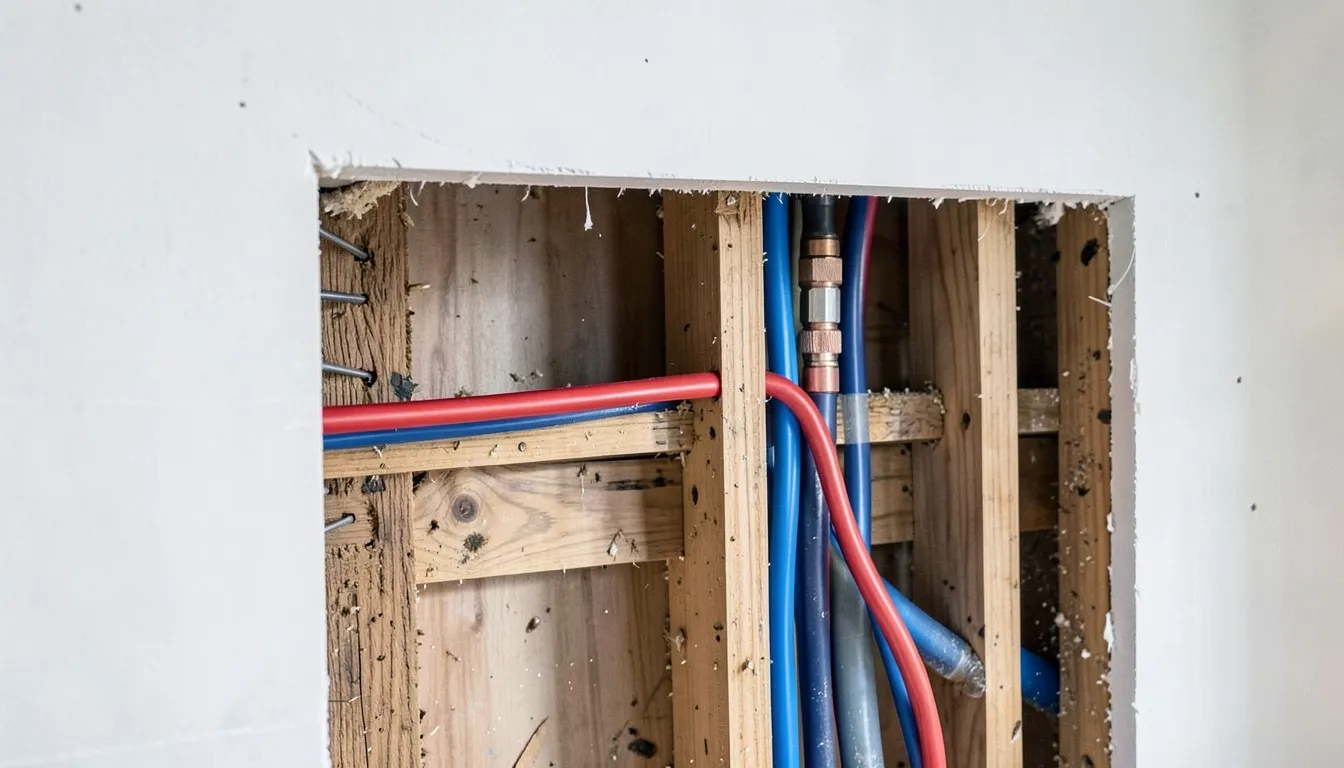
A whole-home repipe replaces all (or substantially all) the supply lines in a house with new material — typically PEX-A or copper Type L. Costs run $4,500–$15,000 in 2026 for a 2–4 bath home (BuildZoom 2024 permit data), with PEX running 30–50% lower-cost than copper. The trigger is almost always recurring failure: 2+ slab leaks, 2+ copper pinhole leaks, polybutylene present, galvanized rust failures (any home pre-1960), or discolored water from corrosion. Per EPA LCRR (2024), lead service-line discovery often triggers a repipe to coincide with utility-side replacement.
What is a whole-home repipe?
A whole-home repipe is the replacement of every supply line in a residence — the pressurized hot and cold water pipes that feed every fixture, from kitchen sink to washing machine to outdoor hose bibb. It does NOT include drain, waste, or vent (DWV) lines (those are a separate "drain repipe" job). The work is bounded at the water-main shutoff (the supply side) and at every fixture stop valve (the consumption side). Per International Plumbing Code Chapter 6, supply piping is the regulated category that whole-home repipe touches.
The work scope is bigger than most homeowners initially expect. A typical 3-bath home has 250–400 linear feet of supply pipe running through walls, ceiling cavities, attic, crawlspace, and slab penetrations per US Census housing characteristics data. Every fixture (sinks, tubs, toilets, dishwasher, clothes washer, refrigerator ice-maker, hose bibbs, water heater) has dedicated hot and/or cold branches feeding it. A repipe replaces ALL of that, plus any in-wall stub-outs and shutoff valves at every fixture per IPC § 605.
Why "substantially all" is the working definition: some plumbers use "repipe" to describe replacing 80%+ of the supply system while leaving short, recently-installed sections in place (for example, a 2018 kitchen remodel that already has new PEX from the manifold to the sink). The technical definition per Uniform Plumbing Code treats the system as a continuous unit, but in practice repipe quotes describe the actual replacement scope — the homeowner should never assume "whole-home repipe" means truly 100% unless that's documented in the contract.
Repipe vs spot repair vs partial repipe
- Spot repair — fixing one leak (cut out a 2-foot section, sweat in a coupling, drywall patch). Costs $250–$900 per BuildZoom permit data. Right answer when ONE pinhole leak appears in copper that's otherwise sound.
- Partial repipe — replacing a single bathroom group, kitchen group, or hot-side-only. Costs $1,800–$4,500 per BLS labor data. Right answer when the failure pattern is geographically localized (a single bath that has had multiple leaks) or material-specific (only the polybutylene branches need replacing).
- Whole-home repipe — every supply line replaced. Costs $4,500–$15,000. Right answer when failures are systemic — multiple slab leaks, multiple pinhole locations, or a material-class failure (polybutylene, galvanized) where the entire system is at end-of-life per Copper Development Association systemic-failure guidance.
The decision between these isn't usually close once a plumber has done a thorough inspection. Per Copper Development Association field data, copper systems failing in one location with documented water chemistry issues will fail in additional locations within 12–36 months — making the whole-home repipe the lower-cost option on a 5-year horizon despite the higher up-front cost.
What materials does modern repipe use?
Three materials dominate the 2026 residential repipe market:
- PEX-A (cross-linked polyethylene, peroxide method) — most flexible, freeze-tolerant, uses cold-expansion fittings (Uponor ProPEX). Standard per PEX Association ASTM F876/F877 and NSF/ANSI 61 + 372 drinking-water certifications.
- PEX-B (silane method) — slightly stiffer, uses crimp or clamp fittings. Lower-cost than PEX-A for the material itself, but slower to install.
- Copper Type L — the legacy gold-standard, soldered joints, 50+ year design life per Copper Development Association. Most expensive option in 2026 due to copper commodity prices and skilled-labor demand.
Two materials that should NOT be used in 2026 repipe:
- CPVC (chlorinated polyvinyl chloride) — still legal under most code adoptions but declining in market share. Brittleness at age, glued joints that can fail, and incompatibility with some sealants. Allowed by IPC Chapter 6 but not recommended for new repipe work.
- Polybutylene (PB / Qest / Quest) — NEVER. Subject to chlorine-induced disintegration. Class action settled in the 1990s; most remaining PB systems have failed or are failing. Will not pass plumbing inspection in most jurisdictions for new install.
For a side-by-side material comparison, see the PEX vs copper comparison. AlertPlumber matches you with plumbers experienced in both — the recommended material depends on local water chemistry, climate, and your budget, not the plumber's preference.
When is a whole-home repipe the right call?
A repipe is rarely the FIRST plumbing decision — it's almost always the answer to a pattern of failures the homeowner has been chasing for a year or more. Here are the trigger events that put repipe on the table:
1. Multiple slab leaks (2+ in 24 months)
A slab leak — pinhole or rupture in the supply line under the concrete foundation slab — is one of the most expensive single repairs in residential plumbing ($1,500–$4,500 per occurrence including jackhammering, repair, and floor restoration). When a home has TWO confirmed slab leaks within 24 months, the underlying cause is almost always systemic copper corrosion (acidic water, galvanic reaction with the slab, or manufacturing-defect copper from the 1970s). Per Copper Development Association field data, a third slab leak follows within 18 months 70%+ of the time. Repipe with overhead PEX (routed through attic/ceiling, AVOIDING the slab) is the permanent fix.
2. Multiple pinhole leaks in copper (2+ in 36 months)
Pinhole leaks in copper are caused by water-chemistry-driven internal corrosion (low pH water, high chloramine concentrations, or stray-current electrolysis). A single pinhole can be fixed with a $250 spot repair. Two pinholes in different locations within 36 months means the entire copper system is corroding from inside out — every other pipe in the house is at the same risk. Per EPA Safe Drinking Water Act water-quality data, regions with naturally aggressive water (the Pacific Northwest, parts of New England, Florida) see this failure pattern at significantly higher rates than the national average.
3. Polybutylene present (any vintage)
If the home was built between roughly 1978 and 1995 and you find gray plastic pipe with brass crimp fittings, that's polybutylene — and it's a repipe trigger regardless of current condition. Per the original Cox v. Shell class action settlement, PB is a known-failing material with no safe expected lifespan. Most insurers will refuse coverage for water damage from PB failure per Insurance Information Institute, and many home buyers will require a full PB-removal repipe as a condition of purchase. Identifying it: dull gray (occasionally blue), 3/8"-1" diameter, often stamped "PB2110" or "Qest" or "Quest" on the pipe surface. Brass fittings will be marked with "Qest" branding. Per Plastic Pipe Institute material-history guidance, PB has been formally retired from the residential supply market since the late 1990s.
4. Galvanized steel rust failures (any home pre-1960)
Galvanized steel pipe was the residential standard from roughly 1900–1960. The zinc galvanization layer protects the steel for 40–70 years; after that, the steel rusts from the inside out, gradually narrowing internal diameter (you notice when bath flow drops to a trickle) and eventually rupturing. Per US Census housing-vintage data, ~12% of US housing stock predates 1960 and a meaningful fraction still has original galvanized supply lines. If your home is pre-1960 with original galvanized, it's not a question of IF it will fail — it's WHEN. Repipe is the only durable fix; spot repairs on galvanized are temporary because the entire system is at the same age.
5. Frozen-burst events on lead or galvanized pipe
A single freeze-burst event in old supply pipe (lead, galvanized, or original copper from a cold-climate home) often reveals systemic embrittlement that IRC P2904 freeze-protection requirements would not allow in a new install. Once one section bursts at a freeze, the rest of the same-vintage pipe is statistically much more likely to burst at the next freeze cycle. Repipe with PEX-A (which has documented freeze tolerance because of its ability to expand 6–8% before rupturing per PEX Association cold-weather testing) eliminates the recurring-failure pattern.
6. Lead service line discovery (post-LCRR inventory, 2024)
The EPA Lead and Copper Rule Revisions (LCRR) effective 2024 required water utilities to inventory every service line and notify homeowners of lead presence. If your inventory result shows lead on your service line OR your in-home supply, the utility-side replacement work creates a once-in-a-decade window to coincide with full in-home repipe — restoration costs are shared, you only do the wall demo once, and the home becomes lead-free in a single project. Per EPA SDWA guidance, there is no safe level of lead in drinking water; even very low-lead systems (LCRR action level 10 µg/L) have measurable cognitive impact on children.
7. Discolored or rust-colored water from pipe corrosion
Persistent rust-colored or yellow-brown water at first-draw (after pipes have been sitting overnight) indicates internal corrosion shedding into the water. Common in galvanized systems and in older copper exposed to soft, low-pH water. Once internal corrosion is visible in the water, the pipe interior is materially degraded and the failure curve has accelerated. Repipe is the only long-term fix.
8. Selling the home with a known supply-line issue
State real-estate disclosure laws require notification of known plumbing defects. A pre-listing repipe converts a "buyer-flagged risk" into a marketing asset (closed-out permits, new pipe warranty, lead-free certification). Per US Census ACS, ~30% of US homes are sold with original supply piping; a recent repipe materially supports listing price.
The cost-crossover threshold: ~$3,500
Rule of thumb: once cumulative spot-repair spending on a single supply system has crossed roughly $3,500, the math has flipped — additional spot repairs are throwing money at a system that needs replacement per BuildZoom cost-crossover analysis. A whole-home PEX repipe at $5,500 is lower-cost over a 5-year horizon than three more spot repairs at $1,200 each. The matched plumber can pull permit history and prior-work documentation to help you confirm cumulative spend per BLS labor-pricing benchmarks.
Materials compared: PEX-A vs PEX-B vs copper vs CPVC
The single biggest decision in any repipe is material. The decision drives 30–50% of total project cost, ALL the labor timeline, and the system's long-term performance characteristics. Here's the honest comparison:
PEX-A (cold-expansion, peroxide method)
What it is: Cross-linked polyethylene tubing manufactured via the peroxide (Engel) method, which produces the highest cross-linking density and the most flexibility. Brands: Uponor (was Wirsbo), Rehau. Standard per PEX Association ASTM F876/F877, certified per NSF/ANSI 61 + 372.
Fittings: Cold-expansion (Uponor ProPEX). The fitting is inserted into a temporarily expanded pipe end; as the PEX shrinks back, it grips the fitting permanently. No clamps, no rings, no glue. Joints are stronger than the pipe itself.
Pros: Most flexible (lowest fitting count for the same run). Documented freeze-burst tolerance — pipe can expand 6–8% before rupture per PEX Association testing. Widest fitting/manifold ecosystem. Fastest install of any rigid or semi-rigid material per BLS pipefitter labor-time data.
Cons: Material cost ~15% higher than PEX-B per PPI material price index. Requires a specific (Uponor or licensed) expansion tool — not every plumber stocks one.
Best for: Cold-climate repipes (MN, MA, IL, WA — see NOAA NCEI frost-depth zones), retrofit work in finished homes (flexibility = fewer access cuts), homes with documented freeze-burst history.
PEX-B (crimp or clamp, silane method)
What it is: Cross-linked polyethylene via the silane (Sioplas) method. Slightly less flexible than PEX-A, lower cross-linking density. Brands: Viega, Apollo, SharkBite. Same ASTM F876/F877 standard per PEX Association.
Fittings: Either copper crimp ring (most common) or stainless steel clamp ring. Crimp tool is mechanical and inexpensive ($150 retail) — every plumber has one. Joints reduce internal diameter slightly because the fitting goes INSIDE the pipe (PEX-A fittings are full-flow per PEX Association full-flow specifications).
Pros: Lowest material cost of the modern options. Crimp fittings are universally stocked. Many plumbers have years of crimp-PEX experience per BLS occupational data.
Cons: Lower freeze tolerance than PEX-A. More fittings required for same run (less flexible, sharper bends not possible). Internal-diameter restriction at every fitting reduces flow modestly per IPC § 604 fixture-flow guidance.
Best for: Budget-conscious repipes in moderate climates, simple straight-run plumbing topologies, homes with already-roughed-in PEX where matching brand/method matters.
Copper Type L
What it is: Drawn copper tubing, "Type L" wall thickness (medium — Type M is thinner, Type K is thicker). Per Copper Development Association, Type L is the residential standard for water supply. Joints are sweat-soldered with lead-free solder (mandated post-1986 per EPA LCR original 1991 rule).
Pros: 50+ year design life with proven track record over 100+ years of installs. Doesn't degrade under UV exposure (PEX does — exterior runs MUST be copper or wrapped). Code-approved for every jurisdiction without exception. Resale value: many buyers in higher-end markets pay a premium for copper.
Cons: 30–50% more expensive than PEX (commodity price + skilled labor) per BLS skilled-trades wage data. Install time 50–100% longer (every joint requires sweating). Vulnerable to internal corrosion in low-pH or high-chloramine water per EPA SDWA water-chemistry guidance — the very problem that drove the original repipe in many cases. Subject to theft from job sites (commodity scrap value).
Best for: Higher-end retrofits where buyer expectation is copper, exterior runs (hose bibbs, irrigation), homes in areas with stable water chemistry that won't recreate the original failure pattern.
CPVC (chlorinated polyvinyl chloride)
What it is: Rigid plastic supply pipe, glued joints with solvent cement. Per IPC Chapter 6, allowed for residential supply.
Pros: Lower material cost than copper. Doesn't corrode internally. Code-allowed in nearly all jurisdictions.
Cons: Becomes brittle with age (15–25 years) — leading to cracks at fitting hubs. Glued joints can fail if cement was applied poorly during install (and there's no way to inspect the joint after the fact). Incompatible with many spray foams, certain caulks, and some pipe insulations — the chemicals can craze the pipe surface. Declining market share — many plumbers no longer stock or work with it.
Best for: Replacing-like-with-like in homes already plumbed in CPVC where local code requires matching material. Otherwise rarely the right choice in a 2026 repipe.
Side-by-side materials table
| Material | Material cost | Install speed | Lifespan | Freeze tolerance | Best use case |
|---|---|---|---|---|---|
| PEX-A | $0.85–$1.40 / ft | Fastest (1.5x baseline) | 50+ years | Excellent (6-8% expansion) | Cold-climate retrofit, finished homes |
| PEX-B | $0.55–$0.95 / ft | Fast (1.3x baseline) | 50+ years | Good | Budget repipe, moderate climates |
| Copper Type L | $3.50–$5.50 / ft | Slow (baseline) | 50–80 years | Poor (rigid, will burst) | Premium retrofit, exterior runs |
| CPVC | $0.65–$1.10 / ft | Medium (1.2x baseline) | 15–40 years | Poor (brittle, will fracture) | Like-for-like in existing CPVC homes |
Material costs are pipe only — fittings, manifolds, valves, and labor add 60–80% to the total installed price.
For a deeper material decision walk-through, the PEX vs copper comparison covers water-chemistry compatibility, code variations, and resale-value considerations specific to your market. AlertPlumber matches you with plumbers experienced in both PEX-A expansion and traditional copper sweat work — the matched plumber's recommendation should be driven by your home's specific conditions, not by which method they prefer to install.
What actually happens during a whole-home repipe?
A whole-home repipe is among the most invasive plumbing projects a homeowner will ever experience. Plumbers typically execute in five phases over 5–14 calendar days. Here's what actually happens on each:
Phase 1: Planning + permits (1-2 weeks before start)
- Walkthrough. The plumber maps every fixture, identifies pipe routes (using existing access where possible — attic, crawlspace, basement), confirms manifold location (typically near the water heater for centralized control), and notes any code-required upgrades (vacuum breakers, anti-scald valves, expansion tank if a check valve is present).
- Material spec. PEX vs copper decision finalized. Brand and fitting type chosen. Manifold + valve count specified.
- Permit. The plumber pulls a city plumbing permit. Permit fees range $75–$500 depending on jurisdiction (see "Cost by city" below). Per IPC § 106, plumbing permits are required for any work involving pipe replacement of more than minimal scope.
- Scheduling. Typical lead time is 2-4 weeks for a non-emergency repipe. The plumber coordinates with the homeowner on water-shutoff windows (water OFF for ~6-12 hours per work day during pipe-cut sections).
Phase 2: Demo + access cuts (Day 1)
- Wall + ceiling cuts. The plumber identifies the minimum number of access points needed to pull old pipe and route new pipe. Typical 2-bath PEX repipe: 8-15 access cuts (each roughly 12"×12"). Copper repipes: 15-25 cuts (less flexibility means more access needed) per Copper Development Association install practices.
- Furniture protect / floor protect. Plastic sheeting + drop cloths over everything in working zones. Drywall dust is dramatic — every horizontal surface gets a layer.
- Old-pipe pull. Old supply lines are cut at the manifold and at every fixture, then pulled out through the access cuts. Polybutylene comes out easily; copper requires more cuts to navigate around joists. Galvanized is the hardest to remove because the rust binds the pipe to its own fittings per US Census housing-vintage analysis.
- Manifold install location. A central manifold (typically 8-16 ports, one per fixture) replaces the old "trunk and branch" topology per PEX Association manifold-system guidance. Manifold goes in the basement, garage, or utility closet — the location chosen for accessibility (you should be able to shut off any single fixture from the manifold).
Phase 3: Rough-in (Days 2-4 typical)
- Run new pipe. PEX is pulled through wall cavities, attic, crawlspace, or floor joists. Each fixture gets its OWN dedicated hot/cold runs from the manifold (this is why manifold systems use more total pipe footage than trunk-and-branch — but it gives you fixture-by-fixture shutoffs and minimizes pressure loss when other fixtures are in use).
- Stub-outs at each fixture. Each new pipe terminates at a stub-out with a quarter-turn shutoff valve. The valve is the new "fixture stop" — it's what gets shut off when you change a faucet.
- Manifold connections. All fixture branches land at the manifold. The manifold has individual labeled shutoffs for each fixture and a master shutoff for the whole house.
- Anti-scald + anti-siphon devices. Per IPC § 605/607, code-required devices include vacuum breakers on hose bibbs, anti-scald valves at tubs/showers, and an expansion tank on the water-heater side if there's a check valve or pressure-reducing valve at the meter.
- Insulation. All hot lines and any cold lines in unconditioned space (attic, crawlspace, exterior walls in cold climates) get foam pipe insulation per IRC P2904 freeze-protection.
Phase 4: Pressure test + city inspection (Day 4-5)
- Pressure test. The new system is pressurized to 80-100 psi for 15-30 minutes per IPC § 312. Any pressure loss indicates a leak. The plumber walks every accessible pipe with the pressure gauge — joints get an immediate visual + listening check.
- City inspection. A city inspector visits the property BEFORE drywall closes the access cuts. The inspector verifies: pipe material is code-approved, fittings are correctly installed, fixture stops are present at each fixture, anti-scald and vacuum-breaker devices are correctly placed, insulation meets minimum code, and the manifold is accessible.
- Inspection-fail scenarios. Common issues: missing hose-bibb vacuum breaker, missing dishwasher air-gap (some jurisdictions still require), incorrect pipe-strap spacing (PEX requires straps every 32" horizontal per PEX Association install guide). Plumber corrects, re-inspection within 24-48 hours.
Phase 5: Drywall + paint restoration (Days 5-14 typical)
- Drywall patches. Each access cut gets a drywall patch + 3-coat mud + sanding + texture matching. A 12"×12" patch takes ~3 hours of skilled drywall labor across multiple visits (mud needs to dry between coats).
- Texture match. Knockdown, orange peel, smooth, or skip-trowel — texture matching is the hardest part of restoration to do invisibly. A skilled drywall finisher can make most patches indistinguishable from original; a poor finisher leaves obvious patches that you'll see every day.
- Paint. Patched areas need primer + 2 coats of finish paint. Color-match is tricky — even 1-year-old paint has weathered enough that a fresh coat shows as a brighter patch. Best practice: paint the entire wall, not just the patch.
- Fixture reconnect. The plumber returns to reconnect every faucet, toilet supply, washing-machine box, dishwasher, ice-maker. Each fixture gets a new flexible supply line (typically braided stainless) to its new shutoff valve.
- Final inspection. Some jurisdictions require a final inspection AFTER drywall + paint are complete to confirm everything still works. Most don't — the pre-drywall inspection is the binding one.
Most plumbers handle plumbing-side work directly and SUBCONTRACT drywall + paint to specialists. The drywall/paint phase typically runs concurrent to other plumbing finalization. Get the restoration scope and cost in the original quote — restoration can equal or exceed the plumbing labor on a high-finish home.
How long does a whole-home repipe really take?
Marketing copy from repipe specialists often promises "1-day repipe!" — and that's true for the actual plumbing work in a small PEX job. But the FULL project (including drywall, paint, and inspections) is always longer. Here are realistic ranges:
Plumbing-only timing
- 1-bath PEX home (small / single-story / accessible attic): 1 day on site for the plumbing.
- 2-bath PEX home (typical 1,800 sqft): 1-2 days on site.
- 3-4 bath PEX home (typical 2,500-3,500 sqft): 2-3 days.
- 2-bath copper home: 3-4 days on site (every joint requires sweating + cool time).
- 3-4 bath copper home: 4-6 days.
- Slab-foundation home with overhead-routed PEX: add 1 day for additional attic-access work.
- Multi-story home with finished basement: add 1-2 days for basement-ceiling demo + restore.
Restoration timing
- Drywall patches (8-15 cuts in a typical 2-bath PEX repipe): 4-7 days across 3-4 visits (cut-mud-sand-texture-paint).
- Drywall patches (15-25 cuts in a 2-bath copper repipe): 6-10 days.
- Paint (single-color, single-room): 1 day per room.
- Paint (multi-color or wallpaper rooms): +50% time, +50% cost.
Total elapsed time (from start to ready-to-live-with)
| Scenario | Plumbing days | Restoration days | Total elapsed |
|---|---|---|---|
| 2-bath PEX, simple | 1-2 | 5-7 | 1-2 weeks |
| 3-bath PEX, average | 2-3 | 7-10 | 2 weeks |
| 4-bath PEX, complex | 3-4 | 10-14 | 2-3 weeks |
| 2-bath copper, simple | 3-4 | 7-10 | 2 weeks |
| 3-bath copper, average | 4-5 | 10-14 | 2-3 weeks |
| 4-bath copper with finished basement | 5-7 | 14-21 | 3-4 weeks |
Living-arrangement considerations
- Water-off windows: Water is OFF for ~6-12 hours per work day during pipe-cut sections. Plumber typically restores temporary service overnight (the existing fixtures still work; the new ones are not yet plumbed).
- Stay or relocate? Most homeowners stay during a PEX repipe (single-day water-off windows are tolerable). Most homeowners relocate during a copper repipe (multi-day work + heavy soldering smoke + dust). Hotel cost: $700-$1,500 for a 4-day stay in most markets per US Census ACS lodging-cost data.
- Pet-and-elderly considerations: Drywall dust is meaningful. Plan for HVAC filter changes immediately after demo phase; consider a portable HEPA air filter ($150-$300) during demo + drywall phase per EPA indoor air quality guidance.
Per BLS Plumbing-Pipefitting wage statistics 2024, the median plumber hourly rate is $89/hr nationally. A 2-bath PEX repipe at 16 plumber-hours puts the labor floor near $1,400 just for the plumber's time — actual quotes will be 3-5x that figure when you include materials, fixtures, manifold, valves, supply lines, drywall + paint sub, permits, and overhead.
What does a whole-home repipe cost in 2026?
National cost ranges (per BuildZoom 2024 permit data + BLS plumber wages OES 47-2152 + Copper Development Association price index):
- Pre-repipe inspection + quote: $0-$250 (most reputable plumbers waive inspection if the job moves forward)
- 1-bath PEX repipe: $2,800-$5,500
- 2-bath PEX repipe: $4,500-$8,500
- 3-bath PEX repipe: $5,800-$11,000
- 4+ bath PEX repipe: $7,500-$15,000+
- 2-bath copper repipe: $7,500-$13,500 (50-80% premium over PEX)
- 3-bath copper repipe: $10,000-$18,000
- 4+ bath copper repipe: $14,000-$25,000+
- Permit fees: $75-$500 (varies by city — see "Cost by city" below)
- Drywall + paint restoration: $1,200-$4,500 (typically a separate sub line item, NOT included in plumbing labor)
- After-hours / weekend service: +15-30% premium on labor
Cost ladder by bath count (PEX, average market)
| Bath count | Approx supply runs | PEX install cost | Copper install cost | Restoration add-on | Total elapsed PEX |
|---|---|---|---|---|---|
| 1 bath | ~150 ft | $2,800-$5,500 | $5,500-$9,500 | $800-$1,800 | $3,600-$7,300 |
| 2 bath | ~250 ft | $4,500-$8,500 | $7,500-$13,500 | $1,200-$3,000 | $5,700-$11,500 |
| 3 bath | ~350 ft | $5,800-$11,000 | $10,000-$18,000 | $1,800-$4,000 | $7,600-$15,000 |
| 4 bath | ~450 ft | $7,500-$15,000 | $14,000-$25,000 | $2,500-$4,500 | $10,000-$19,500 |
| 5+ bath | ~550+ ft | $9,500-$18,000+ | $18,000-$30,000+ | $3,500-$5,500 | $13,000-$23,500+ |
Partial vs full repipe cost comparison
| Scope | PEX cost | Copper cost | When right |
|---|---|---|---|
| Single-bath partial repipe | $1,800-$3,500 | $2,800-$5,500 | One bath has had multiple leaks; rest of system fine |
| Hot-side-only repipe | $2,500-$5,000 | $4,500-$8,500 | Hot side has corroded faster (chloramine + heat); cold OK |
| PB removal only | $3,500-$6,500 | $5,500-$10,000 | Polybutylene must go; rest of original copper sound |
| Galvanized removal (whole-home) | $5,000-$9,500 | $8,000-$14,500 | Pre-1960 home, original galv throughout |
| Full PEX whole-home repipe (2-bath) | $4,500-$8,500 | $7,500-$13,500 | Multiple failures, systemic material issue |
What drives variance
- Bath count. Each additional bath adds ~75 linear feet of pipe + 4-6 fixture stops + manifold ports per IPC fixture-unit calculations.
- Number of stories. Multi-story homes need more in-wall vertical pipe routing; chases may not be in convenient locations.
- Foundation type. Slab-on-grade homes (common in TX, AZ, FL per US Census housing structure data) require overhead routing through attic/ceiling — more access cuts. Crawlspace (common in Southeast, parts of West) is the easiest. Full basement (common in Midwest, Northeast) is the easiest of all — most pipe runs in the basement ceiling.
- Existing material. Galvanized takes 20-30% longer to remove than copper because of seized fittings. PB removal is fastest.
- Wall finish type. Drywall is straightforward to patch. Plaster + lath (pre-1950 homes) requires specialty restoration ($150-$300 per patch instead of $80-$150 for drywall). Tile walls (older bath surrounds) may require full tile re-do.
- Manifold complexity. 8-port manifold ($150 retail) vs 16-port ($300) vs custom-built ($500+). Larger homes need more ports.
- City labor + permit cost. See cost-by-city section below — Boston, San Francisco, Seattle, Chicago run materially higher than Phoenix, Atlanta, Houston per BLS metro wage variation.
- Time-of-year demand. Spring/summer is peak repipe season; winter typically 10-15% lower pricing in non-emergency work per BLS CPI seasonal index.
The IRC §25C federal tax credit does NOT apply to repipe. The Energy Efficient Home Improvement Credit (IRS § 25C) covers heat pumps, water heaters, insulation, and certain HVAC — but not supply piping. Local utility rebates for low-flow fixtures may apply if the repipe replaces fixtures along with pipe; check EPA WaterSense partner programs for your local utility.
For a ZIP-localized estimate before scheduling, use the cost calculator. AlertPlumber's matched plumber will give you a written estimate based on bath count, square footage, and current material on the call back.
How much does a repipe cost by city in 2026?
Permit fees, labor rates, and material requirements vary materially across US metros. Climate, water chemistry, and code adoption all push the per-city numbers in different directions. Here's the picture in 8 major markets where AlertPlumber has scraped per-city data — using a typical 2-bath PEX whole-home repipe as the standard:
| City | Permit fee | 2-bath PEX (typical) | 2-bath copper (typical) | Source |
|---|---|---|---|---|
| Phoenix, AZ | $185 | $5,200-$8,800 | $8,500-$13,800 | Phoenix Development Services |
| Boston, MA | $95 | $6,500-$11,200 | $10,500-$16,500 | Boston ISD |
| Atlanta, GA | $110 | $4,800-$8,200 | $7,800-$13,000 | Atlanta City Planning |
| Seattle, WA | $165 | $6,800-$11,500 | $11,000-$17,500 | Seattle SDCI |
| Dallas, TX | $145 | $4,900-$8,500 | $8,200-$13,500 | Dallas SDC |
| Chicago, IL | $200 | $6,200-$10,800 | $10,000-$16,000 | Chicago Buildings Dept |
| Houston, TX | $160 | $4,700-$8,300 | $7,900-$13,200 | Houston Public Works |
| Minneapolis, MN | $75 | $6,400-$11,000 | $10,200-$16,500 | Minneapolis Regulatory Services |
Phoenix, AZ — hard water + slab-on-grade pushes PEX
Phoenix water hardness averages 17 grains per gallon per USGS national water-hardness map — extremely hard. Hard water doesn't typically corrode supply pipe (that's a low-pH issue), but it accelerates fixture-end mineral buildup. The bigger Phoenix-specific factor: nearly all homes are slab-on-grade, which means slab leaks are a recurring failure mode and overhead-routed PEX (avoiding the slab entirely) is the standard repipe approach. Verify plumber license through AZ Registrar of Contractors before any work.
Boston, MA — old housing stock + cold climate
Boston's housing stock includes a high proportion of pre-1960 multi-family triple-deckers with original galvanized supply piping. Repipe demand here is driven heavily by galvanized failure. Cold climate (Boston frost depth ~48" per NOAA NCEI) means freeze tolerance matters — PEX-A is the dominant repipe material. Verify license through MA Board of Plumbers + Gas Fitters.
Atlanta, GA — moderate cost, root-system caveats
Atlanta is one of the lower-cost major markets for repipe. Mild winters mean no frost-line consideration for supply piping (only sewer side). Caveat: many older Atlanta homes have copper repipe issues from low-pH water in some neighborhoods — get a water-chemistry test through your utility before repiping back to copper. PEX is the safer default.
Seattle, WA — UPC code, soft acidic water
Seattle uses Uniform Plumbing Code (vs IPC in most US cities). Pacific Northwest water is naturally soft and slightly acidic — historically aggressive on copper, leading to a high rate of copper pinhole failures in 1980s-1990s installs. Repipe back to PEX is the dominant solution. Verify license + permit through Seattle SDCI.
Dallas, TX — hard water (8-15 gpg), slab issues
Dallas water averages 8-15 gpg per USGS — moderately to very hard depending on neighborhood. Like Phoenix, slab-on-grade construction is common, which makes PEX with overhead routing the standard. Verify plumber through Texas State Board of Plumbing Examiners.
Chicago, IL — code complexity + winter access
Chicago has its OWN plumbing code (Chicago Plumbing Code, separate from IPC and UPC) with stricter rules around several details — including some materials. In some Chicago jurisdictions, PEX is restricted in commercial work but allowed in residential repipe; verify with Chicago Department of Buildings before specifying material. Higher per-job permit fee ($200) and winter access challenges (cold-climate scheduling) push Chicago costs higher than warmer Sun Belt markets.
Houston, TX — clay soils + hurricane-area code
Houston repipe pricing is similar to Dallas (both Texas, both use IPC adopted by TSBPE). Houston's clay soils are aggressive on buried supply lines (the entry from meter to house can shift with seasonal soil expansion); the matched plumber may recommend repiping the meter-to-house section as part of any whole-home repipe. Check Houston Public Works for permit specifics.
Minneapolis, MN — extreme cold drives PEX-A choice
Minneapolis has a 60"+ frost depth per NOAA NCEI and reliable winter cold-snaps to -20°F or lower. Freeze-burst tolerance is the single biggest material decision factor — and PEX-A's documented expansion-before-rupture behavior per PEX Association is the default repipe material. Verify license through Minnesota DLI; permit through Minneapolis Regulatory Services.
For a ZIP-localized estimate before any callback, use the cost calculator. The matched plumber on the AlertPlumber call back has access to per-city permit fees and labor rates and gives you a written estimate before any work.
What local code and permit rules apply to a repipe?
Whole-home repipe always requires a city plumbing permit and a verified plumber. Code adoption varies by region — most US cities follow International Plumbing Code (IPC); West Coast and Mountain states largely follow Uniform Plumbing Code (UPC); single-family work also references International Residential Code (IRC) Chapter 29 (P2904 freeze protection).
The relevant code sections
- IPC § 605 — Materials and joints for water supply piping. Defines code-approved materials for supply lines (copper, PEX, CPVC, brass, stainless), forbidden materials (lead, polybutylene for new install), and joint requirements.
- IPC § 607 — Hot water supply. Defines required anti-scald devices (mixing valves at fixtures), expansion tanks if pressure-reducing valve or check valve is present, and temperature limits.
- IRC P2904 — Freeze protection. Requires insulation on supply lines exposed to freezing temps, including attics, crawlspaces, exterior walls in cold-climate zones.
- IPC § 608 — Backflow prevention. Requires vacuum breakers on hose bibbs, anti-siphon devices on irrigation, code-approved backflow preventers at the meter.
- IPC § 312 — Tests and inspections. Requires pressure testing of new supply systems (typically 80-100 psi for 15-30 minutes) and city inspection BEFORE concealment.
- EPA Lead and Copper Rule (LCRR) — Lead-free requirement. Solder used on copper joints must be lead-free (post-1986 federal mandate). All fittings, valves, and fixtures touching potable water must meet NSF/ANSI 61 + 372 lead-free standards.
What a permit does for you
- Inspection at completion — a city inspector verifies the work meets code BEFORE drywall closes the access. Pre-drywall inspection is the binding milestone.
- Insurance + warranty defense — un-permitted work voids many homeowners insurance claims related to subsequent water damage and is grounds for the plumber's warranty being denied.
- Resale disclosure record — closed-out permits show up on title searches and provide proof to buyers that the repipe was done correctly.
- Future-claim documentation — if a fitting fails in 5 years and you need warranty work, the original permit is the foundation of that claim.
Examples of local repipe requirements
- Boston, MA: $95 permit + inspection through Boston Inspectional Services Division. Pre-drywall + final inspections required. Lead-free solder mandated for all copper joints (state has been ahead of federal on this since the 1980s). Verify plumber via MA Board of Plumbers + Gas Fitters.
- Phoenix, AZ: $185 permit through Phoenix Development Services. PEX install requires pipe-strap spacing per PEX Association install guide (32" horizontal, 48" vertical). Verify plumber license (C-37) through AZ ROC.
- Minneapolis, MN: $75 permit through Minneapolis Regulatory Services. Cold-climate freeze-protection per IRC P2904 actively enforced. Verify plumber via MN DLI.
- Atlanta, GA: $110 permit through Atlanta City Planning. Backflow preventer on irrigation required if home has lawn sprinklers; vacuum breakers on all hose bibbs.
- Seattle, WA: $165 permit through Seattle SDCI. UPC-jurisdiction; pipe specifications follow UPC § 604 rather than IPC equivalent.
- Houston, TX: $160 permit through Houston Public Works. Hurricane-area code requires anchored water-heater tank; if repipe includes water-heater replacement, verify wall-anchor straps installed.
What to ask before signing the repipe quote
- "What permit are you pulling, and what's the fee?" (should match published city rates)
- "What's the inspection schedule?" (typically pre-drywall + final)
- "What pipe material + brand are you using?" (PEX-A Uponor, PEX-B Viega, Copper Type L, etc. — get specifics)
- "What's the warranty?" (industry standard: 5-25 years on workmanship from larger plumbing companies; 25+ years on PEX from manufacturer per PEX Association)
- "Do you carry contractor liability insurance? Can I see the certificate?" ($1M minimum standard)
- "Are you ?" (state-required for verified contractors above a project-value threshold)
- "Will you handle drywall + paint restoration, or do I subcontract that separately?"
- "Will you provide written before/after pressure-test results?"
A plumber who can't answer these in 30 seconds is the wrong plumber. A plumber who answers all of them with documentation in hand is the right one.
Does insurance cover a repipe, and what about lead lines?
Two adjacent considerations on any repipe deserve dedicated attention: how the project interacts with your homeowners insurance, and how to coordinate with utility-side lead service line replacement (a 2024-2027 wave of work driven by EPA LCRR).
Insurance: standard claim treatment, no surcharge
Whole-home repipe is treated as a maintenance/improvement project by most homeowners insurance carriers — it does NOT trigger a premium surcharge or policy review. In fact, having a recent repipe is usually a positive signal to underwriters: it reduces the likelihood of a future water-damage claim, which is one of the highest-frequency claim categories per Insurance Information Institute claim-frequency data.
Two scenarios where insurance interacts directly:
- Repipe triggered by a covered water-damage claim. If a slab leak or pinhole leak caused covered damage (drywall, flooring, mold remediation), the insurance pays for the damage repair — but typically NOT for the repipe itself (which is preventative). Some carriers will offer a "matching" credit if the homeowner repipes to prevent future claims; ask your agent.
- Polybutylene-related claims. Many insurers will REQUIRE repipe as a condition of continued coverage if a PB system has had a documented failure. The insurance won't pay for the repipe, but it will refuse coverage on future PB failures if you don't.
Per Insurance Information Institute water-damage data, water damage and freezing claims are the second-most-common homeowners insurance claim category (after wind/hail), accounting for ~24% of claims and averaging ~$13,000 per claim. A whole-home repipe in PEX-A in cold-climate zones materially reduces freeze-burst risk and is a defensible underwriting argument.
Lead service line (LSL) coordination
The EPA Lead and Copper Rule Revisions (LCRR), finalized in 2024, requires every public water utility to inventory every service line in its system and notify homeowners of lead presence by October 2024. Utilities have 10 years to replace all lead service lines — meaning a wave of utility-side LSL replacement work is happening 2024-2034.
The "service line" is the pipe from the city main under the street to your home's water meter (or to your foundation, depending on where the meter sits). Historically, the utility owns the section from the main to the property line, and the homeowner owns from the property line into the house — but LCRR has prompted many utilities to fund or coordinate FULL replacement to incentivize getting lead out.
Why coordinate repipe with LSL replacement
- Single restoration project. If the utility is excavating from the street to your meter, they're going to disturb landscape, possibly a driveway. Coordinating in-home repipe to the same project means one restoration instead of two.
- Confirmed lead-free outcome. Replacing only the utility side leaves any in-home lead solder or fittings still in the system. The home isn't truly lead-free until the in-home work is also done.
- Per-galvanized-or-copper-system age. If the home has lead service line, the in-home plumbing is almost certainly the same vintage (pre-1960). The same logic that retired lead from the service line applies to retiring galvanized supply lines inside the home.
- Possible utility cost-share. Per EPA LCRR Section 80, some utilities offer cost-share or full-coverage programs for LSL replacement that include home-side coordination. Check with your utility.
The lead-removal verification step
After both utility-side LSL replacement AND in-home repipe, the homeowner should request a post-replacement water-quality test. Most utilities offer free testing for the first 6 months after LSL replacement to verify lead has been removed from the system. The matched plumber documents the in-home work; the utility documents the service-line work; together they form the "lead-free home" record.
Per EPA Safe Drinking Water Act guidance, there is no safe level of lead exposure. Even sub-action-level lead (below 10 µg/L) has measurable cognitive impact on children. The combined LSL replacement + repipe project is one of the highest-impact health investments a homeowner can make in a pre-1960 home.
What should you expect from a verified plumber on a repipe?
A repipe is among the larger residential plumbing projects, and the plumber's process should reflect that. Here's what an experienced repipe plumber's workflow should look like — and the warning signs that your plumber isn't approaching the project correctly:
Pre-job: walkthrough + scoping
- Initial walkthrough (60-90 min). The plumber should walk every floor of the house, examine every fixture, identify the existing pipe material (often visible at the water heater, under sinks, at exposed sections in the basement or crawlspace), test water pressure at multiple fixtures, and note any visible signs of past leaks (water staining, drywall patches, tile cracks).
- Material recommendation with rationale. The plumber should recommend a material (PEX-A, PEX-B, copper) and explain WHY based on your specific home's conditions — climate, water chemistry, foundation type, existing material, your budget. A plumber who only sells one material is the wrong plumber.
- Written quote. The quote should specify: bath count + linear footage, pipe brand + type, manifold type + port count, fixture count, fixture-stop count, restoration scope (drywall + paint subbed or done in-house), permit cost, timeline, payment terms, warranty terms, and itemized labor + materials.
- References. Past customer references for similar repipes — preferably in your neighborhood. A reputable plumber has 5-10 recent repipe customers willing to talk.
Day-of: arrival, demo, install
- Arrival (8-9 AM typical). Crew of 2-4 plumbers depending on home size. Walk the project plan with the homeowner. Confirm water-shutoff timing.
- Setup (60-90 min). Floor protection, furniture moves, drop cloths, plastic sheeting on furniture, HVAC vent sealing in working areas (drywall dust travels through ductwork — close vents in working zones).
- Demo + access cuts (rest of Day 1). Drywall cut at planned access points. Old supply lines pulled through cuts. Manifold mounted in chosen location.
- Install (Day 2 + into Day 3 for larger jobs). New pipe pulled through walls/ceiling/attic. Manifold connections made. Fixture stub-outs placed at every fixture. Anti-scald and vacuum-breaker devices installed.
- Pressure test (last day of plumbing work). System pressurized to code-required pressure (typically 80-100 psi per IPC § 312). 15-30 minute test. Any pressure loss = leak; plumber locates and repairs before inspection.
- City inspection. Inspector arrives (typically scheduled day-before). Walks every accessible joint, verifies materials and methods. Approves, fails with corrections, or fails outright.
- Drywall + paint sub starts. Either the same plumbing crew or a subcontractor handles patches. Multi-day process across several visits.
- Fixture reconnects. All faucets, toilets, dishwasher, washing machine, ice maker reconnected to new fixture stops with new flexible supply lines.
- Final walkthrough. Plumber tests every fixture with the homeowner. Documents pressure-test results. Provides written warranty + permit close-out paperwork.
License verification — do this BEFORE signing
Every state has a contractor licensing board with a public lookup. Verify your plumber's license is active, in good standing, and (where applicable) properly :
- California: CSLB License Lookup — C-36 plumbing classification
- Texas: Texas State Board of Plumbing Examiners — Master Plumber or Responsible Master Plumber
- Arizona: AZ Registrar of Contractors — C-37 plumbing classification
- Florida: Florida DBPR — Certified Plumbing Contractor (CFC) or Registered Plumbing Contractor (RFC)
- Massachusetts: MA Board of Plumbers + Gas Fitters — Master Plumber
- Minnesota: Minnesota DLI — Master Plumber, contractor license
Per BLS occupational data, there are roughly 458,000 licensed plumbers in the US — verifying your plumber is among them takes 30 seconds and protects you from contractor fraud. Unlicensed work is also a code violation that voids insurance coverage on subsequent claims.
Warning signs
- "No need to pull permits for repipe — it's interior work." (FALSE — every US jurisdiction requires permits for supply-line work.)
- "Polybutylene is fine, saves money." (NEVER. PB is grandfathered for SOME existing systems; it cannot be specified for new install.)
- "You don't need a city inspection — the license covers it." (FALSE. License + permit + inspection are separate. All three are required.)
- "$15,000 cash, no contract — you'll save 20%." (Cash discount above ~5% is unusual and often signals tax avoidance or under-the-table work without permits.)
- "It can be finished in one day." (Possible for a 1-bath PEX repipe in a simple home; impossible for anything larger. If you have a 3-bath home and the quote is one day, the contractor is cutting corners.)
The matched plumber on the AlertPlumber call back has been verified for state license, $1M+ contractor liability insurance, and ability to pull city permits in your jurisdiction. AlertPlumber matches you with plumbers who pass these filters; you confirm the personal fit before scheduling.
What happens after a repipe — restoration, warranty, disputes?
Like sewer-lateral work, the plumbing portion of a repipe is half the project. Drywall + paint restoration, fixture reconnection, and ongoing warranty service are the other half:
Restoration timeline
Within 1-3 days of plumbing completion: drywall patches start. Each patch goes through cut, mud (3 coats over 3-4 days with drying between), sand, prime, paint. A 12"×12" patch takes ~3 hours of skilled labor across multiple visits.
Within 5-10 days: drywall patches complete. Paint touch-up in working zones (or full-room repaint, depending on contract scope).
Within 14 days: texture matches stabilize, paint cures, dust settles. Final walkthrough with the plumber to address any minor issues.
Warranty terms (industry standard)
- Workmanship warranty (plumber): 5-25 years on the plumber's labor (joints, fittings, manifold connections). Larger plumbing companies offer 25+ years; smaller operations 5-10 years. Get specifics in writing.
- Material warranty (PEX manufacturer): 25-year limited warranty from Uponor on PEX-A, similar from Viega on PEX-B per PEX Association industry standards. Material warranty is passed through by the plumber.
- Material warranty (copper manufacturer): 50-year material warranty per Copper Development Association on copper Type L from major mills.
- Restoration warranty: if a subcontractor handled drywall + paint, their warranty (usually 1-2 years) applies separately.
What's NOT covered by warranty
- Damage from external trauma (someone drilling a screw into a wall and hitting a pipe)
- Damage from frozen burst if the homeowner failed to maintain heat or insulation in unconditioned spaces
- Damage from acidic water chemistry that wasn't treated (some PEX warranties exclude pH < 6.5; some copper warranties exclude pH < 6.5 or chloramines > 2 ppm)
- Damage from pressure exceeding design max (typical PEX max: 100 psi at 180°F; pressure-reducing valve required at meter if street pressure exceeds)
- Restoration of items the plumber didn't disturb (e.g., a wall painting accent the homeowner had completed independently)
If something goes wrong after the job
First step: contact the plumber who did the install. Most legitimate issues are warranty work — a leaking fitting, a fixture that doesn't quite seat right. Most reputable plumbers respond within 24-48 hours for warranty calls and resolve at no charge.
Second step (if the plumber refuses warranty work or has gone out of business): file a complaint with the appropriate state contractor licensing board. Boards have authority to mediate disputes, order remediation, and revoke licenses. Examples: CSLB (California), TSBPE (Texas), AZ ROC (Arizona), DBPR (Florida), MA Board (Massachusetts), MN DLI (Minnesota).
Third step: insurance claim. If a fitting failure caused water damage to your home (drywall, flooring, mold), your homeowners insurance typically covers the damage even if it doesn't cover the repipe itself. Per Insurance Information Institute, water-damage claims average ~$13,000 — well above most deductibles. Document the failure with photos before any cleanup.
Long-term maintenance after repipe
A modern repipe in PEX or copper is largely maintenance-free for the first 25-50 years. The exceptions:
- Water heater replacement (every 10-15 years). The repipe doesn't include the water heater; that has its own service life. Plan for replacement at the manufacturer-rated interval.
- Fixture supply lines (every 10-15 years). Braided stainless flex connectors at faucets and toilets eventually corrode at the fitting. Replace proactively rather than after a leak.
- Pressure regulator + expansion tank (every 8-12 years). If your system has a pressure-reducing valve at the meter and an expansion tank at the water heater, both have finite service lives. Inspect annually.
- Sediment filter at meter (annually). Replace cartridge per manufacturer interval.
- Annual visual inspection. Quick walk-through of accessible pipe (basement, crawlspace, under sinks) to check for any visible drip or staining. Catches problems early.
Per PEX Association field studies and Copper Development Association lifespan data, a properly installed PEX or copper system in normal water chemistry should outlast its 25-50 year warranty period and routinely deliver 50+ years of trouble-free service.
Need a whole-home repipe callback?
ZIP, phone, kind of work. AlertPlumber routes to a verified plumber for an over-phone estimate.
Whole-Home Repipe by city
City-specific pricing, code references, climate-driven pathology, and frequently-asked questions for the 12 cities where AlertPlumber ships whole-home repipe pages today.
- Whole-Home Repipe in Atlanta, GA →
- Whole-Home Repipe in Phoenix, AZ →
- Whole-Home Repipe in Boston, MA →
- Whole-Home Repipe in Minneapolis, MN →
- Whole-Home Repipe in Seattle, WA →
- Whole-Home Repipe in New York, NY →
- Whole-Home Repipe in Los Angeles, CA →
- Whole-Home Repipe in Chicago, IL →
- Whole-Home Repipe in Dallas, TX →
- Whole-Home Repipe in Houston, TX →
- Whole-Home Repipe in Philadelphia, PA →
- Whole-Home Repipe in San Jose, CA →
What else do people ask about whole-home repipe?
How long does a whole-home repipe take?
1-2 days for a 2-bath PEX home; 3-5 days for the same scope in copper. Add 5-10 days for drywall + paint restoration. Total elapsed time from start to "ready to live with normally" is typically 1-2 weeks for a PEX repipe and 2-3 weeks for copper. Larger homes (3-4 bath) add 1-2 days of plumbing and 3-5 days of restoration.
How much does a whole-home repipe cost in 2026?
$4,500-$15,000 for most US homes per BuildZoom 2024 permit data. PEX runs 30-50% lower-cost than copper (e.g., $5,500 PEX vs $9,500 copper for a typical 2-bath repipe). Cost is driven primarily by bath count, material, foundation type, and city labor rates. Use the cost calculator for a ZIP-localized estimate.
Should I choose PEX or copper for my repipe?
For most modern repipes, PEX-A is the right answer: 30-50% lower-cost, 50% faster install, freeze-burst tolerant per PEX Association testing, 25-50 year warranty. Copper makes sense for: high-end homes where buyer expectation is copper, exterior runs (UV exposure), or jurisdictions where local code restricts PEX. The PEX vs copper comparison walks through specifics by water chemistry, climate, and budget.
Do I need to leave my house during a repipe?
Most homeowners stay during a PEX repipe (water-off windows are 6-12 hours per work day, restored overnight). Most homeowners relocate during a copper repipe (multi-day work + heavy soldering smoke + dust). Hotel cost: $700-$1,500 for a 4-day stay in most markets. Plan especially for any household members with respiratory sensitivities — drywall dust is significant during demo + restoration.
Will my homeowners insurance cover a repipe?
Standard homeowners insurance does NOT cover preventative repipe (it's considered maintenance/improvement). Insurance covers WATER DAMAGE caused by a failure, not the repipe itself. Two exceptions: (1) some carriers offer a credit if you repipe to prevent future claims; (2) some carriers REQUIRE polybutylene removal as a condition of continued coverage. Per Insurance Information Institute, water-damage claims are the second-highest-frequency homeowners claim category.
Does the IRC §25C federal tax credit apply to repipe?
No. The Energy Efficient Home Improvement Credit (IRS § 25C) covers heat pumps, water heaters, insulation, and some HVAC — but NOT supply piping. Local utility rebates may apply if the repipe replaces fixtures with WaterSense-certified low-flow models; check EPA WaterSense partner programs for your local utility.
Do I need a permit for a whole-home repipe?
Yes. Every US city requires a plumbing permit for supply-line replacement work. Permit fees range $75-$500 depending on jurisdiction. Per IPC § 106, plumbing permits are required for any work involving pipe replacement of more than minimal scope. Your matched plumber pulls the permit. See Boston ISD ($95), Phoenix Development Services ($185), or your local city development services for examples.
What is polybutylene and why does it need to be replaced?
Polybutylene (PB / Qest / Quest) is a gray plastic supply pipe manufactured roughly 1978-1995. It reacts with chlorine and chloramines in municipal water, becoming brittle and failing at fittings. Class action settled in the 1990s; most original PB systems have failed or are failing. If you find PB in your home, it's a repipe trigger regardless of current condition — most insurers refuse coverage for water damage from PB failure, and most home buyers will require removal.
How do I know if my home has galvanized steel supply lines?
Look at exposed pipe in the basement, crawlspace, or near the water heater. Galvanized is silver-gray, magnetic (a magnet sticks), and typically threaded at fittings. If your home was built before 1960 and you've never had a repipe, it almost certainly has at least some galvanized. Per US Census, ~12% of US housing stock predates 1960. Galvanized supply lines have a 40-70 year service life; pre-1960 means you're past or near the failure window.
What's a repipe manifold and why use one?
A manifold is a centralized distribution point — usually 8-16 ports, one per fixture — with individual labeled shutoffs for each fixture. Instead of trunk-and-branch piping (where one main line feeds branches with no isolation), a manifold gives you fixture-by-fixture control: shut off one toilet without affecting the rest of the house. Manifolds also reduce pressure loss when multiple fixtures are in use. Modern repipes (especially PEX) almost always use manifolds; older trunk-and-branch is a legacy topology.
Can a PEX repipe be done while I keep living in the house?
Yes for most 1-3 bath homes. The plumber works in zones — water is off in the working zone for 6-12 hours per day, while the rest of the house remains operational. The plumber temporarily reconnects existing pipe at the end of each day so you have water service overnight. Larger or multi-story homes may have 1-2 days where water is fully off; in those cases, plan a hotel stay or arrange for kitchen/laundry access elsewhere.
My plumber recommends PEX but my neighbor's plumber recommends copper. Who's right?
Both can be right depending on conditions. PEX is the default for: cold climates (freeze tolerance), retrofit work in finished homes (flexibility = fewer access cuts), budget-conscious projects, and areas with aggressive water chemistry on copper. Copper is the default for: high-end homes where buyer expectation is copper, exterior runs (UV exposure), and jurisdictions with local code restrictions on PEX. Get the rationale in writing — a plumber who only sells one material is the wrong plumber. The PEX vs copper comparison covers specifics.
What if my home has lead supply lines?
Two-step process: (1) Confirm with your water utility per EPA LCRR 2024 inventory whether the SERVICE LINE (utility-side, from main to meter) is lead. (2) Identify any in-home lead piping or lead solder in old copper joints. Coordinate utility-side LSL replacement with in-home repipe — single restoration project, confirmed lead-free outcome, possible utility cost-share. Per EPA SDWA, there is no safe level of lead exposure.
How many years of warranty should I expect on a repipe?
Industry standard: 5-25 years workmanship warranty from the plumber (larger national companies offer 25+ years; smaller operations 5-10). Pipe material warranty is separate: 25 years on PEX from manufacturers like Uponor, Viega per PEX Association; 50 years on copper Type L per Copper Development Association. Get both warranties in writing. Larger plumbing companies that offer 25+ year workmanship warranties almost always have a national brand reputation worth the slight cost premium.
What if I have hard water? Does that affect repipe choice?
Hard water (high calcium + magnesium per USGS hardness data) doesn't typically corrode supply pipe — that's a low-pH issue. But hard water accelerates fixture-end mineral buildup (faucet aerators, water-heater tank) and can shorten dishwasher/washing machine life. In hard-water markets like Phoenix (17 gpg) and Dallas (8-15 gpg), the repipe itself doesn't change with material choice, but the homeowner should consider adding a water softener as part of the project. Soft water also extends PEX and copper system life.
Will the repipe break my walls and tile?
Yes — that's unavoidable. A typical 2-bath PEX repipe has 8-15 access cuts (12"×12" each). Copper repipes need more (15-25 cuts). The plumber chooses cut locations to minimize disruption to tile, accent walls, and high-visibility areas. Drywall patches restore well; tile cuts are harder to make invisible. Get the cut-location plan reviewed before work starts so you can flag any tile or accent areas you want preserved if possible.
What's the difference between a repipe and a re-plumbing?
"Repipe" = replacing the SUPPLY lines (pressurized hot/cold water lines). "Re-plumbing" is sometimes used as a synonym, but technically can include drain/waste/vent (DWV) work as well. If a quote uses "re-plumbing", clarify the scope: just supply, just drain, or both. Drain repipe is a separate (and typically more expensive) project — it involves cutting concrete slab or excavating crawlspace.
Should I get the pressure-reducing valve replaced during repipe?
Yes if the existing PRV is older than 8-10 years or showing inconsistent regulation. PEX systems require pressure stay below 80 psi for warranty (some manufacturers spec 60-80 psi); if street pressure is higher, the PRV is what protects the system. Per IPC § 604, max design pressure for residential is 80 psi static; a PRV is required if street pressure exceeds. Bundling PRV replacement with repipe adds $150-$350 in materials + 1-2 hours labor — well worth it for warranty preservation.
How do I find a reputable plumber for a whole-home repipe?
Three filters: (1) state-license verified — look up the plumber on your state contractor board (CSLB CA, TSBPE TX, AZ ROC AZ, DBPR FL, MA Board, MN DLI); (2) carries $1M+ contractor liability insurance with proof on request; (3) provides written quote with pipe brand, manifold type, restoration scope, and warranty terms. AlertPlumber matches you with plumbers who pass all three filters — the matched plumber will give you a no-cost over-phone diagnostic and arrange a walkthrough. Request a callback or estimate cost in your ZIP.
Can I repipe with copper if my original system is copper that failed?
You can, but examine WHY the original copper failed first. If it failed due to water chemistry (low pH, high chloramines), the new copper will fail the same way. Get a water-chemistry test through your utility before specifying copper a second time. If failure was due to manufacturing defect (some 1970s-1980s copper had quality issues), new copper from a reputable mill should be fine. Otherwise, switch to PEX-A — its corrosion resistance is materially better than copper in aggressive water per PEX Association.
Sources
- EPA Lead and Copper Rule Revisions (LCRR) 2024
- EPA Safe Drinking Water Act
- EPA Sewer System Infrastructure Report
- EPA WaterSense partner programs
- BuildZoom 2024 repipe permit data
- BLS Plumbing/Pipefitting wage statistics 2024 (OES 47-2152)
- International Plumbing Code (IPC) 2024 — Chapter 6 (water supply)
- Uniform Plumbing Code (UPC) 2024
- International Residential Code (IRC) Chapter 29 — P2904 freeze protection
- Copper Development Association — plumbing applications
- Plastic Pipe Institute (PPI) — PEX and CPVC standards
- PEX Association — install standards, freeze tolerance testing
- NSF/ANSI 61 + 372 drinking-water lead-free certifications
- USGS national water-hardness map
- NOAA NCEI frost-depth dataset
- IRS § 25C Energy Efficient Home Improvement Credit
- US Census ACS housing-vintage data
- US Census American Community Survey
- Insurance Information Institute — water damage coverage
- Insurance Information Institute — sewer/water backup
- Boston Inspectional Services Division
- Phoenix Development Services
- Minneapolis Regulatory Services
- Atlanta City Planning
- Seattle SDCI
- Dallas Sustainable Development
- Chicago Buildings Department
- Houston Public Works + Engineering
- Arizona Registrar of Contractors (AZ ROC)
- California Contractors State License Board (CSLB)
- Texas State Board of Plumbing Examiners (TSBPE)
- Massachusetts Board of Examiners of Plumbers + Gas Fitters
- Minnesota DLI plumbing license database
- Florida DBPR plumbing license search
- CDC sewage/water exposure health guidance