
Frozen Pipe Repair: Complete Guide
How to safely thaw a frozen pipe, recognize a burst, and prevent recurrence — emergency response steps, freeze-tolerance data, and cost by scenario.
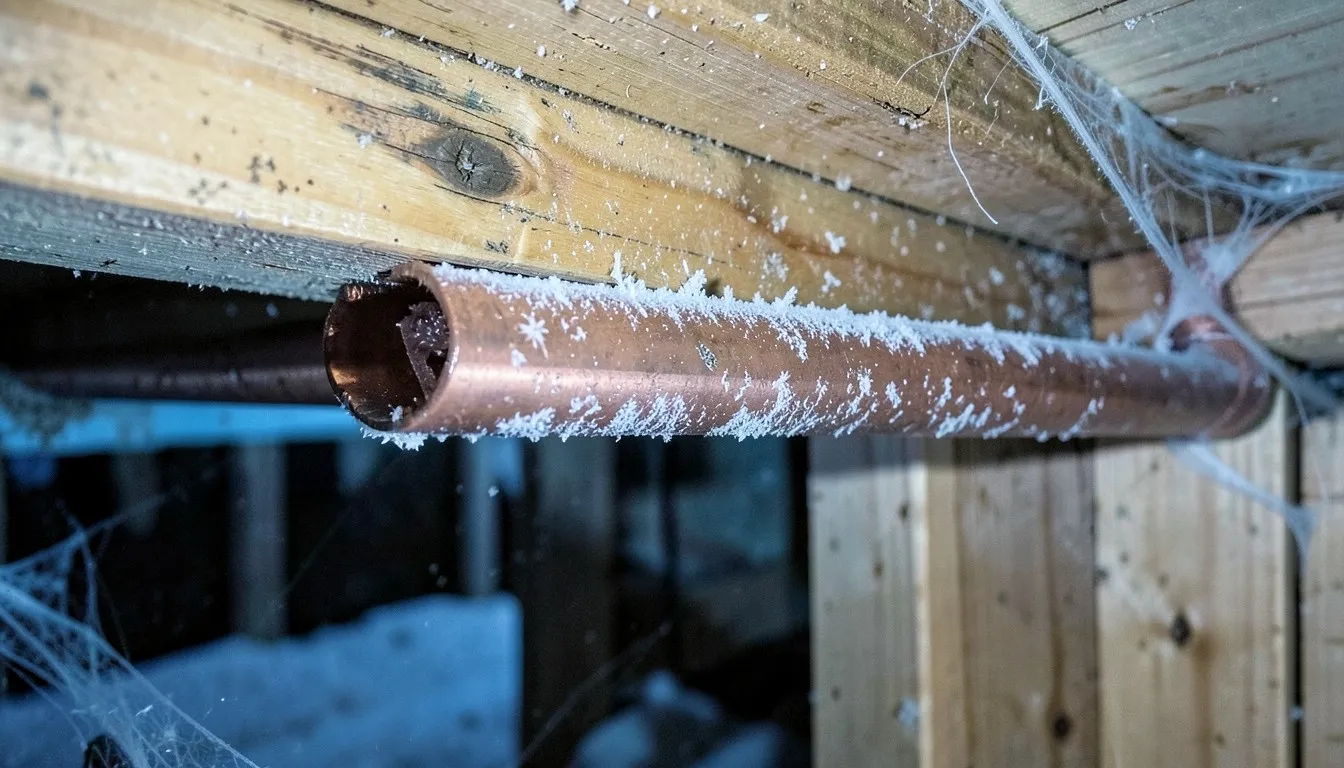
A frozen pipe that has not yet burst can often be thawed safely using a hair dryer, electric heat gun, or portable space heater — never open flame. Shut the main water supply off first in case the pipe has cracked undetected, then open the affected fixture to relieve pressure before applying heat. Repair costs range from $150–$500 for a thaw-only service call to $400–$1,200 for a concurrent burst repair per BuildZoom 2024 frozen pipe repair cost data. PEX-A pipe is the most freeze-tolerant residential supply material, capable of expanding 6–8% before rupturing per PEX Association freeze-cycle testing.
What is a frozen pipe, and why does timing matter?
A frozen pipe is a supply pipe in which water has turned to ice, blocking flow and potentially building dangerous internal pressure. Unlike burst pipes — which have already failed and are actively discharging water — frozen pipes represent a narrow intervention window: thaw the pipe correctly before the pressure causes a crack or rupture, and you prevent the water damage event entirely. Miss that window (or thaw incorrectly), and the repair escalates from a $200 service call to a potentially $5,000–$30,000 water damage event.
The freeze-burst mechanism
Water expands approximately 9% in volume when it freezes. In a sealed pipe, that expansion can generate 2,000–30,000 PSI of internal pressure depending on the temperature differential and pipe geometry per NOAA climate and freeze-depth engineering data. The burst doesn't always happen during the freeze — it often occurs during the thaw. Here's why: ice forms a blockage that seals the pipe. As the ice plug melts from one end, water pressure between the plug and the closed fixture valve downstream builds. When that pressure exceeds the pipe's tensile strength (typically at a fitting, elbow, or thinned section), the pipe fails — releasing all the built-up pressure suddenly.
This means a pipe can freeze completely, remain frozen for hours, and still not burst — then burst during the morning warm-up as the house heats and the ice begins to melt. Understanding this mechanism is why the response sequence matters: shut off the water supply before thawing begins, so that if the pipe has an undetected crack, you limit discharge when that crack is suddenly relieved of the ice seal.
Which pipes freeze
Supply pipes (pressurized water delivery lines) are the freeze-burst risk. DWV pipes (drain, waste, vent) are not under pressure and don't burst when frozen, though frozen drain traps can be a nuisance. Supply pipes most vulnerable to freezing per IRC R303.4 freeze protection requirements:
- Pipes in exterior walls without adequate insulation (especially north-facing)
- Pipes in unheated crawlspaces
- Pipes in unheated attics (a common problem with rooftop HVAC systems or sprinkler feeds)
- Pipes in unheated garages (washing machine supply lines and hose bibb feeds)
- Pipes exposed to exterior air through foundation vents or gaps in the building envelope
- Outdoor hose bibbs and irrigation supply lines above frost line
When freeze events peak
Per NOAA National Weather Service freeze advisory data, the most dangerous freeze events for residential pipes occur when outdoor temperatures drop below 20°F for sustained periods (12+ hours). At 20°F, even marginally insulated pipes in exterior walls begin to be at risk. At 0°F and below, inadequately protected pipes can freeze within 4–6 hours of sustained exposure. The first hard freeze of the season is the highest-risk event — pipes that haven't been tested through a winter season may have undetected vulnerabilities.
How do you identify a frozen pipe?
Frozen pipes are often discovered through symptoms rather than direct inspection, since most supply pipes run inside walls and are invisible without opening the structure.
1. No water or severely reduced flow at a fixture
The most common first signal: you turn on a faucet during or after a cold snap and water barely trickles or nothing comes out at all. If other fixtures in the house have normal flow, the freeze is isolated to the line serving the affected fixture. If all fixtures are affected, the freeze may be in the main supply line — which in cold climates can freeze at the meter box, at an uninsulated section of the main, or at an exposed entry point into the building.
2. Visible frost on exposed pipes
In crawlspaces, garages, basements, and mechanical rooms, frost visible on the outside of a pipe is a direct indicator of freezing inside. The pipe exterior frosts when surface temperature drops below the dew point while the interior ice cools the pipe wall below freezing. A frosted pipe has not necessarily burst — but it's actively at risk and requires immediate attention per CPSC frozen pipe safety guidance.
3. Bulging or discoloration on pipe surface
In accessible copper or CPVC pipe, the freeze expansion sometimes causes visible bulging at weak points — a slight deformation in the pipe wall at the future burst location. This is a sign that the pipe has likely already cracked or is at immediate risk. Do not thaw a visibly bulged pipe — shut off the water supply and call a plumber for pipe replacement before any attempt to restore flow.
4. Unusual sounds — cracking or popping
As water freezes and expands, the pipe material can produce audible cracking or popping sounds — similar to ice forming on a lake. These sounds coming from a wall or floor during a freeze event indicate active freezing in progress.
5. Cold section of drywall
If one section of a wall is noticeably colder than adjacent sections when you press your hand against it, the pipe behind that section may be frozen. The ice in the pipe lowers the wall surface temperature detectably.
6. Running water sounds, then silence
Some homeowners report hearing water running briefly after the temperature drops, then silence when the pipe freezes solid. This is the water in the pipe moving toward the freezing zone and then stopping when the ice plug seals.
7. Water meter stops moving with all fixtures closed
A frozen pipe that has already cracked but not yet fully opened will sometimes show a slowly spinning meter dial — flow past the crack point. This is the most serious scenario: the pipe is already compromised, water may already be leaking into the structure at the freeze location, and thawing will turn a slow leak into a full discharge. In this scenario, shut off the main immediately and call a plumber before any thaw attempt.
What should you do when you find a frozen pipe?
The sequence here matters. Skipping step 1 and going straight to thawing is a common mistake that converts a manageable situation into a flood.
Step 1: Shut off the main water supply
Before any thaw attempt, close the main water shutoff. If the pipe has cracked under the ice — which you cannot know for certain without opening the wall — the ice is currently acting as a plug holding back the water pressure. When you thaw the pipe, that ice plug melts and the crack opens. If the main is still open, water begins discharging immediately. With the main shut off, thawing a cracked pipe results in a slow leak from residual water in the supply lines rather than a full-pressure stream. Locate the main shutoff before every winter season per EPA WaterSense emergency preparedness: main shutoff.
Step 2: Open the affected faucet
Open the faucet that serves the frozen pipe section. This serves two purposes: (1) it releases pressure as the ice melts, preventing the thaw-phase pressure buildup described above; (2) it gives you visual confirmation when the thaw is complete (water begins flowing). Leave the faucet open throughout the thawing process.
Step 3: Locate the frozen section
The frozen section is between the fixture (where there's no flow) and the last point where there is flow. Check: is there flow from fixtures on the other side of the affected wall? Is there flow on the floor below or above? Narrowing the location helps you apply heat to the right area. Common freeze zones: beneath kitchen sinks on exterior walls, in uninsulated crawlspace sections directly under the cold room, and in unconditioned garage spaces where supply lines run to laundry hookups.
Step 4: Apply safe heat — work from faucet toward the freeze zone
Apply heat starting at the faucet end and working toward the frozen zone — not from the far end. Working from the faucet end ensures that as ice melts, water can flow out through the open fixture rather than building pressure in a sealed section between two ice plugs. Safe heat sources:
- Electric hair dryer — The safest, most controlled thaw tool for accessible pipe. Move it continuously; don't hold it in one spot. Safe on copper, CPVC, PEX, and galvanized.
- Portable electric space heater — Effective for thawing pipes in an enclosed space (crawlspace cabinet, under-sink cabinet). Keep heater away from combustible materials per CPSC portable electric heater safety.
- Electric heat tape (self-regulating) — Can be applied directly to the pipe and plugged in. Per CPSC self-regulating heat tape safety standards, self-regulating tape (not constant-wattage) is the safe choice — it modulates heat output to avoid overheating.
- Towels soaked in hot water — Labor-intensive but effective for short exposed sections. Refresh every 2–3 minutes.
| Heat Source | How to Use It Safely |
|---|---|
| Electric hair dryer | Safest, most controlled option; move it continuously and don't hold it in one spot; safe on copper, CPVC, PEX, and galvanized |
| Portable electric space heater | Effective in an enclosed space like a crawlspace cabinet or under-sink cabinet; keep away from combustible materials |
| Electric heat tape (self-regulating) | Apply directly to the pipe and plug in; use self-regulating, not constant-wattage, tape to avoid overheating |
| Towels soaked in hot water | Labor-intensive but effective for short exposed sections; refresh every 2–3 minutes |
Step 5: Inspect for cracks before restoring water
Once flow is restored at the faucet, do NOT immediately reopen the main. First, visually inspect the pipe section you thawed (and adjacent accessible sections) for signs of cracking, bulging, or water staining (which may indicate a slow leak that was sealed by ice). Only after confirming the pipe section appears intact should you slowly open the main water supply — partially at first, then fully while watching for leaks.
Which thawing methods should you avoid?
Several intuitively appealing thaw methods are either unsafe or code-prohibited. Knowing what not to do is as important as knowing the correct approach.
Open flame — torch, heat gun on high, propane burner
Never use open flame to thaw a frozen pipe under any circumstances. Reasons:
- Fire risk — Pipes run through wood framing. A torch applied to a pipe in a wall ignites the framing around the pipe, typically in the wall cavity where the fire is hidden and spreads before detection. Pipe thawing is documented as a residential fire cause per CPSC house fire causes: pipe thawing.
- Steam pressure — Open flame heats water faster than it can drain. Steam pressure in a sealed section can exceed burst pressure for copper, CPVC, or PEX — causing an explosive pipe failure and steam burns.
- PEX and CPVC melting — Plastic supply pipe (PEX, CPVC) melts, deforms, and loses structural integrity at temperatures far below those produced by a torch. A torch will destroy PEX pipe before thawing the ice inside it.
High-wattage constant heat tape without thermostat
Constant-wattage heat tape (as opposed to self-regulating) runs at full power regardless of ambient temperature. Applied to a pipe in an enclosed space without a thermostat, it can overheat the pipe — melting PEX, softening CPVC, or, on poorly installed tape, igniting adjacent insulation. Per CPSC constant-wattage heat tape fire hazard data, constant-wattage heat tape is the leading heat-tape fire cause in residential settings. Only use UL-listed, self-regulating heat tape.
Attempting to thaw a pipe in the wall without professional help
When the frozen section is in-wall and inaccessible, attempting to apply external heat to the wall surface (with a heat gun, hair dryer, or space heater) can work but is slow and unreliable — and does not give you visual access to assess whether the pipe has already cracked. A plumber has two advantages: (1) professional thaw equipment (electric pipe-thawing machines that deliver low-voltage high-amperage current through the pipe material) that is faster and more controlled; (2) thermal imaging or moisture detection equipment to assess whether the pipe has already leaked into the wall.
Did the pipe burst, and how do you find out?
The key question after discovering a frozen pipe is whether it has already cracked or if it's still intact. Several indicators help distinguish.
Signs the pipe likely has NOT burst yet
- No visible water staining, wetness, or damage in accessible areas around the frozen section
- No sound of running water with the main shut off and all fixtures closed
- The pipe exterior shows frost but no visible deformation or bulging
- The pipe looks intact along its entire exposed length
If these conditions hold, proceed with the safe thaw method above — you have a good chance of restoring flow without a burst event.
Signs the pipe may already be cracked
- Visible bulge or deformation on the pipe surface
- Water staining on drywall, floor, or subfloor near the frozen section
- Audible running water with the main shut off and all fixtures closed (indicates flow past a crack)
- The water meter is moving with all fixtures closed
- Soft, wet, or discolored drywall in the area around the frozen pipe location
In any of these cases: do not attempt to thaw the pipe yourself. The ice is currently limiting water discharge. Call a plumber for same-day emergency service — explain that you believe the pipe has already cracked and is currently frozen. The plumber will open the wall, confirm the damage, and replace the pipe section before restoring water. This approach avoids the full-pressure discharge event that would occur if the ice seal melts without the pipe being repaired first.
What a plumber's assessment involves
A professional frozen-pipe assessment typically includes: thermal imaging of the wall to locate the freeze zone without opening drywall unnecessarily; moisture meter testing of the wall surface to detect seepage from a pre-burst crack; pipe inspection of exposed sections; and pipe thawing using electrical resistance equipment (a machine that passes current through the pipe, heating it from the inside out) that is faster and more precise than surface heat per BuildZoom professional pipe thawing service data.
What are your frozen pipe repair options?
The repair tier that applies depends on the outcome of thawing and inspection.
Tier 1: Thaw-only (no structural damage)
The pipe thaws successfully, pressure testing confirms no leaks, and inspection shows no cracks or deformation. The plumber restores water, verifies flow at all fixtures, and the job is complete. Cost: $150–$500 depending on access difficulty and time per BuildZoom frozen pipe thaw cost data. An emergency/after-hours premium of $75–$200 typically applies for call-outs during a freeze event (which are by definition off-hours, nights, and weekends).
Tier 2: Thaw + spot repair (pipe burst at one location)
The pipe thawed and a single crack or rupture is found — typically at a fitting or the weakest section. The plumber cuts out the damaged section (typically 6–24 inches), installs a replacement coupling and new pipe, tests under pressure, and patches the wall opening. Cost: $400–$1,200 per BuildZoom burst pipe repair cost data. Wall patching and painting is a separate cost unless the plumber's scope includes it.
Tier 3: Multiple burst points — section replacement or repipe evaluation
A severe, extended freeze can cause a pipe to burst at multiple locations along its length. In copper or CPVC pipe that experienced a long freeze at very low temperatures, multiple fractures can occur — especially at fittings and elbows. At this point, replacing the entire affected section with PEX-A is often more economical than making multiple spot repairs, and provides significantly better freeze protection for the next cold season per PEX Association cold-climate installation guidance. Cost: $800–$2,500 for a section replacement; $4,500–$15,000 for a whole-home repipe if the freeze revealed systemic pipe vulnerability per the whole-home repipe guide.
Outdoor hose bibbs and irrigation lines
Outdoor hose bibbs (exterior spigots) are a common freeze casualty that homeowners often overlook until spring. A frozen hose bibb that cracked during winter may not be discovered until the first outdoor watering of spring — at which point water has potentially been seeping into the wall cavity since the freeze event. Hose bibb replacement: $100–$350 installed. Frost-free hose bibbs (which drain the supply when closed, leaving no standing water to freeze) are the correct replacement for freeze-prone markets per IRC R303.4 frost-free hose bibb requirement in cold climates.
Freeze tolerance by pipe material: PEX vs copper vs CPVC
Not all supply pipe materials respond to freeze events equally. Material selection is the most durable long-term solution for freeze-prone zones.
PEX-A (best freeze tolerance)
Cross-linked polyethylene made by the peroxide (Engel) method — PEX-A — is the most freeze-tolerant residential supply pipe material. It can expand 6–8% in diameter before reaching failure stress per PEX Association ASTM F876/F877 freeze expansion testing. A single freeze-thaw cycle that would split copper or CPVC can often be survived by PEX-A without rupture. This is because PEX-A's expansion fitting connections (Uponor ProPEX) also expand and contract with the pipe rather than creating a rigid stress concentration point. PEX-A is certified per NSF/ANSI 61 for drinking water contact per NSF/ANSI 61 and 372 certification for PEX and is accepted by both IPC and UPC per IPC § 605.14 PEX pipe acceptance. For any pipe section in a freeze-vulnerable location, specifying PEX-A at replacement is the highest-leverage freeze prevention intervention.
PEX-B and PEX-C (moderate freeze tolerance)
PEX made by the silane (Silopex, PEX-B) and irradiation (PEX-C) methods also provides better freeze tolerance than copper or CPVC, though somewhat less than PEX-A due to the method-specific molecular cross-linking density. PEX-B is the most commonly sold variety in retail home improvement stores. Per PEX Association material comparison: freeze performance by method, PEX-B can survive freeze events in most residential scenarios but is more susceptible to fitting-joint failures during severe freeze events compared to PEX-A with cold-expansion fittings.
Copper (minimal freeze tolerance)
Copper Type L (the standard residential supply material) has essentially no meaningful freeze tolerance — it fractures at the burst point with virtually no expansion. A supply pipe with a single freeze event of sufficient duration will rupture at its weakest point. Copper's redeeming freeze-related characteristic is its thermal conductivity: it absorbs and releases heat quickly, so when heat is applied (correctly) to thaw it, it responds faster than PEX. But in terms of surviving a freeze without a plumber, copper is the worst option per Copper Development Association freeze performance data.
CPVC (least freeze tolerance of common materials)
Chlorinated polyvinyl chloride becomes brittle at low temperatures, making it more susceptible to cracking from ice expansion than copper. A freeze event that causes a copper pipe to split cleanly may shatter a CPVC pipe across a wider section. Per IPC § 605.4 CPVC temperature limitations, CPVC has specific temperature limitations for both hot and cold exposure. For freeze-prone locations, CPVC should not be specified — replacement with PEX-A is the correct approach at any repair opportunity.
Galvanized steel (freeze-tolerant but corroding)
Galvanized steel supply pipe (standard in homes built pre-1960 per US Census housing vintage data) has better freeze tolerance than copper or CPVC due to its wall thickness and tensile strength. Freeze-burst in galvanized steel is less common than in copper systems. However, galvanized steel is in late-stage deterioration in most pre-1960 homes — corrosion-driven failure is the primary risk, not freeze. See the repipe guide for galvanized failure timelines.
How do you prevent the next freeze event?
A frozen pipe event that cost $500 to thaw will cost $10,000+ if it burst instead. The return on prevention investment is high.
Pipe insulation — the baseline intervention
Foam polyethylene pipe insulation (foam tubes cut to fit standard pipe diameters) slows heat loss from the pipe to the ambient air, buying time during cold snaps. Available in standard 3/8", 1/2", 3/4", and 1" IPS pipe sizes at hardware stores. Installation is straightforward: cut to length, split, and close around the pipe. Per DOE Energy Saver pipe insulation and freeze prevention, foam insulation is effective for pipes in spaces that don't drop below 20°F. Below 20°F, insulation alone is insufficient — add heat tape or relocate the pipe.
Self-regulating heat tape — for spaces below 20°F
Electric self-regulating heat tape wraps around the pipe and provides resistance heat when ambient temperature drops. Unlike constant-wattage tape, self-regulating tape automatically reduces heat output as temperature rises, preventing overheating and reducing fire risk per CPSC self-regulating vs constant-wattage heat tape fire data. Always specify self-regulating; always use UL-listed heat cable; never overlap heat tape. Apply over the pipe first, then add foam insulation over the heat tape to retain the heat it generates.
Maintaining minimum indoor temperature
When traveling or leaving a property unoccupied, set the thermostat to a minimum of 55°F per DOE Energy Saver cold-weather occupancy guidance. Many freeze events occur in vacation properties where owners turned the heat off entirely. For pipes in unconditioned crawlspaces or attics, interior temperature maintenance helps but does not directly warm the unheated space — supplemental heating or insulation in those specific zones is still required.
Opening cabinet doors on exterior walls
Kitchen and bathroom supply lines on exterior walls run behind cabinets that block the heated interior air from reaching the pipe. During extreme cold (below 10°F), opening those cabinet doors allows heated room air circulation around the pipes. A quick, free intervention that can meaningfully reduce freeze risk during a short-duration cold event per EPA WaterSense freeze prevention guidance.
Allowing a slow trickle at vulnerable fixtures
Running water freezes at a lower temperature than standing water — the kinetic energy of moving water inhibits ice crystal formation. During extreme cold events (overnight temperatures forecast below 10°F), allowing a small trickle from the fixture at the end of each vulnerable pipe run can prevent freezing. This wastes water, so it's an emergency measure for cold extremes, not a year-round practice per EPA WaterSense water conservation during freeze events.
Outdoor hose bibb winterization
Per IRC R303.4 outdoor hose bibb requirements, frost-free hose bibbs are required in most cold-climate jurisdictions (and are best practice everywhere they may freeze). A frost-free hose bibb has a stem that extends 6–12 inches inside the heated envelope of the home — the actual shutoff point is inside the warm space, not at the exterior. When the bibb is closed, water drains from the exposed stem, eliminating standing water that could freeze. Verify your outdoor bibbs are frost-free: look for a stem handle rather than a round knob, and measure the stem length from the wall to the handle. Standard hose bibbs (short stem) are not frost-free. Replace them before winter.
Full draindown for seasonal properties
Vacation properties and homes left unoccupied through winter should be completely drained to eliminate freeze risk. Sequence:
- Shut off the main water supply at the meter
- Open all faucets (hot and cold) to drain supply lines — starting at the lowest point
- Flush all toilets to empty the tank
- Add propylene glycol RV antifreeze (not automotive antifreeze — toxic) to toilet bowls and all P-traps to prevent trap freezing
- Open the water heater drain valve briefly to remove standing water
A complete draindown eliminates all supply-pipe freeze risk for unoccupied properties — no heat tape, no insulation work required per IRC R303.4 seasonal dwelling winterization.
How do you protect crawlspace and attic pipes?
Crawlspaces and attics are the highest-frequency freeze zones for residential supply pipes — these unconditioned spaces are both cold and often inaccessible, making post-event repairs difficult and expensive.
Crawlspace venting — a freeze risk trade-off
Building codes historically required crawlspace vents to control moisture. Per IRC R408 crawlspace ventilation requirements, the current IRC allows both vented and unvented (encapsulated) crawlspace designs. An encapsulated crawlspace — with insulation on the foundation walls and a vapor barrier on the floor — keeps the crawlspace temperature within a few degrees of interior temperature, eliminating freeze risk for pipes inside it. A vented crawlspace in a cold-climate home can reach outdoor temperatures during a cold snap, exposing all pipes inside to freeze conditions.
The highest-leverage freeze prevention for a vented crawlspace with pipes: (1) insulate the pipes directly; (2) add self-regulating heat tape to particularly vulnerable sections; (3) consider encapsulation — which also controls moisture, reduces energy bills, and eliminates the largest ongoing freeze risk zone in the home. Crawlspace encapsulation: $3,000–$8,000 depending on size per BuildZoom crawlspace encapsulation cost data.
Attic pipes — the surprise freeze location
Most homeowners don't think of their attic as a location with supply pipes — but there are several scenarios where supply lines run through unheated attic spaces: sprinkler system feeds, rooftop HVAC units with humidifier feeds, and in some older construction, supply lines that were routed over the top of a finished ceiling rather than through the floor. Attic temperatures in cold-climate markets can drop to outdoor temperatures or below (dark attic absorbs cold from the roof deck). Any supply pipe in an unheated attic is a freeze risk. Solutions: reroute the pipe to a conditioned space when any significant work is done in that area; insulate with both pipe foam and heat tape; or, for irrigation/sprinkler lines, install a seasonal drain-down capability per IRC freeze protection for attic supply lines.
What does frozen pipe repair cost?
Frozen pipe service calls span a wide cost range because the scope varies from simple thaw-only to full burst repair with water damage remediation.
Thaw-only service call
- Standard hours (8am–5pm weekday) — $150–$400. Most freeze events happen overnight or on cold mornings, so true standard-hours thaw calls are uncommon.
- Emergency/after-hours (nights, weekends, holidays) — $250–$600. After-hours premium of $75–$200 on top of the standard service call rate is typical per BuildZoom emergency service premium data.
- Difficult access (crawlspace, attic) — Add $75–$200 for confined-space work per BLS skilled trade hazard differential data.
Thaw + spot repair (pipe cracked during freeze)
- Copper or CPVC, accessible location — $400–$900 for thaw plus patch coupling.
- PEX repair, accessible location — $350–$750 (push-fit coupling; no soldering).
- Wall access required — Add $150–$400 for drywall cutting and temporary patch (cosmetic wall repair is a separate trade).
- Outdoor hose bibb replacement — $100–$350 installed (frost-free bibb).
Water damage remediation (if burst went undetected)
When a freeze-burst is not discovered for hours or days — common in vacation properties — the water damage component dwarfs the pipe repair. Per Insurance Information Institute water damage restoration cost data, remediation for a multi-day undiscovered burst can run $5,000–$50,000 or more depending on the area of saturation and the materials affected. Homeowner's insurance (HO-3) typically covers sudden and accidental burst pipe damage but may dispute claims where a freeze event could have been prevented by reasonable cold-weather precautions (thermostat left off, for example).
Prevention vs. repair: the cost comparison
- Foam pipe insulation for a crawlspace: $100–$400 (materials + labor for standard-size crawl)
- Self-regulating heat tape for a 20-foot run: $50–$150 materials + $100–$200 installation
- Frost-free hose bibb (two exterior bibbs): $200–$700 total installed
- Crawlspace encapsulation: $3,000–$8,000 — eliminates freeze risk and provides moisture control
The average freeze-burst repair (tier 2: thaw + pipe repair) costs $600–$1,200. The average prevention investment for a vulnerable home runs $200–$500. One avoided freeze-burst event pays for prevention investments many times over per BuildZoom freeze prevention ROI data.
Do you need a permit for frozen pipe repair?
Frozen pipe repair permitting follows the same general rules as burst pipe repair — the extent of work determines whether a permit is required.
Permit-exempt work (most freeze repairs)
Per IPC § 106.2 work exempt from permit, minor pipe repair — replacing a cracked section with like-for-like material — is typically exempt from permitting in most jurisdictions. A licensed plumber replacing 12 inches of copper with copper at the same size is standard maintenance and repair, not new installation. This covers the majority of freeze-burst repairs.
Work that may require a permit
- Converting from copper or CPVC to PEX-A for a significant pipe section (material change)
- Rerouting a pipe to a new path (not just replacing in place)
- Installing a new frost-free hose bibb where none existed
- Crawlspace encapsulation if it involves blocking required ventilation openings
- Any work that is part of a broader repipe scope
License requirement
Most states require a licensed plumber for supply pipe repair. Key state licensing authorities:
- California: CSLB C-36 plumbing contractor license
- Texas: Texas State Board of Plumbing Examiners
- Florida: Florida DBPR plumbing license verification
- Arizona: Arizona ROC contractor search
- Minnesota: Minnesota DLI plumber license lookup
Always verify license status before hiring — insurance claim coverage for pipe failure events may be disputed if the repair was performed by an unlicensed contractor.
Need a frozen pipe repair callback?
ZIP, phone, kind of work. AlertPlumber routes to a verified plumber for an over-phone estimate.
Frozen Pipe Repair by city
City-specific pricing, code references, climate-driven pathology, and frequently-asked questions for the 12 cities where AlertPlumber ships frozen pipe repair pages today.
- Frozen Pipe Repair in Minneapolis, MN →
- Frozen Pipe Repair in Phoenix, AZ →
- Frozen Pipe Repair in Boston, MA →
- Frozen Pipe Repair in Atlanta, GA →
- Frozen Pipe Repair in Seattle, WA →
- Frozen Pipe Repair in New York, NY →
- Frozen Pipe Repair in Los Angeles, CA →
- Frozen Pipe Repair in Chicago, IL →
- Frozen Pipe Repair in Dallas, TX →
- Frozen Pipe Repair in Houston, TX →
- Frozen Pipe Repair in Philadelphia, PA →
- Frozen Pipe Repair in San Jose, CA →
What else do people ask about frozen pipe repair?
What should I do first if I think a pipe is frozen?
Can I thaw a frozen pipe myself?
How do I know if my frozen pipe has burst?
How long does it take to thaw a frozen pipe?
Will my homeowner's insurance cover a frozen pipe?
What pipe material is most resistant to freezing?
Which pipes in my home are most likely to freeze?
How much does frozen pipe repair cost?
How can I prevent my pipes from freezing this winter?
Is it safe to use a heat gun to thaw a frozen pipe?
My hose bibb is frozen and cracked — what does that repair involve?
My crawlspace pipes froze — what is the long-term fix?
Can frozen pipes cause mold?
Sources
- PEX Association — ASTM F876/F877 Freeze Expansion Testing
- PEX Association — Cold-Climate Installation Guidelines
- PEX Association — Material Comparison: Freeze Performance by Method
- NSF — ANSI/NSF 61 and 372 PEX Certification for Drinking Water
- International Plumbing Code (IPC) — § 605.14: PEX Pipe Acceptance
- International Plumbing Code (IPC) — § 605.4: CPVC Temperature Limitations
- International Plumbing Code (IPC) — § 106.2: Work Exempt from Permit
- International Residential Code (IRC) — R303.4: Freeze Protection Requirements
- International Residential Code (IRC) — R303.4: Frost-Free Hose Bibb Requirements
- International Residential Code (IRC) — R408: Crawlspace Ventilation Requirements
- International Residential Code (IRC) — R303.4: Seasonal Dwelling Winterization
- NOAA — Freeze Depth and Climate Data by Region
- NOAA — National Weather Service Freeze Advisory Data
- CPSC — Frozen Pipe Thawing Safety Guidance
- CPSC — House Fire Causes: Pipe Thawing with Open Flame
- CPSC — Portable Electric Heater Safety Guidelines
- CPSC — Self-Regulating vs. Constant-Wattage Heat Tape Fire Data
- CPSC — Constant-Wattage Heat Tape Fire Hazard Documentation
- UL — Listed Heat Cable Certification Requirements
- EPA WaterSense — Emergency Preparedness: Main Shutoff Location
- EPA WaterSense — Freeze Prevention: Cabinet Door and Trickle Guidance
- EPA WaterSense — Water Conservation During Freeze Events
- DOE Energy Saver — Pipe Insulation and Freeze Prevention Guide
- DOE Energy Saver — Cold-Weather Occupancy Guidance: Minimum Temperature
- CDC — Water Damage and Mold Growth Timeline in Building Materials
- Insurance Information Institute — Homeowner's Insurance: Frozen Pipe Coverage
- Insurance Information Institute — Water Damage Restoration Cost Data
- Copper Development Association — Freeze Performance Data for Copper Type L
- U.S. Census Bureau — Housing Vintage Data: Pre-1960 Home Distribution
- BuildZoom — Frozen Pipe Thaw Service Cost Data 2024
- BuildZoom — Emergency Service Premium: After-Hours Plumbing
- BuildZoom — Burst Pipe Repair Cost Data 2024
- BuildZoom — Crawlspace Encapsulation Cost Data
- BuildZoom — Freeze Prevention ROI: Prevention vs. Repair Cost Comparison
- BLS — Occupational Employment Statistics: Plumbers
- BLS — Skilled Trade Hazard and Confined-Space Differential Data
- CSLB — California C-36 Plumbing Contractor License
- Texas State Board of Plumbing Examiners — License Verification
- Florida DBPR — Plumbing Contractor License Verification
- Arizona ROC — Contractor License Search
- Minnesota DLI — Plumber License Lookup