
Emergency Water Heater Repair in Columbus, Ohio
Active water damage compounds by the hour — a licensed OH plumber is on call for Columbus right now.
Local plumbing data for Columbus, OH
Seeing these conditions at your place in Columbus? A state-licensed plumber can confirm it over the phone — free, no obligation.
Pipe conditions in Columbus, OH
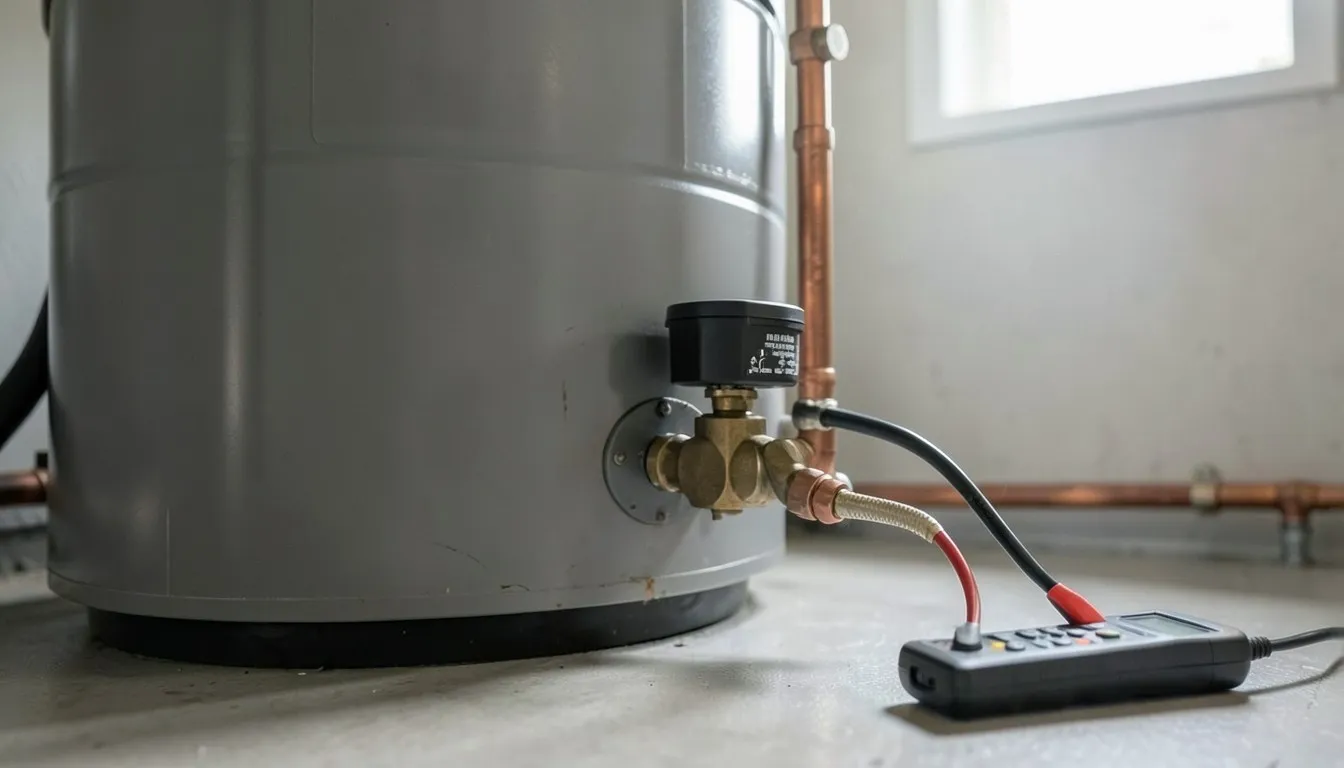
Water heater repair in Columbus starts with isolating the failure mode: a unit producing no hot water usually has a failed heating element or thermostat (electric) or a pilot or gas valve issue (gas); a unit leaking at the base has a failed tank — a repair is not possible and replacement is immediate. Sediment flushing and anode rod replacement extend the life of units under 10 years significantly; units over 12 years are typically beyond economic repair. AlertPlumber routes your request to an Ohio-licensed plumber who diagnoses before recommending repair vs. replacement. Freeze events and frost-depth requirements add pipe insulation, exterior faucet winterization, and burst-risk assessment to service calls in this climate.
Columbus's housing stock spans multiple construction eras — median home age 49 years — meaning pipe materials and failure modes vary significantly by neighborhood and building vintage. An inspection-led approach that confirms pipe material before recommending a service path is standard practice for mixed housing profiles.
Hard water in Columbus accelerates scale buildup inside water heater tanks, on heating elements, and at fixture connections. Sediment accumulation in tank heaters reduces efficiency and shortens element life; visible deposits at aerators and showerheads are an early indicator. A licensed plumber can assess whether a water softener or conditioner is appropriate for the home's service configuration.
Frost line depth in Columbus means supply lines and outdoor plumbing must be installed below the freeze threshold — typically 32 — to prevent pipe burst during cold events. Exterior hose bibs, irrigation shutoffs, and any exposed pipe runs are the most common winterization service points in freeze-risk markets.
- Median home age
- 49 yrs
- Water hardness
- 8 gpg
- Frost line
- 32 in.
- Permit
- $125
A licensed OH plumber reads these conditions the moment you describe the symptom.
Water Heater Repair in Columbus: Local Infrastructure Context
Columbus Division of Water delivers from the Scioto River watershed at approximately 8 grains per gallon — moderately hard water that produces consistent sediment accumulation in tank water heaters. At 49 years median home age, Columbus water heater repair volume concentrates in two distinct construction eras: the 1920s-1940s German Village, Clintonville, and Italian Village housing stock where replacement units may themselves be 15-25 years old, and the 1960s-1980s Westerville, Grove City, and Gahanna suburban tract corridor where original or once-replaced equipment is approaching failure age.
Columbus averages approximately 112 days at or below freezing annually, and freeze-related water heater incidents — burst inlet supply connections, thermal stress tank events, and freeze-damaged expansion tank failures — are a consistent winter service category. The 32,000 lead service lines under active Columbus Department of Public Utilities replacement create homeowner awareness for any plumbing work: contractors scoping supply line connections to aging water heaters should note that LSL status and supply condition are related assessments.
Ohio plumbing contractors must hold a current license through the Ohio Construction Industry Licensing Board (OCILB). The $125 permit covers water heater installation inspection in Columbus. At 8 GPG, anode rod inspection every 3-4 years is standard — comparable to Detroit and Washington in the moderately hard range. Columbus's dual-era housing stock means replacement projects often encounter mixed pipe vintages: cast-iron drains in German Village homes versus ABS or PVC in 1970s suburban installations.
What shapes plumbing demand in Columbus, OH
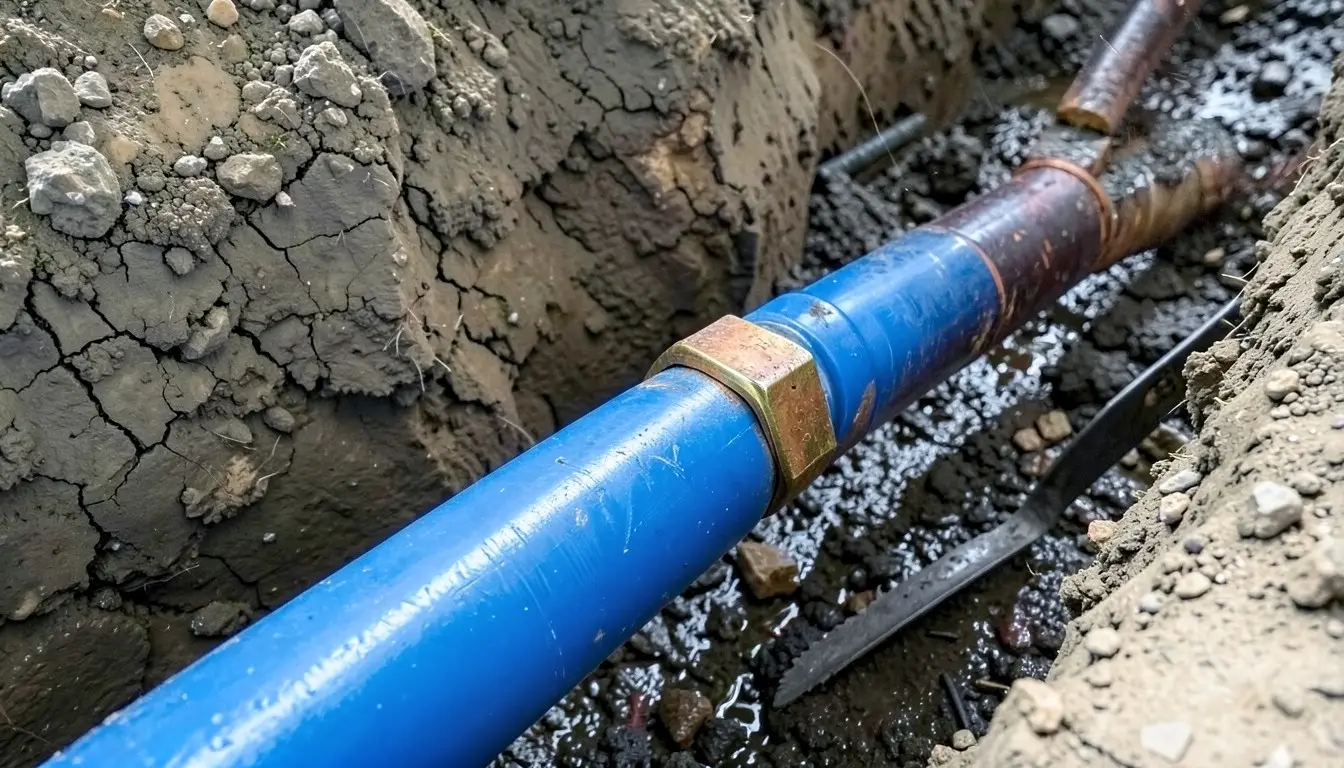
1950s–70s copper supply is now 50–70 years into its service cycle in Columbus. Thermal fatigue at fittings and slab-on-grade access complexity — common in Sun Belt construction — make repair vs. replacement a live decision on most jobs. This housing cohort is the active primary replacement wave in this market.
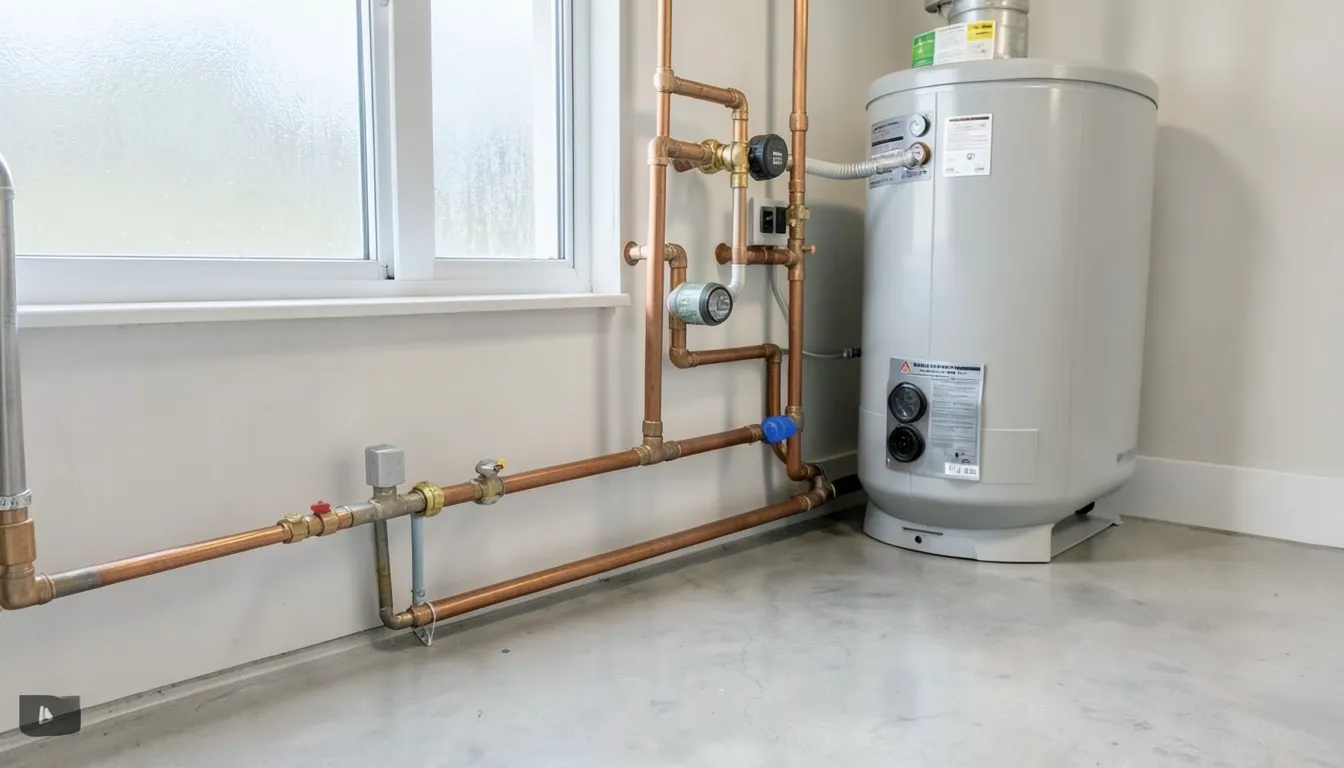
8–14 GPG shortens water heater service life to 8–11 years in Columbus and drives rolling maintenance demand at aerators, shower cartridges, and heat exchanger ports. Annual flushing prevents premature failure; skipped maintenance cycles push units toward early replacement. Scale-related calls represent a significant share of the annual service workload here.
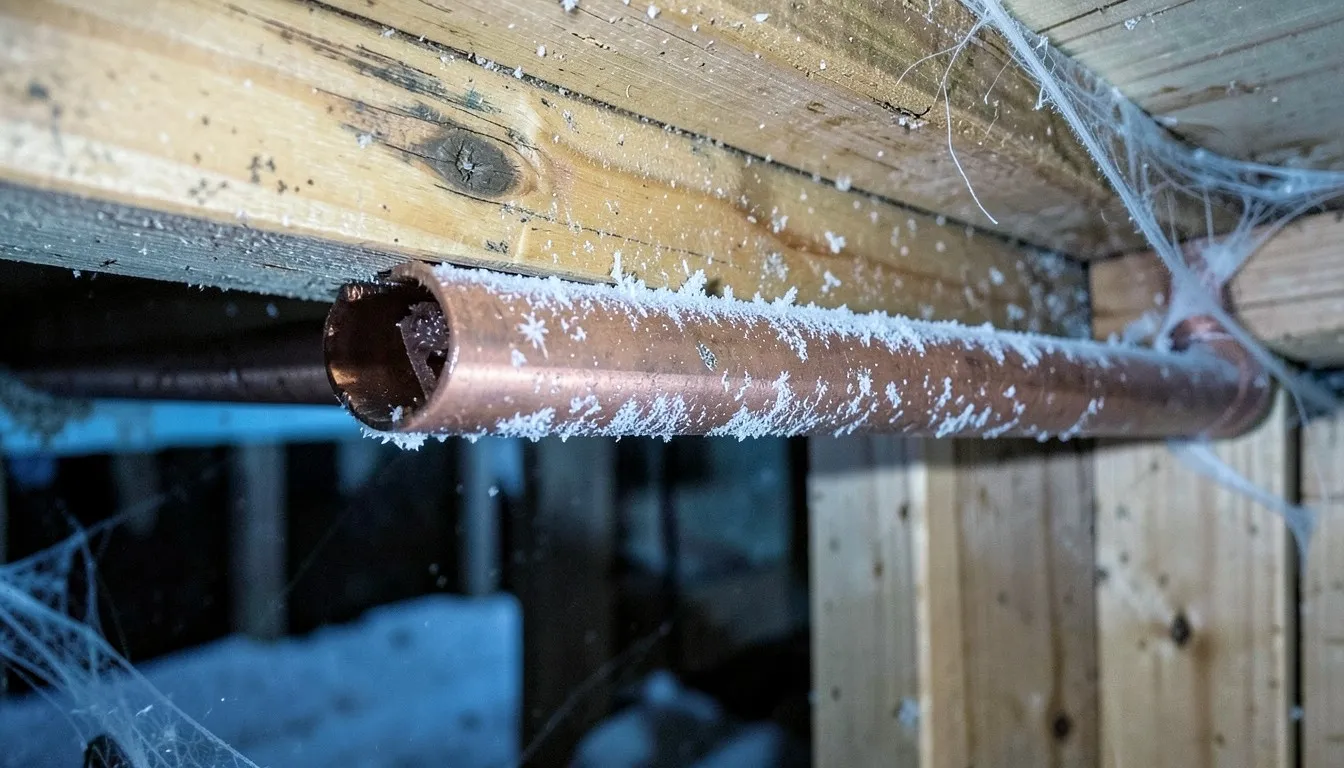
The primary surge in Columbus runs January–March, with a secondary wave at the spring thaw — when pipes that held through the freeze rupture as pressure is restored above 32°F. Scheduling competition peaks exactly when emergency calls are highest. Homeowners who wait for visible damage compete for the same limited plumber slots at the worst possible time.
Active damage in Columbus: contain, assess, restore
Submit your Columbus address and describe the active damage — flooding, failed shutoff, burst or frozen line. AlertPlumber marks the request as priority and an OH-licensed plumber confirms receipt within 15 minutes, without routing through a national call center.
The plumber arrives with a confirmed ETA, locates the nearest shutoff, and maps the damage boundary — affected lines, access points, material condition. You receive a verbal assessment of what requires immediate containment and what can wait until the full repair scope is confirmed.
You approve a written containment and repair scope before any work begins. Temporary isolation is priced separately from full restoration. No phase proceeds without your explicit sign-off.
Water Heater Repair cost calculator — Columbus
Pre-filled for water heater repair in Columbus. Adjust the ZIP for a neighboring area, or change the service to compare. Calculator pulls from the city's scraped permit-fee + state plumber-density data.
Water Heater Repair emergency in Columbus?
Every hour without a repair increases structural risk and remediation cost. A verified plumber calls back with an ETA and a written estimate before any work begins.
Water Heater Repair in Columbus — frequently asked
How much does water heater repair cost in Columbus, OH?
Columbus water-heater work spans a wide band because the metro splits across three install eras and two fuel types. Single-fault gas-tank repairs on the Columbia Gas of Ohio network — thermocouple, gas control valve, T&P relief, dip tube, drain valve — typically quote $195–$565 in 2026 dollars. Electric-tank single-element or thermostat swaps run $165–$420. Sediment flush on a Columbus tank fed 8 grains-per-gallon moderate water from the Olentangy + Scioto blend is $155–$245, and the OH OCILB plumber will usually descale a tankless heat exchanger for $295–$425 in the same visit. A full 40–50 gallon gas-tank replacement installed in a German Village basement, an Upper Arlington utility room, or a Hilliard garage runs $1,495–$2,950, with the $125 Columbus Department of Building & Zoning Services plumbing permit + inspection bundled into the written quote per Ohio Department of Commerce specialty plumber rules. Heat-pump WHR conversions tied to the AEP Ohio rebate framework run $2,650–$4,250 net of utility incentive.
What symptoms tell me my Columbus water heater is failing?
On Columbus water (8 gpg moderate, Olentangy + Scioto blend through Columbus Department of Public Utilities) the failure pattern stacks predictably. Rumbling or kettling at the burner means calcium-carbonate sediment has baked onto the tank bottom — typical at year 4–6 here. Rusty or metallic-tasting hot water means the sacrificial anode rod is consumed and the steel tank lining is now corroding (anodes last 4–6 years on 8 gpg vs the 8–10 year national norm). T&P relief valve dripping into the pan means thermal expansion or an over-temp event — common in winter when 110+ freeze days extend heat-up cycles. Pilot won't stay lit on Columbia Gas units points to thermocouple, draft, or flue-venting issues — basement installs in 1920s German Village stock often have marginal combustion air. Bottom-of-tank pooling means perforation; replacement only. The OCILB plumber pressure-tests the T&P, checks anode draw with a millivolt meter, and inspects flue draft per AHRI install practice.
Why does Columbus's 8-gpg water and 110-day winter shorten water heater life?
Two Midwest stressors compound on Columbus tanks. First, the Columbus DPU blend off the Olentangy and Scioto rivers tests at roughly 8 grains per gallon — moderate hardness per USGS water-hardness classifications. That's softer than Mesa's 17 gpg attic-tank punishment but harder than Oakland's 3 gpg EBMUD supply, so Columbus tankless heat exchangers last 5–7 years between full descales (vs 18 months in Mesa, vs 10+ years in Oakland). Second, the continental-climate winter pulls 110+ freeze days per year per NOAA NWS Wilmington (CMH forecast office), which lengthens every heat-up cycle: incoming groundwater drops to 38–42°F in January vs 62–68°F in July, so the burner or element runs roughly 2.4× longer per draw all winter. That extra cycling accelerates anode consumption, dip-tube fatigue, and gas-valve duty-cycle wear — the reason Columbus tanks average 8–11 year life vs the 12–15 year national norm DOE publishes.
Should a Columbus home pick gas tank, tankless, or heat-pump WHR?
Three honest paths in this market. Gas tank is the Columbus default — Columbia Gas of Ohio service is near-universal inside I-270, basement and utility-room installs are standard, and 40–50 gallon atmospheric-vent units fit the chimney chase in 1920s German Village and 1960s Upper Arlington stock. Total installed cost is the lowest of the three, and recovery rate handles the winter heat-up cycle. Tankless (gas or electric) makes sense in 1990s+ Hilliard, Dublin, and Westerville new-build tract where venting can be sidewall-direct and the homeowner wants endless hot water — but expect to budget annual descaling at 8 gpg or risk warranty. Heat-pump WHR is increasingly viable in conditioned basements with adequate air volume; DOE Energy Saver heat-pump WHR guidance notes 60% energy reduction vs electric resistance, and AEP Ohio offers utility-rebate incentives for qualifying installs. Cold basements (under 50°F) cut heat-pump efficiency, so a Bexley basement that already runs 55–62°F is a better candidate than an unconditioned crawlspace.
Will my Ohio HO-3 homeowners policy cover water heater damage in Columbus?
Standard Ohio HO-3 policies cover sudden and accidental discharge — a tank that ruptures and floods a German Village basement, a T&P valve that fails open and soaks an Upper Arlington utility room — but exclude two categories Columbus homeowners hit often. First, the cost of the tank itself: that's wear-and-tear, not a covered peril. Second, gradual seepage the homeowner reasonably should have noticed — a Hilliard garage drip pan with three weeks of staining will almost always be denied. Documentation matters: keep flush receipts, anode-rod inspection reports, and the OCILB plumber's written diagnostic. For replacements, the $125 Columbus Department of Building & Zoning Services plumbing permit and follow-up inspection establish that combustion air, flue venting, gas-supply sizing, and T&P discharge routing meet Ohio Building Code (OBC) — skipping the permit gives carriers a clean denial path on subsequent discharge claims. Older 1920s-40s German Village basements with original chimney flues sometimes need liner work to pass inspection.
How often should I replace the anode rod on a Columbus tank?
Anode-rod cadence is the single biggest lever on tank life in Columbus. The sacrificial magnesium or aluminum rod corrodes preferentially to protect the steel tank lining; once the rod is consumed the tank itself starts corroding, which is irreversible. On the Columbus DPU blend at 8 grains per gallon moderate hardness, expect to inspect the anode at year 3 and replace at year 4–5 — vs the 6–8 year cadence common on soft-water markets like Oakland EBMUD. Inspection is straightforward: the OCILB plumber backs the hex plug out of the tank top, pulls the rod, and measures remaining diameter — under 1/2" or with exposed core wire means replace. Cost is $145–$245 installed, and a $185 anode swap at year 4 routinely buys 3–5 additional years of tank life on a $1,800 replacement. Powered (impressed-current) anodes are an option for chronic odor or short-life situations, especially in 1920s German Village basements with older galvanized inlet plumbing that can shed iron into the tank.
How long does water heater repair take in Columbus?
Component-level repairs on Columbus gas or electric tanks are typically same-day in-and-out: thermocouple swap 45–75 minutes, gas-control valve 75–110 minutes, electric element + thermostat 60–90 minutes, T&P relief valve 30–45 minutes, anode rod 60–90 minutes (longer if the original rod is welded in by mineral). Sediment flush on a moderate-hardness Columbus tank with three-plus years of buildup runs 90–150 minutes including refill and air-purge. Tankless descale via vinegar or commercial circulator is 60–90 minutes plus inlet/outlet filter clean. Full tank replacement in a German Village basement with chimney-vent reroute, an Upper Arlington utility room, or a Hilliard garage typically takes 3.5–5.5 hours including drain-down, removal, set, gas + water + flue connections, fill, and combustion-test. The Columbus Department of Building & Zoning Services inspection on a $125 permit usually happens within 3–7 business days after install — the homeowner doesn't need to be present if the install meets OBC code on combustion air and flue termination.
Does install location vary across German Village, Upper Arlington, and Hilliard?
Three Columbus housing eras drive three install patterns. 1920s-40s German Village, Clintonville, and Old Worthington stock has tanks in unfinished basements next to the original gravity-vent chimney chase — combustion air is usually adequate, but original cast-iron flue can need stainless liner work to meet current OBC venting code on a replacement, adding $385–$650 to the quote. Floor-pan drain routing into a basement floor drain is standard. 1960s-80s Upper Arlington, Bexley, Worthington, and inner Hilliard tract has tanks in attached-garage utility closets or first-floor utility rooms; sidewall power-vent or atmospheric-vent through a B-vent chase is typical, and replacement is straightforward. 1990s+ outer Hilliard, Dublin, Westerville, and New Albany new-build often has tanks in mechanical rooms or garages with PVC sidewall direct-vent — these are the easiest replacements and the cleanest tankless-conversion candidates because the venting is already category-IV-ready. The OCILB plumber confirms vent classification before quoting because mismatched venting voids manufacturer warranty.
What does the Columbus permit and OH OCILB credential cover?
Columbus Department of Building & Zoning Services charges $125 for a residential plumbing permit covering tank or tankless water-heater replacement; component repair (element, thermostat, T&P, anode, gas valve) does not require a permit. The state-credentialed Ohio plumber pulls the permit on the homeowner's behalf and the fee bundles into the written quote. Ohio Department of Commerce, Division of Industrial Compliance lists roughly 9,480 active Ohio OCILB-credentialed plumbing contractors statewide — substantially fewer than California's 19,840 CSLB C-36 holders, which is why dispatch ETAs in Columbus track tighter to the network's verified roster. The OBC inspection verifies T&P discharge routing to within 6 inches of the floor, gas-supply sizing for the BTU rating, combustion-air volume per federal SDWA-aligned backflow prevention, flue-vent termination clearances, and seismic strapping is not required (Ohio is outside the high-seismic zones that drive California's strap rule). AlertPlumber routes only to plumbers in good OCILB standing.
Does a heat-pump WHR conversion pencil out in Columbus with the AEP Ohio rebate?
Heat-pump water heater conversion economics in Columbus are improving but situational. Installed cost on a 50–80 gallon HPWH typically lands $3,250–$4,950 before incentives — meaningfully higher than the $1,495–$2,950 gas-tank baseline. AEP Ohio offers utility-rebate dollars for qualifying ENERGY STAR heat-pump WHR installs (rebate amount and eligibility shift annually, so the OCILB plumber confirms current program tier on the quote), and federal IRS Section 25C tax credits per DOE Energy Saver guidance stack with utility rebates. Net installed cost commonly drops to $2,650–$4,250 after incentives. The energy math: HPWH uses roughly 60% less electricity than resistance-electric and competes favorably with Columbia Gas of Ohio on operating cost when gas commodity prices spike. Best Columbus candidate is a conditioned basement above 50°F with adequate air volume — a 1960s-80s Upper Arlington or Bexley basement is ideal; a 1920s German Village uninsulated basement under 45°F in January is marginal and may need a hybrid-mode bias toward resistance backup during the 110-freeze-day winter.
Sixty seconds from now, a plumber can be working your problem.
Call and talk to dispatch, or put your number in the form below — a licensed Ohio plumber calls you back about the water heater repair and gives a written estimate by phone.
Request a water heater repair callback in Columbus
In a meeting, with the kids, or just prefer not to hold? Drop your ZIP and number below. AlertPlumber routes your request to a verified plumber in your area — they’ll call you back directly.
- 1 Submit your info. ZIP, phone, and what kind of work you need.
- 2 AlertPlumber matches you with a verified plumber serving your area.
- 3 The plumber calls you back with a written estimate, no obligation.
Water Heater Repair in Columbus — fast response
Acute plumbing failures cannot wait. AlertPlumber has verified Ohio plumbers available for water heater repair in Columbus — call now or submit the form above for rapid callback.