
Emergency Hydro Jetting in Aurora, Colorado
Camera first, quote second — know exactly what's wrong in your Aurora home before you approve a dollar.
Local plumbing data for Aurora, CO
Seeing these conditions at your place in Aurora? A state-licensed plumber can confirm it over the phone — free, no obligation.
Pipe conditions in Aurora, CO
Hydro-jetting in Aurora clears what drain snaking leaves behind: scale buildup from hard water, grease layers coating pipe walls, and root tendrils that regrow from fragments left by a cable machine. The process uses 3,000–4,000 PSI water pressure through a rotating nozzle that scrubs the pipe wall — not just punches through the blockage. A camera scope before jetting confirms the pipe can withstand high pressure and identifies any structural defects that jetting would worsen. AlertPlumber connects you with a Colorado-licensed plumber who scopes before jetting as a standard practice.
Aurora's housing stock spans multiple construction eras — median home age 35 years — meaning pipe materials and failure modes vary significantly by neighborhood and building vintage. An inspection-led approach that confirms pipe material before recommending a service path is standard practice for mixed housing profiles.
Very hard water in Aurora is a primary driver of accelerated appliance failure: water heater anode rods exhaust in 2–3 years instead of 6–8, scale deposits at fixture connections form within months of installation, and tankless heat exchangers accumulate mineral buildup that can reduce lifespan by half without regular descaling. A softener or whole-house conditioner is strongly recommended alongside any appliance service call.
Frost line depth in Aurora means supply lines and outdoor plumbing must be installed below the freeze threshold — typically 36 — to prevent pipe burst during cold events. Exterior hose bibs, irrigation shutoffs, and any exposed pipe runs are the most common winterization service points in freeze-risk markets.
- Median home age
- 35 yrs
- Water hardness
- 12 gpg
- Frost line
- 36 in.
- Permit
- $58
A licensed CO plumber reads these conditions the moment you describe the symptom.
What shapes plumbing demand in Aurora, CO
CPVC becomes brittle in the 20–35-year range and snaps under thermal stress or incompatible pipe dopes. Early PEX fittings (pre-2010) may develop chloramine compatibility issues at 15–25 years. The 1980s–1990s housing stock in Aurora is entering its first wave of material-driven service calls — not from neglect, but from normal service-life progression.
At 15–20+ GPG, calcium scale forces compressed equipment cycles in Aurora: tank heaters average 6–9 years vs. the 10–12-year national benchmark, and tankless units require annual descaling. Anode rods calcify within 12–18 months. Most plumbers here assess heater age against the local scale timeline — not the manufacturer's service life.
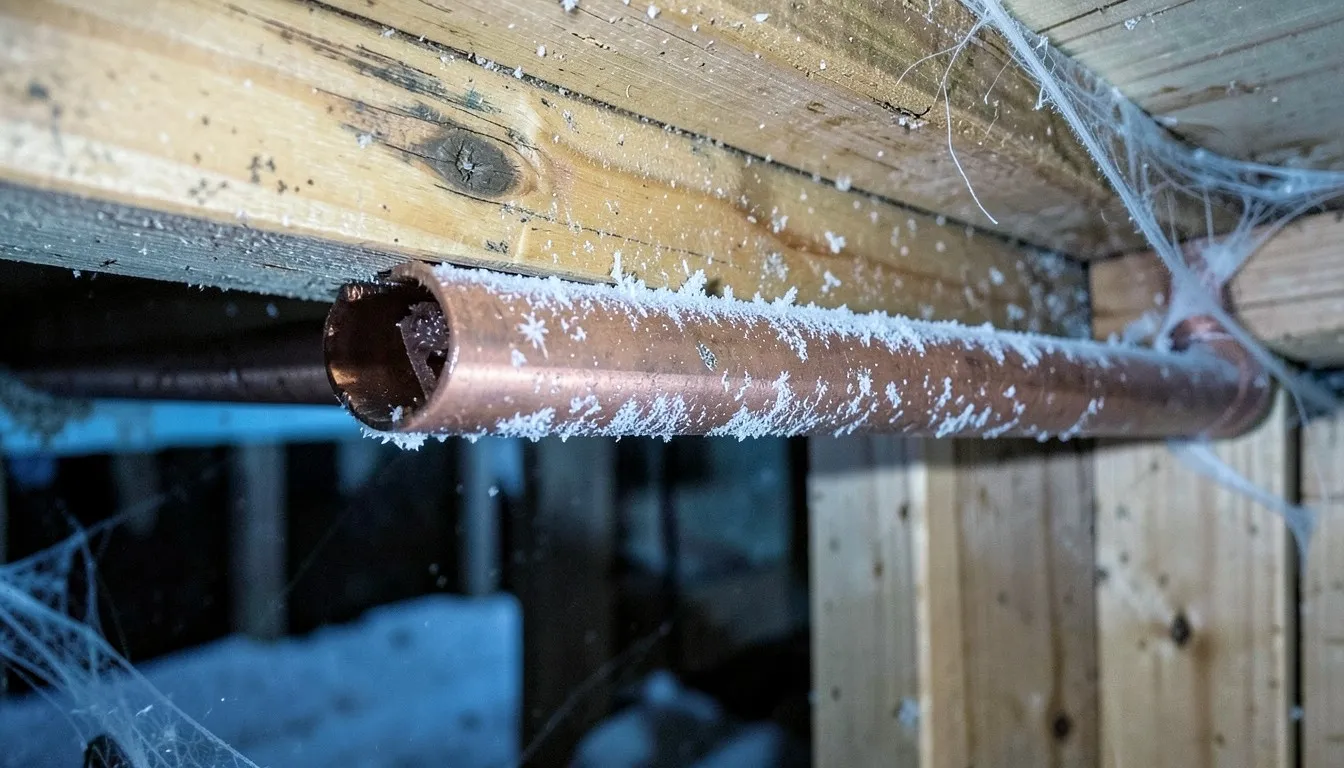
The primary surge in Aurora runs January–March, with a secondary wave at the spring thaw — when pipes that held through the freeze rupture as pressure is restored above 32°F. Scheduling competition peaks exactly when emergency calls are highest. Homeowners who wait for visible damage compete for the same limited plumber slots at the worst possible time.
Aurora: diagnose first, repair second
Describe the symptom — not the repair. AlertPlumber routes to a CO-licensed plumber trained in diagnostics. The site visit uses camera tracing, acoustic detection, or hydrostatic pressure testing — matched to the reported failure type.
The plumber delivers a written diagnostic report: confirmed failure location, available repair methods, and tradeoffs — disruption level, material durability, long-term cost, and whether a Aurora building permit applies to the selected method.
You select the repair path. The Colorado-licensed plumber proceeds on the authorized method with a fixed scope and price. Where required, the permit application to Aurora is handled by the contractor.
Hydro Jetting cost calculator — Aurora
Pre-filled for hydro jetting in Aurora. Adjust the ZIP for a neighboring area, or change the service to compare. Calculator pulls from the city's scraped permit-fee + state plumber-density data.
Hydro Jetting in Aurora — the longer it runs, the more it costs.
Slow failures compound: soft pipe walls, root penetration, mineral buildup. A verified plumber calls back with a scope-first estimate before anything is dug up.
Hydro Jetting in Aurora — frequently asked
How much does hydro jetting cost in Aurora, CO?
Aurora hydro jetting on the Denver east metro plains is priced by line size, footage, and pipe vintage — not flat-rate. Typical bands: 2"–3" residential branch jet $385–$685; 4" main-line jet through an existing two-way cleanout $585–$985; pre-1940 Original Aurora cast-iron with 80+ years of trans-basin carbonate scale $785–$1,285; vertical-stack jet protocol on an Anschutz Medical Campus area mid-century apartment riser $985–$1,685; mandatory pre-jet camera scope $155–$265 add-on. The $58 City of Aurora Building Division, 2024 plumbing permit is exempt for pure jetting under Colorado-adopted IPC § 707 maintenance scope and only attaches when scope crosses into pipe replacement. AlertPlumber routes to a Colorado DORA Plumbing Board, 2024-credentialed plumber who quotes by phone before dispatch.
What PSI is safe for a 1940s Original Aurora cast-iron stack?
PSI selection is the most consequential decision on any pre-1940 Original Aurora call. Cast-iron drain stacks in the East Colfax corridor are now 80+ years old and have lost wall thickness to 12 gpg Aurora Reservoir + South Platte + Colorado River trans-basin carbonate scale plus interior tuberculation. Standard residential jetters run 4,000 PSI at 4 gpm; on Original Aurora cast-iron that pressure can punch through a thinned wall section. The protocol on pre-1940 stacks: 1,800–2,800 PSI with rotating descaler tip for wall-scour, not centerline punch-through. The pre-jet camera scope grades pipe condition per NASSCO PACP defect codes; a Grade 4 or 5 stack routes to spot-replacement bid rather than higher PSI.
Why is a pre-jet camera scope mandatory on Aurora cast-iron?
Three reasons specific to Aurora housing stock. (1) Pipe-condition grading. The scope produces a NASSCO PACP-coded grade of the stack interior — Grade 1–3 tolerates jetting; Grade 4–5 calls for replacement bid. Jetting a Grade 5 stack at any PSI risks blowout. (2) Failure-mode identification. Trans-basin carbonate scale, root intrusion at a clay lateral joint, an offset joint from 36-inch-frost-line shift across 157 annual freeze days per NWS Boulder, 2024, and a pipe belly all present as "main-line slow drain" but route to different repair scopes. (3) Saddle Rock golf-course irrigation cross-connection risk. Master-planned communities in SE Aurora occasionally have legacy irrigation cross-connections that show up as unexpected pressure at sewer cleanouts; the scope confirms whether jetting will load the sanitary side or push backflow into the irrigation main.
Does 12 gpg Aurora Reservoir trans-basin water make jetting worth it on Highline Villages tract?
Yes — and the math is specific to Aurora Water's source mix. Aurora Water, 2024 blends Aurora Reservoir, South Platte River, and Colorado River trans-basin diversions delivered to 386,261 east-metro residents at roughly 12 grains per gallon — USGS hardness classification puts that at "hard." Highline Villages 1970s-80s cast-iron stacks along the Highline Canal corridor are now 40–50 years into accumulating chalky trans-basin carbonate residue. A cable snake punches a clear path through center bore; a hydro jet at 2,400–3,200 PSI strips the wall buildup the cable just bypassed. Households recovering full bore extend mean-time-between-clog from ~14 months on cable-only to ~5 years on jet-with-descaler-tip.
How long does an Aurora hydro jet job take?
Time-on-site bands by job type on the Denver east metro plains. 2"–3" residential branch jet: 90–150 minutes including setup, jetting, flow test, cleanup. 4" main-line jet through existing cleanout: 2–3.5 hours including pre-jet scope plus post-jet scope. Pre-1940 Original Aurora cast-iron stack with carbonate descaling: 3.5–5 hours — the wall-scour at 1,800–2,800 PSI takes longer than centerline punch-through. Anschutz Medical Campus area mid-century apartment vertical-stack protocol: 4–6 hours, scheduled off-peak and coordinated with the building manager. Add 30–60 minutes anywhere a cleanout has to be located or installed, common on pre-1960 stock that predates current two-way cleanout code under IPC § 708.
How fast can an Aurora plumber arrive for an emergency main-line backup?
Most Aurora plumbers in the AlertPlumber network respond within 1–3 hours during business hours and 2–4 hours overnight for an emergency main-line backup needing a jet. ETA depends on sub-market — Original Aurora, the Anschutz Medical Campus area, and Highline Villages dispatch faster than Tallyn's Reach near E-470 because crew density tracks the older I-225 corridor. The Colorado DORA Plumbing Board–credentialed plumber confirms the exact ETA on the callback, and a same-day jet typically requires the cleanout to be accessible and pre-jet camera scope to confirm pipe condition before pressure goes in the line.
Do I need a permit for hydro jetting in Aurora?
No. Hydro jetting is classified as maintenance under IPC § 707 maintenance procedures as adopted by the City of Aurora Building Division — jetting, descaling, and camera scoping a line do not trigger the $58 Aurora plumbing permit. The permit attaches the moment scope crosses into pipe replacement, fixture re-pipe, cleanout installation, or any code-altering work, and the plumber pulls it and includes the fee in the written quote. 4,200 residential plumbing-touching permits issued by the City of Aurora Building Division in 2024 reflects that split — pure jet/scope clears without permit while replacement scope properly enters the system.
What pipe materials in Aurora can be safely hydro jetted?
Material-by-material protocol on the Denver east metro plains. PVC (Saddle Rock 1990s-2000s, Tallyn's Reach 2000s+, newer Anschutz infill): tolerates standard 4,000 PSI, 4 gpm residential jetting with rotating tip. ABS DWV (some 1980s tract): standard PSI fine; avoid sustained high-temp water injection. Cast-iron, intact (Highline Villages 1970s-80s, mid-century Anschutz area): 2,400–3,200 PSI with descaler tip — wall-scour the trans-basin carbonate. Cast-iron, 80+ years (Original Aurora pre-1940 East Colfax corridor): 1,800–2,800 PSI with rotating descaler, mandatory pre- and post-jet camera scope. Clay sewer lateral (pre-1960 lateral runs): low-PSI flush only after root-cutter pass; the joint offsets driven by 36-inch frost-line freeze-thaw cycles can't tolerate concentrated force at the joint.
Should I jet my Aurora kitchen line for chronic FOG buildup?
Yes — kitchen branch lines are the highest-payback jetting target in any Aurora housing era. Cable snakes punch through grease plugs but leave the FOG layer on the pipe wall, which re-narrows in weeks. A 2,400–2,800 PSI rotating-tip jet on the 2" kitchen branch strips the wall, and the post-jet camera confirms full bore restoration. Bands: $385–$685 for a kitchen branch jet on PVC or intact cast-iron; $585–$885 if the branch ties into a pre-1940 Original Aurora stack that needs the lower-PSI descaler protocol. Combined with periodic enzyme treatment between calls, kitchen branch mean-time-between-clog extends from a few months to 3–5 years.
Are AlertPlumber-matched plumbers verified for hydro jetting in Aurora, CO?
The partner network requires every plumber routed through AlertPlumber in Aurora to maintain active Colorado state-credentialed status. Colorado DORA Plumbing Board, 2024 lists 8,400 active CO DORA credentials statewide. AlertPlumber doesn't independently verify each plumber on a per-call basis — homeowners are encouraged to confirm credentials with the state board directly via the link above before authorizing any work. Aurora Water is a separate municipal utility from Denver Water, so make sure the contractor knows the specific east-metro service-area protocols before any cleanout or main-tap jet work.
Will my Colorado homeowners insurance cover hydro jet damage in Aurora?
Standard Colorado HO-3 policies do NOT cover routine hydro jetting — that's maintenance. They do typically cover water damage caused by a clog-driven backup (drywall, flooring, mold remediation) subject to deductible, only if you carry the optional water/sewer backup endorsement. In Aurora the endorsement runs $55–$135/year for $5,000–$15,000 of backup coverage. The risk specific to jetting: a Grade 4–5 pre-1940 Original Aurora cast-iron stack can blow out under any PSI — that's why the pre-jet camera scope is mandatory. If a blowout occurs without a documented pre-jet scope, the property insurer can deny on workmanship grounds. The Colorado DORA Plumbing Board–credentialed plumber documents the scope + invoice naming the failure mode — verbal diagnoses get denied. File within 30 days. 99% of the city is on municipal sewer per Aurora Water reporting.
Does my Aurora neighborhood's housing stock change the jetting approach?
Yes — five distinct Aurora sub-markets, each with a different jetting protocol. Original Aurora (pre-1940 East Colfax core). Cast-iron + clay lateral, 1,800–2,800 PSI descaler protocol only, mandatory pre/post scope. Highline Villages (1970s-80s tract along Highline Canal corridor). Intact cast-iron, 2,400–3,200 PSI with descaler tip for trans-basin scale. Anschutz Medical Campus area (Fitzsimons redevelopment). Mixed mid-century + 2010s+ infill — scope-first; protocol varies block-by-block. Saddle Rock (1990s-2000s SE Aurora master-planned). PVC/PEX, standard 4,000 PSI residential jetting; watch for legacy golf-course irrigation cross-connection. Tallyn's Reach (2000s+ master-planned near E-470). Newer code-compliant PVC, standard PSI; jetting rarely needed since smooth-bore PVC doesn't scale.
When does a single Aurora jet job escalate to a recurring maintenance schedule?
Escalation triggers the Colorado DORA Plumbing Board–credentialed plumber will name on-site. One-time jet stays one-time when post-jet scope shows Grade 1–2 pipe condition and a clear point-cause (one-time grease event, a single FOG plug). One-time jet escalates to annual maintenance when (a) the home is pre-1990 with cast-iron stacks in Original Aurora, Highline Villages, or the Anschutz Medical Campus area, (b) 12 gpg Aurora Reservoir trans-basin scale is visible on the wall after first pass, or (c) the household generates concentrated FOG (frequent home cooking, large household). Annual maintenance escalates to spot-replacement bid when NASSCO grading hits 4 or 5 — collapse, offset, or significant root mass at a clay lateral joint typical of pre-1960 Aurora stock. 386,261 residents per U.S. Census Bureau, 2024 on the Buckley Space Force Base region of the Denver east metro plains.
The fix gets cheaper the sooner a plumber sees it.
Degradation problems compound quietly. Call now, or use the form below and a licensed Colorado plumber calls you back with a no-obligation estimate for the hydro jetting.
Request a hydro jetting callback in Aurora
In a meeting, with the kids, or just prefer not to hold? Drop your ZIP and number below. AlertPlumber routes your request to a verified plumber in your area — they’ll call you back directly.
- 1 Submit your info. ZIP, phone, and what kind of work you need.
- 2 AlertPlumber matches you with a verified plumber serving your area.
- 3 The plumber calls you back with a written estimate, no obligation.
Hydro Jetting in Aurora — catch it early
Degradation-driven failures worsen over time and cost more to fix the longer they run. A verified CO plumber in Aurora diagnoses your specific condition and provides a written scope before any work begins.