
Sewer Lateral
Underground pipe carrying wastewater from the house to the city sewer main; ownership boundary varies by municipality.
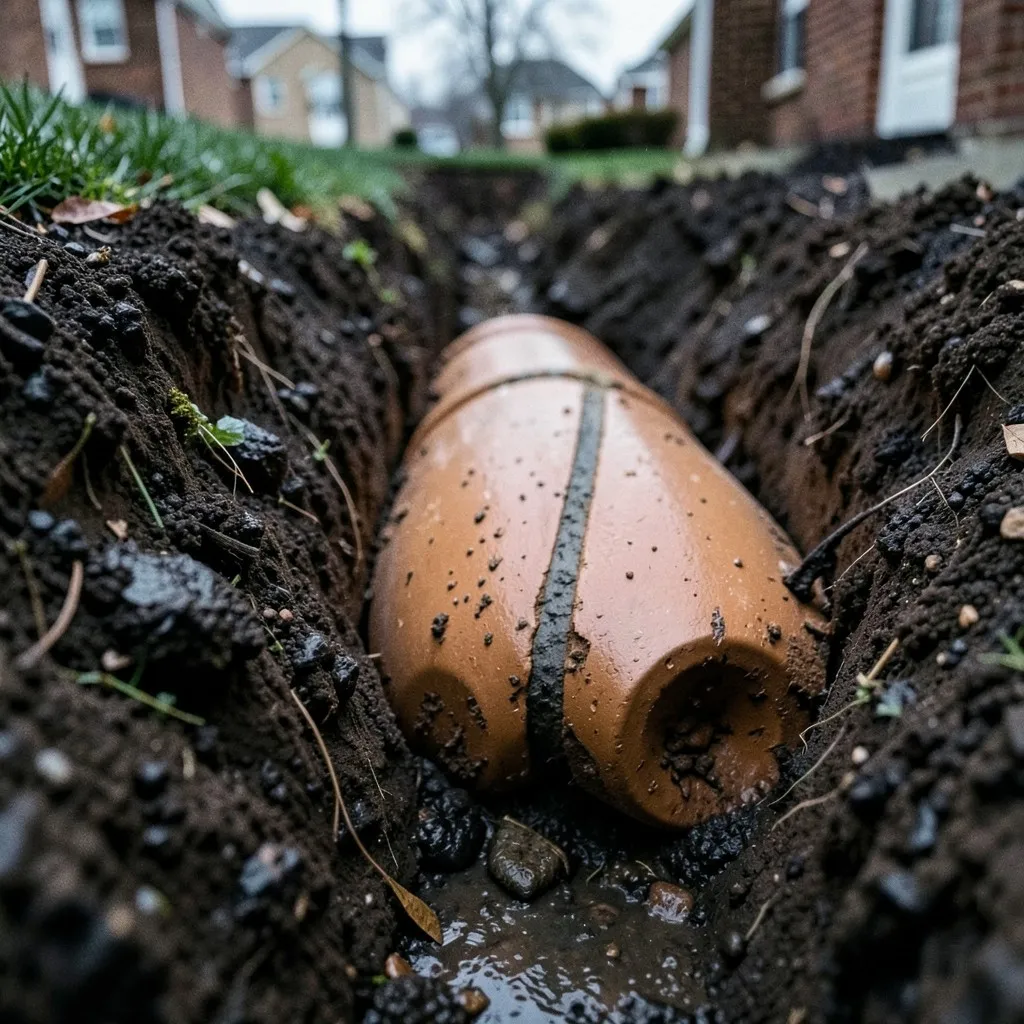
The sewer lateral (also called the building sewer or house lateral) is the underground pipe that carries wastewater from a building drain at the foundation out to the public sewer main in the street or easement. It is the single longest run of drain pipe on most properties and is almost always the homeowner's responsibility for some portion of its length. Diameter is typically 4 inches for single-family homes, 6 inches for small multi-family, with material ranging from clay tile and cast iron in older construction to PVC, ABS, or HDPE in modern installations.
Who owns the sewer lateral, the homeowner or the city?
The dividing line between homeowner-owned lateral and municipality-owned main varies by city. Three common models exist. (1) Property line: the homeowner owns from the building to the property line, and the city owns from the property line to the main. This is the most common model. (2) Curb stop or wye: the homeowner owns to the wye connection at the city main; everything to the main itself is private. This is common in older Eastern cities and puts the homeowner on the hook for the most expensive section. (3) Building only: the city owns everything outside the building footprint. Local utility ordinances or municipal code spell out which model applies, and the answer materially changes who pays for repair or replacement.
What are the common failure modes of a sewer lateral?
Tree-root intrusion is the dominant failure mode in laterals more than 20 years old. Roots enter at hub-and-spigot joints in older clay or cast-iron pipe, then expand and crack the pipe wall. Cracks and offsets allow soil infiltration, eventually forming a partial or full blockage. Bellying or sagging occurs when settling soil drops a section of pipe out of grade, creating a low spot that traps solids and slows flow. Channeling in cast iron is the loss of the bottom half of the pipe wall to corrosion, leaving only a half-pipe trough. Offset joints from soil shift snag wipes, paper, and grease.
How is a sewer lateral problem diagnosed?
Inspection is by camera (CCTV) push from a cleanout, with NASSCO-PACP coding used to grade the severity and type of each defect on a 1 to 5 scale. The same camera locates the depth and horizontal position of the pipe so excavation or trenchless work can be scoped. A static or smoke test confirms infiltration points.
What does sewer lateral replacement involve?
Open-cut excavation removes and replaces the entire run from the cleanout to the city tap. Trenchless options include pipe bursting (pulling a new HDPE pipe through the old line while a bursting head fractures the old pipe outward) and cured-in-place pipe (CIPP) lining (inverting a resin-saturated felt sleeve into the old pipe and curing it in place to form a new structural pipe wall). Trenchless preserves landscaping and hardscape but requires a reasonably intact host pipe and is not always permitted by the AHJ for full replacement.
Code reference: IPC Section 708 and UPC Section 718 cover building sewer materials, slope (typically 1/4 inch per foot for 4-inch pipe), cleanout spacing, and cover depth. NASSCO-PACP is the industry-standard inspection grading system referenced by most municipalities.
Researching the term is one thing — hiring for it is another. See sewer line repair services for scope, timelines, and what drives the price, or call (888) 530-4445 for a no-cost estimate.
For the full picture — materials, process, timelines and what drives the cost — read Sewer Line Repair: The Complete Guide.
What related terms should you know?
What sources back this up?
Need a verified plumber for sewer line repair?
AlertPlumber matches you with a licensed plumber for sewer line repair. Written estimate before any work begins.