
Compression Fitting
A plumbing connector that joins pipes without soldering — a compression nut and ferrule (ring) compress against the pipe to create a watertight seal.
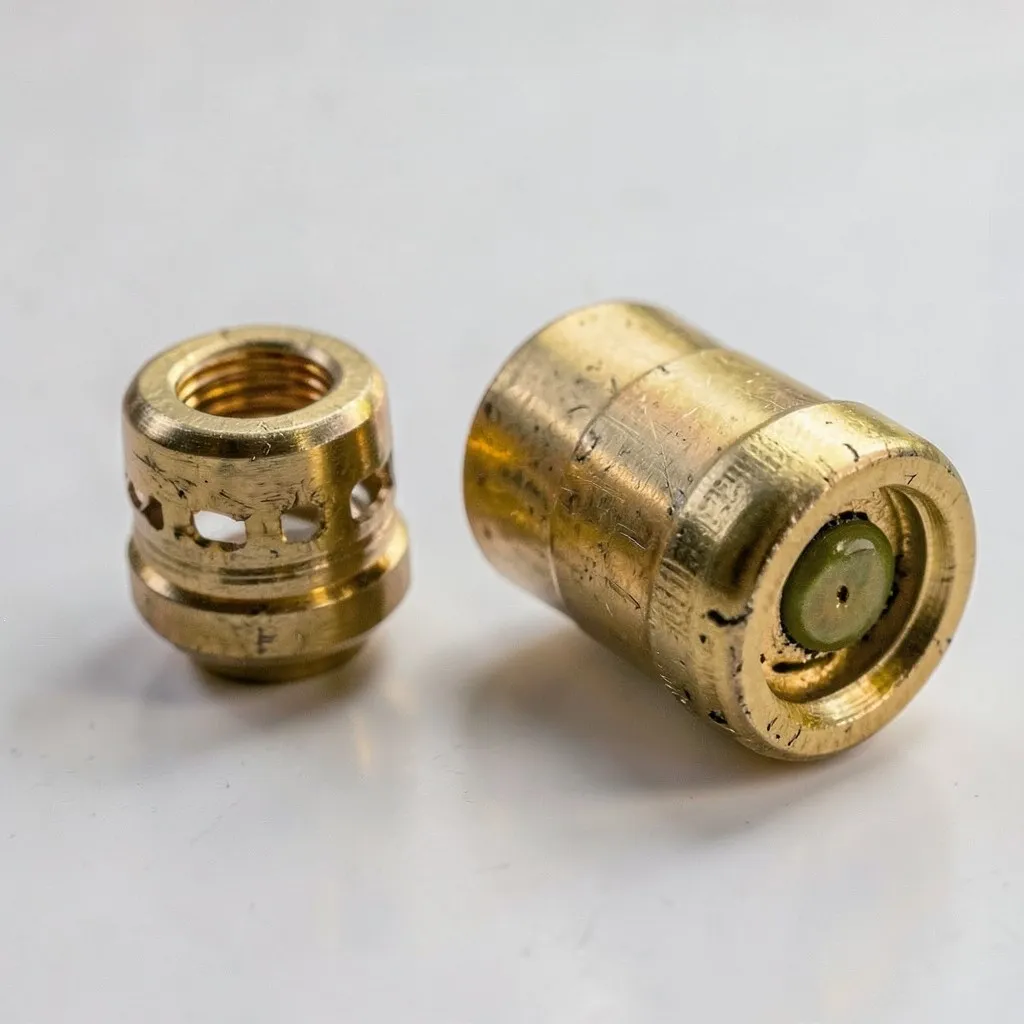
A compression fitting is a type of pipe connection that creates a watertight seal through mechanical compression — no soldering, gluing, or crimping required. The fitting consists of three parts: the fitting body, a compression nut, and a ferrule (a small brass or plastic ring). As the nut tightens, it squeezes the ferrule against the pipe and the fitting body, sealing the joint through deformation.
How do compression fittings work?
- Slide the compression nut onto the pipe (threads facing the fitting), then slide on the ferrule.
- Insert the pipe into the fitting body until it seats fully.
- Hand-tighten the nut, then tighten with a wrench — typically 1¼ turns past hand-tight for copper, ¾ turn for plastic.
- The ferrule deforms slightly, locking onto the pipe and sealing against the fitting body.
Where are compression fittings used?
- Supply line connections at angle stops and fixture valves
- Connecting flexible supply tubes to rigid copper stub-outs
- Saddle valves (ice maker connections)
- Underground gas service connections (with gas-rated fittings)
- Whenever soldering isn't practical (e.g., near flammable materials)
What are the pros and cons of compression fittings?
Pros: no special tools, no heat, no skill required beyond basic wrench work. Works on copper, PEX, CPVC, and plastic tubing. Cons: not suitable for high-vibration applications; cannot be easily removed and re-used (the ferrule deforms permanently). Over-tightening cracks fitting bodies; under-tightening causes drips.
Compression or push-fit — which should you use?
Push-fit fittings (like SharkBite) are faster and fully removable, but cost more per fitting. Compression fittings are lower cost, proven over decades, and standard at fixture connections. For supply-line work at shutoff valves, compression is the traditional choice; push-fit is increasingly common for DIY applications.
Researching the term is one thing — hiring for it is another. See whole-home repipe services for scope, timelines, and what drives the price, or call (888) 530-4445 to talk to a local plumber about the job.
For the full picture — materials, process, timelines and what drives the cost — read Whole-Home Repipe: The Complete Guide.
What related terms should you know?
What sources back this up?
Need a plumber for whole-home repipe?
Calls are connected to independent licensed local plumbers in our partner's network for whole-home repipe. Ask for the license number and a written estimate before any work begins.