
ABS Pipe (Acrylonitrile Butadiene Styrene)
Black rigid plastic pipe for drain, waste, and vent service; one-step cement; common in Western U.S. residential.
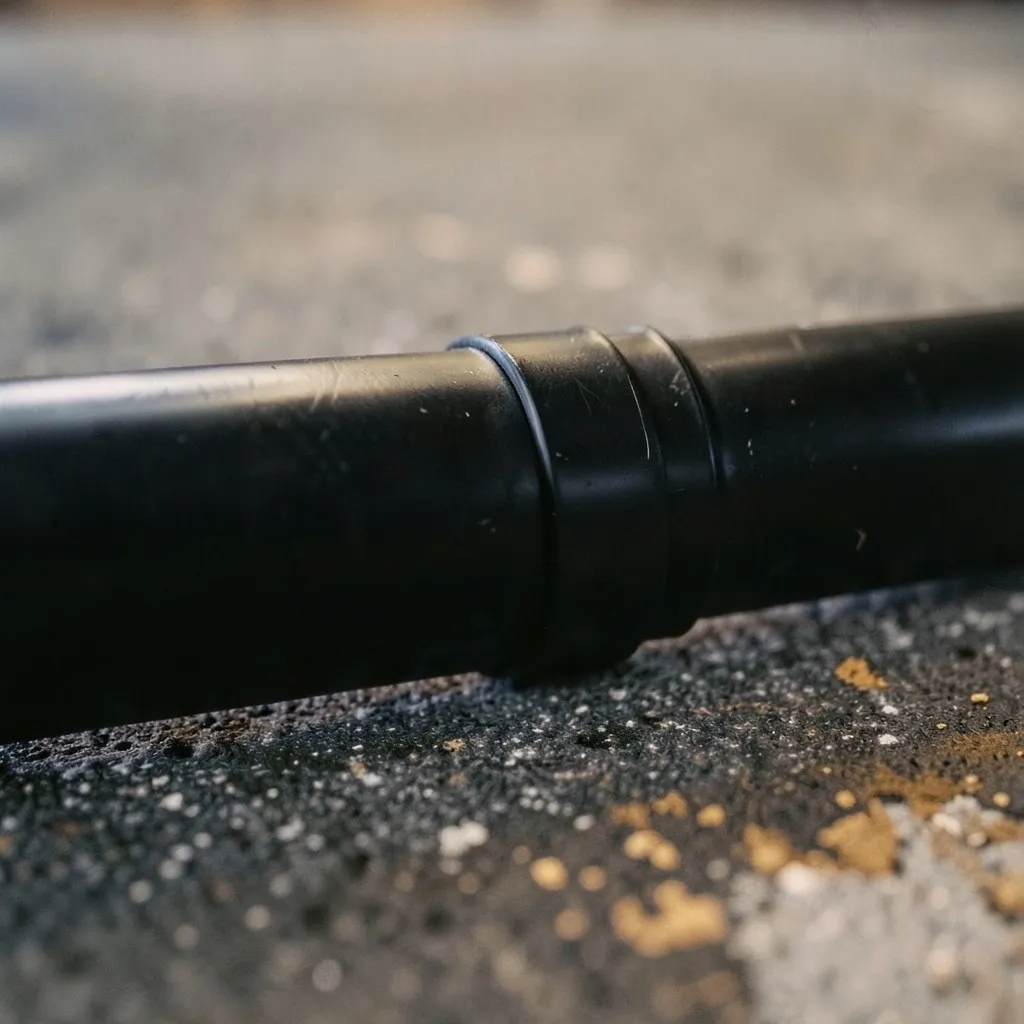
ABS stands for Acrylonitrile Butadiene Styrene, a thermoplastic polymer used almost exclusively for non-pressurized drain, waste, and vent (DWV) plumbing in residential construction. ABS pipe is uniformly black, distinguishing it at a glance from white PVC. It dominates residential DWV in the Western U.S. (notably California, Oregon, Washington, Arizona, and Nevada), while PVC is more common in the Midwest, South, and Northeast. Both materials carry the same waste flows and meet the same DWV performance requirements; the regional split is largely historical and code-driven rather than functional.
How do you identify ABS pipe?
ABS is matte black with a slight surface texture and is stamped with the manufacturer, nominal size, ASTM standard (typically ASTM D2661 for pipe and fittings or ASTM F628 for cellular-core foam-filled pipe), and the DWV designation. Foam-core ABS has a sandwich construction with a solid skin and a foamed interior layer for weight and cost reduction; it is recognized for above-grade DWV but is not permitted for buried service in many jurisdictions. Fittings are also black and are sold in DWV patterns (long-sweep elbows, sanitary tees, combination wye-and-eighth-bends) suited to gravity drainage.
Joints and assembly: ABS uses a single-step solvent cement (typically yellow or amber) with no primer required. The cement softens the surface and chemically welds the joint in one operation, which speeds installation compared to two-step PVC work. Cement must be ABS-specific; PVC cement does not produce a sound joint on ABS, and vice versa. Dual-purpose cements labeled for ABS-to-PVC transitions exist but are restricted by code in many jurisdictions to a specific transition coupling.
Can ABS pipe be joined directly to PVC?
The IPC and UPC both prohibit chemically cementing ABS directly to PVC because the materials have different thermal expansion coefficients and the joint fails over time. Where an ABS-to-PVC transition is unavoidable (often where an existing ABS DWV stack ties into a buried PVC sewer lateral), a mechanical no-hub coupling, banded shielded coupling, or threaded transition fitting is required. AHJs commonly cite this on inspection.
How long does ABS pipe last and how does it fail?
ABS has a 40 to 80 year design life when protected from UV. Direct sunlight degrades the pipe surface, causing chalking, brittleness, and longitudinal cracking. Earlier ABS production runs (mid-1980s to early 1990s) included some defective batches subject to class-action settlement that exhibited premature cracking; visual inspection and pressure testing are used to identify them. Mechanical impact, frozen blockages, and over-aggressive snaking can also fracture brittle older pipe.
What does ABS pipe replacement involve?
Spot repairs use a coupling and a replacement length, joined with ABS cement. Full DWV replacement is scoped from the building drain through the roof vent terminations.
Code reference: IPC Section 702 and UPC Section 701 recognize ASTM D2661 ABS for DWV. ASTM F628 covers foam-core. ASTM D2235 governs the solvent cement.
Researching the term is one thing — hiring for it is another. See sewer line repair services for scope, timelines, and what drives the price, or call (888) 530-4445 for a no-cost estimate.
For the full picture — materials, process, timelines and what drives the cost — read Sewer Line Repair: The Complete Guide.
What related terms should you know?
What sources back this up?
Need a verified plumber for sewer line repair?
AlertPlumber matches you with a licensed plumber for sewer line repair. Written estimate before any work begins.