
Cast Iron Pipe
Heavy iron drain, waste, and vent piping used in homes built before 1980, with 75 to 100 year typical lifespan.
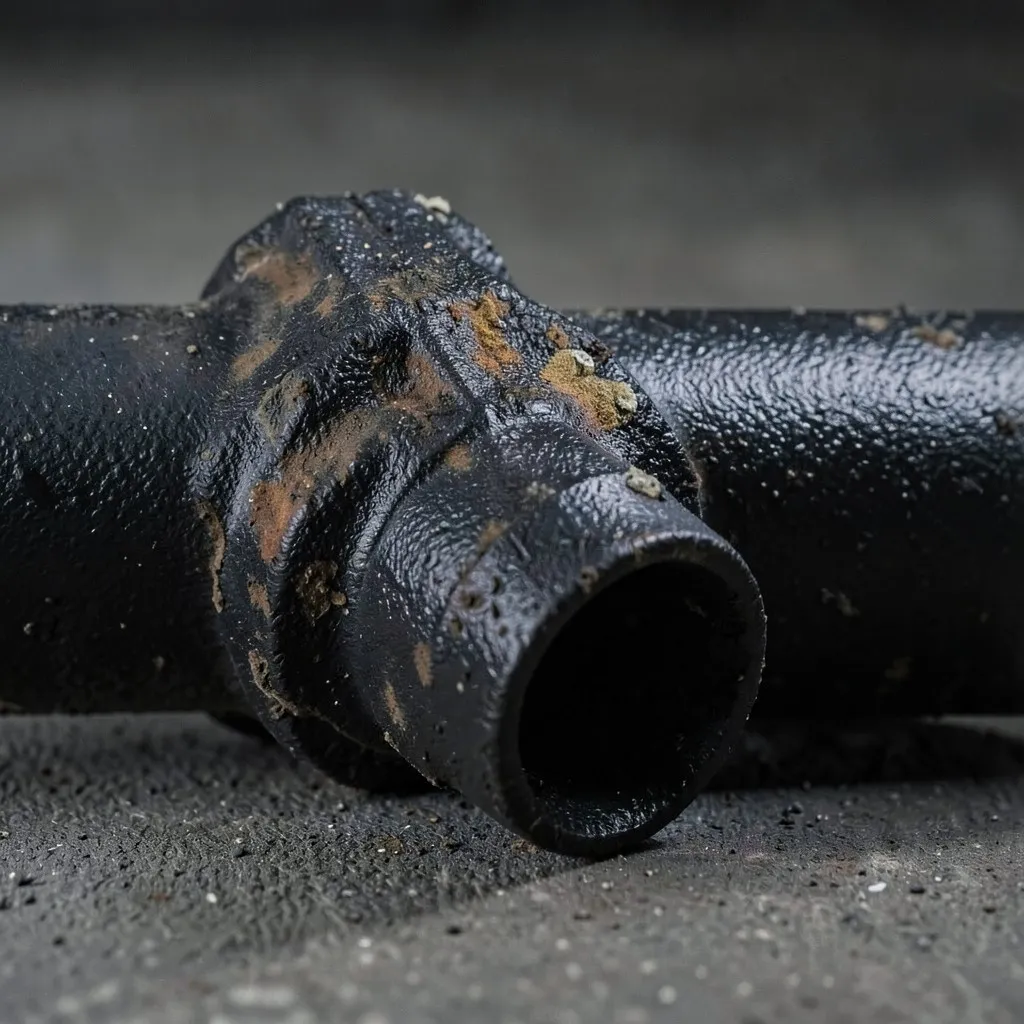
Cast iron pipe is heavy, gray, sand-cast iron piping used for drain, waste, and vent (DWV) systems. From the late 1800s through the 1970s it was the standard material for vertical waste stacks, horizontal drain lines, and underslab building drains in American homes and commercial buildings. Cast iron is valued for its durability, its quiet operation under flowing water (it dampens sound far better than PVC), and its high resistance to fire and crushing loads. Many cast iron systems installed in the early 1900s remain in service today, though most are nearing the end of their useful life.
How do you identify cast iron pipe?
Cast iron pipe is dark gray to black, has a rough sand-cast exterior texture, and is significantly heavier than PVC or ABS of the same diameter. Two joining systems are common. Hub-and-spigot pipe has a flared bell (hub) on one end and a plain spigot on the other; the joint is sealed with oakum and molten lead, or in newer installations with a compression neoprene gasket. No-hub (or hubless) pipe has plain ends joined by a stainless steel band clamp tightened over a neoprene sleeve. A magnet sticks firmly to cast iron, distinguishing it from any plastic pipe at a glance.
How long does cast iron pipe last, and how does it fail?
Typical service life is 75 to 100 years above grade and 50 to 80 years below grade, with significant variance based on soil conditions, water chemistry, and the volume of corrosive waste passing through. The dominant failure modes are interior scale buildup that restricts flow (especially in horizontal runs that carry grease, soap, and laundry detergent), channeling along the bottom of the pipe where standing water and chlorides eat through the wall from the inside, root invasion at hub joints where the lead seal has degraded, and complete pipe collapse in underslab sections from external soil pressure on a corroded wall. Sewer camera inspection, scored on the NASSCO PACP scale, is the standard diagnostic for grading remaining service life.
When should cast iron pipe be replaced?
Spot repairs at accessible joints can run $400 to $1,200 per location. Full replacement of a vertical waste stack typically runs $2,500 to $7,500 depending on accessibility through walls and floors. Underslab cast iron replacement is the most expensive scenario, often $5,000 to $25,000 because of jackhammering, excavation, and slab restoration. Pipe lining (cured-in-place pipe, or CIPP) is an alternative for some underground sections and runs $80 to $250 per linear foot. Replacement triggers include repeated drain backups, sewer gas odors that indicate joint failure, or PACP grade 4 or 5 findings on a camera inspection.
What code governs cast iron pipe?
Cast iron remains an approved DWV material under IPC Section 702.1 and ASTM A888 (hubless) and ASTM A74 (hub-and-spigot). NASSCO PACP standards govern condition assessment.
Researching the term is one thing — hiring for it is another. See sewer line repair services for scope, timelines, and what drives the price, or call (888) 530-4445 for a no-cost estimate.
For the full picture — materials, process, timelines and what drives the cost — read Sewer Line Repair: The Complete Guide.
What related terms should you know?
What sources back this up?
Need a verified plumber for sewer line repair?
AlertPlumber matches you with a licensed plumber for sewer line repair. Written estimate before any work begins.