
Emergency Slab Leak Repair in San Diego, California
Detects and repairs leaks in pipes beneath the concrete slab foundation. AlertPlumber matches you with a verified CA plumber serving San Diego.
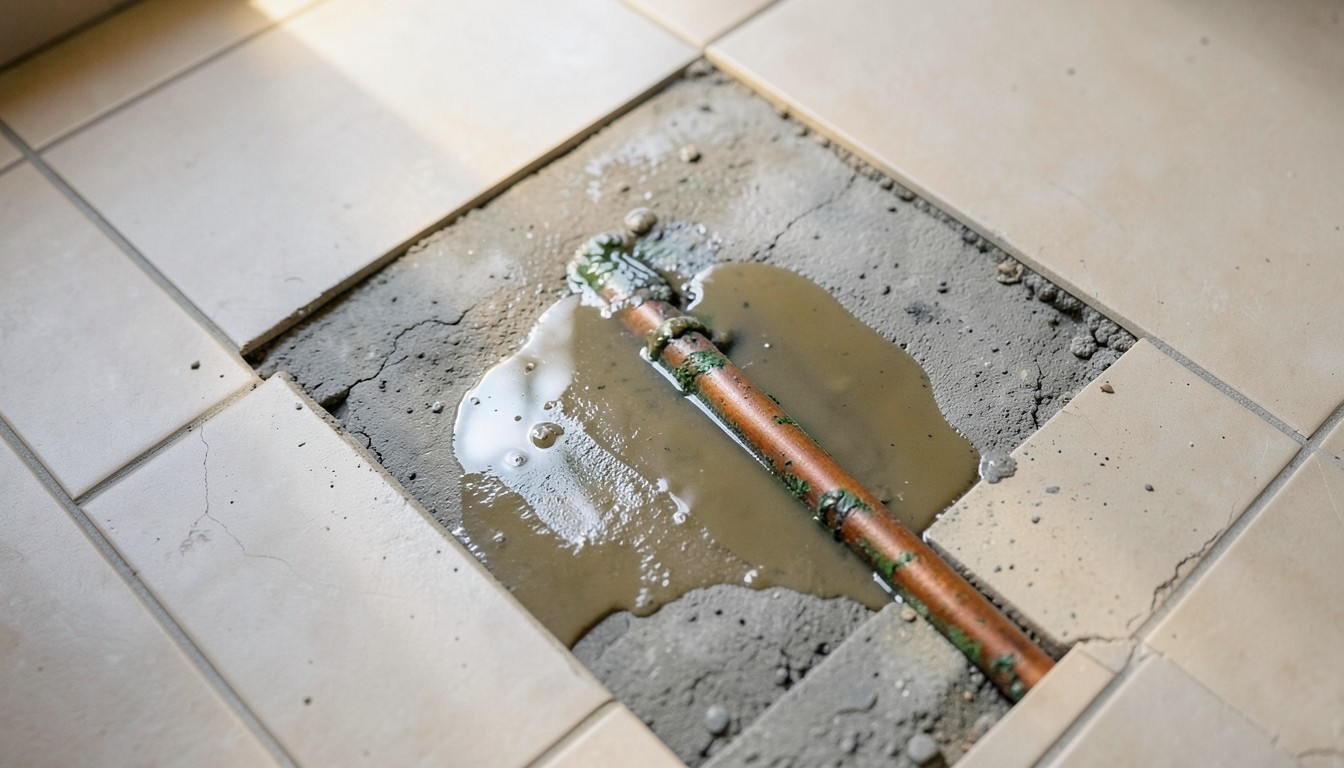
Local plumbing data for San Diego, CA
Climate angle. Coastal salt-air corrosion accelerates pipe + fitting wear; 1970s-80s slab tracts (Mira Mesa, Rancho Penasquitos) have copper-in-slab pinhole patterns. Drought-driven low-flow retrofits + greywater systems are common renovation triggers.
Slab Leak Repair cost calculator — San Diego
Pre-filled for slab leak repair in San Diego. Adjust the ZIP for a neighboring area, or change the service to compare. Calculator pulls from the city's scraped permit-fee + state plumber-density data.
Slab Leak Repair in San Diego — frequently asked
How much does slab leak repair cost in San Diego?
San Diego slab leak repair pricing in 2026 sits in three tiers tied to the failure pattern in Mission Valley and Clairemont 1950s-70s tract stock — the city's densest concentration of Type M copper-in-slab supply. Spot repair runs $1,500–$3,300 (jackhammer one slab section, splice in a copper or PEX-A coupling, dry-pack concrete patch). Reroute through walls or attic runs $2,400–$5,500 (abandon the failed slab branch, run new PEX-A overhead from manifold to fixture). Full PEX-A repipe of a 3-bath La Jolla or North Park home runs $4,800–$14,500 — the durable answer once multiple pinholes have surfaced. The $195 San Diego Development Services permit applies to any supply-line work and is pulled by the state-credentialed California plumber before the slab is opened. Coastal La Jolla and Coronado homes with finished travertine, terrazzo, or original 1920s tile push the high end on tear-out + restoration. The written quote should itemize detection, demolition, repair, concrete patch, and permit fee separately so the line items match what HO-3 carriers reimburse.
How do I know if I have a slab leak in my San Diego home?
Mission Valley and Clairemont 1950s-70s slab homes show a consistent symptom set when copper-in-slab supply starts to pinhole. Watch for:
- Warm patch on the floor — hot-side leaks dominate at 7-9 gpg moderate-hard Colorado River blend, and the slab transmits heat directly through tile or LVP
- Public Utilities Department water bill spike of $45–$130/month with no household-use change (drought-tier surcharges amplify the dollar impact in San Diego)
- Meter low-flow triangle creeping with every fixture and irrigation valve closed
- Faint hiss near the water heater closet between 1 and 4 a.m. when ambient is quiet
- Marine-layer humidity inside the home rising even with windows shut — slab moisture wicking up through grout
- Hairline cracks radiating from a single point in tile, terrazzo, or original 1930s North Park craftsman flooring
Why are slab leaks common in San Diego homes built before 1995?
San Diego's pre-1995 housing stock concentrates the failure mode. Mission Valley, Clairemont, Allied Gardens, and the Linda Vista 1950s-70s tract build-out used Type M copper supply run directly through the slab — standard mid-century practice, now the dominant pinhole pattern in the county. North Park, South Park, and Hillcrest 1920s-30s craftsman bungalows show different failure curves (galvanized + early copper retrofitted into slab additions). The Pacific marine-layer + salt-aerosol corrosion penalty is real within roughly 1 mile of the coast — La Jolla, Pacific Beach, Ocean Beach, and Coronado see roughly 2x the external-corrosion rate on copper fittings per marine-air guidance, and the slab edge is where airborne chloride meets the supply line. Internally, the 7-9 gpg Colorado River + Lake Hodges + Lake Murray blend delivered by the San Diego Public Utilities Department drives standard hot-side pinhole chemistry — not as aggressive as hard-water inland markets but compounded by the 50-year median home age. Per Copper Development Association, Type M copper in conditioned slab applications enters the 30–50 year failure window — the bulk of San Diego's pre-1995 supply stock is now inside that band.
Spot repair, reroute, or full repipe — which fits my San Diego home?
The right answer depends on neighborhood vintage and how many pinholes have surfaced. Spot repair ($1,500–$3,300): correct for a single first-time leak on otherwise-sound Type M copper in a Clairemont or Allied Gardens 1960s tract — open the slab, splice, patch, document with photos for the next owner's disclosure. Reroute ($2,400–$5,500): correct when a single branch (kitchen island, hall-bath group) has failed and overhead access through walls or the shallow San Diego attic is feasible — common in Mission Valley split-level + Tierrasanta 1970s tract. Full PEX-A repipe ($4,800–$14,500): correct when 2+ slab leaks have surfaced inside 24 months, when North Park / South Park / Hillcrest 1920s-30s craftsman shows multi-branch corrosion, or when a La Jolla or Coronado coastal-luxury home is being opened up for a kitchen or primary-bath remodel anyway and the pipe disturbance is sunk cost. Per Copper Development Association, the 2-pinhole-in-24-months pattern signals the full copper system has reached end-of-life — spot-fixing further leaks rarely pencils out against repipe.
Does California HO-3 + earthquake-rider cover San Diego slab leak detection?
Most California HO-3 policies covering San Diego homes reimburse the detection fee when the underlying leak is documented as "sudden and accidental" rather than gradual seepage — the verified plumber's written moisture-mapping report is the load-bearing document. Tear-out and access (slab cut, tile demo, wall opening) is typically covered; the failed copper pipe itself is excluded as wear-and-tear. State Farm, Farmers, AAA, and USAA reimburse San Diego County detection invoices regularly when paired with thermal-imaging and acoustic-detection findings. California earthquake riders (CEA or private) sit separately — they cover earthquake-triggered slab cracks but do not pay for corrosion-driven pinholes. Coronado and La Jolla coastal-luxury policies sometimes carry endorsement language specific to marine-air corrosion exclusions; read the wear-and-tear clause carefully on those. Submit the credentialed plumber's written diagnostic report with the claim — verbal-only diagnosis is the #1 cause of denial in the San Diego market.
How long does San Diego slab leak repair take?
Detection workup at the home: 60–120 minutes (pressure-isolation test, FLIR thermal imaging, acoustic triangulation, electronic line-trace). Spot repair on a Clairemont or Mission Valley single-leak job: 4–7 hours start to finish, with whole-house water off for roughly 4 hours of that window. Reroute through walls or attic: 1–2 days depending on branch length and Tierrasanta-style finished-ceiling restoration. Full PEX-A repipe of a typical 3-bath San Diego home: 2–3 days; La Jolla or Coronado coastal-luxury homes with original 1920s-40s tile, plaster, and crown moulding stretch to 4–5 days because of preservation-grade restoration. Concrete cure on slab patches: 24–48 hours before tile or terrazzo finish work resumes. San Diego's near-zero freeze risk (under 2 days/year below freezing per NOAA NWS San Diego) means there's no winter weather pressure on the schedule — the matched verified plumber sequences whole-house shutoff to the shortest practical window.
How does La Jolla or Coronado coastal-luxury preservation change the slab leak job?
La Jolla and Coronado coastal-luxury homes — many of them 1900s-40s historic stock with original Spanish Colonial Revival, Craftsman, or Mid-Century architecture — push slab leak work into a different category from standard Mission Valley tract repair. Three constraints drive that: (1) original tile, terrazzo, oak parquet, and plaster cannot be sourced new, so the verified plumber sequences slab cuts to preserve as much original material as possible and coordinates with restoration trades who can lift and reset historic flooring. (2) Pacific salt-aerosol corrosion within 1 mile of the coast roughly doubles the external-fitting failure rate per marine-air guidance, so detection scope expands to map all at-risk branches before any concrete opens. (3) Coronado and La Jolla Historic Resources Board review applies to certain designated structures — the $195 Development Services permit may need supplemental historic-resource sign-off before exterior or visible-interior work proceeds. The credentialed plumber routed through the network for these homes typically defaults to overhead PEX-A reroute over slab spot-repair when access allows, because every additional slab cut compounds the preservation cost.
What about Carmel Valley, 4S Ranch, and Otay Ranch — are slab leaks rare there?
Yes — and the reason is plumbing era, not geography. Carmel Valley, 4S Ranch, Del Sur, Pacific Highlands Ranch, and Otay Ranch were built out from the mid-1990s through the 2010s on PEX-A supply lines from day one rather than copper-in-slab. PEX-A is corrosion-immune to the 7-9 gpg Colorado River blend, flexes through minor seismic movement without micro-fracturing, and carries a 25-year manufacturer warranty per PEX Association. The slab leaks that do surface in these neighborhoods are almost always (1) fitting failures at brass crimp connections that were over-torqued during original construction, (2) post-construction settling that stressed an under-slab manifold, or (3) post-2000 remodels where a homeowner or unverified handyman tied copper into the existing PEX system at the water heater closet. Detection workup in Carmel Valley typically isolates to a single fitting rather than mapping a system-wide pinhole pattern — repair cost lands at the low end of the spot-repair range ($1,500–$2,400) because there is no cascading failure to plan around.
What's the San Diego permit + CSLB credential check?
San Diego slab leak repair touching supply lines requires a $195 Development Services plumbing permit plus inspection — pulled by the verified plumber, not the homeowner, because the permit ties to the credential holder. CA Contractors State License Board, 2024 Q4 lists 19,840 active CSLB C-36 plumbing credentials statewide; San Diego County holds a substantial share given the 1.4M city population plus the broader San Diego County Water Authority service area. Slab leak work specifically requires both the C-36 plumbing credential AND demonstrated experience with concrete cutting, slab patching, and supply repipe — those are not separate credentials but the verified plumber's track record matters. Confirm any specific plumber's CSLB number with the state board lookup before authorizing work. The eLocal partner network requires every plumber routed through AlertPlumber for San Diego slab leak work to maintain active CSLB C-36 status, and the credentialed plumber should hand the permit number, inspection-pass documentation, and moisture-mapping report at job close — those three documents support both insurance reimbursement and future disclosure.
When does full PEX-A repipe pencil out in San Diego?
PEX-A repipe is the durable answer when one of three conditions hits: (1) two or more slab leaks have surfaced inside 24 months — per Copper Development Association, that pattern means the full copper system has reached end-of-life and additional spot repairs become throwing-good-money mathematics; (2) the home is past 30 years on Type M copper-in-slab at 7-9 gpg moderate-hard Colorado River + Lake Hodges + Lake Murray blend — the failure curve steepens after that threshold; (3) detection identifies multiple at-risk hot-side branches even if only one has failed yet. PEX-A run overhead through walls, attic, or chase — never re-buried in the slab — is the standard San Diego repipe geometry. Local context. Pacific marine-layer fog and salt-aerosol corrosion within 1 mile of the coast accelerate external fitting wear in La Jolla, Pacific Beach, and Coronado; Mission Valley and Clairemont 1950s-70s tract concentrates the copper-in-slab pinhole pattern; North Park and South Park 1920s-30s craftsman show mixed-era failure curves; Carmel Valley and 4S Ranch 1990s-2010s infill is PEX-A from the start. With 1,386,932 San Diego residents, 50-year median home age, and 7-9 gpg San Diego County Water Authority blend, the at-risk supply stock sits squarely inside the 30–50 year window per PEX Association. PEX-A in 2026 carries a 25-year manufacturer warranty when installed per spec by a CSLB C-36 credentialed plumber.
Request a slab leak repair callback in San Diego
ZIP, phone, kind of work. AlertPlumber routes to a verified plumber for a free over-phone estimate.