
Emergency Slab Leak Repair in Milwaukee, Wisconsin
Detects and repairs leaks in pipes beneath the concrete slab foundation. AlertPlumber matches you with a verified WI plumber serving Milwaukee.
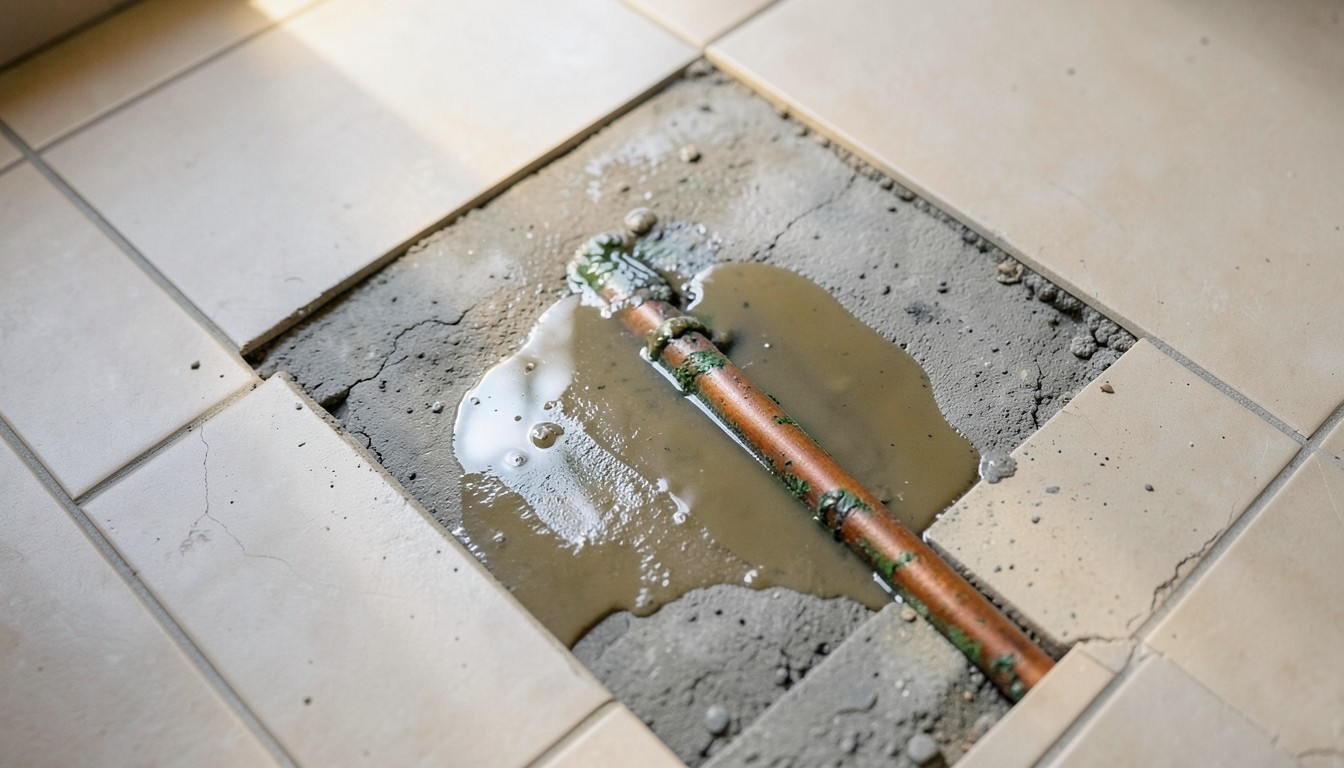
Local plumbing data for Milwaukee, WI
Climate angle. Pre-WWII Polish Flats + Bay View housing stock with 100-year-old cast-iron + lead service lines. Lake Michigan soft water (~7 gpg). Burst-pipe season Nov-Mar (avg 140 freeze days). Active LSL replacement program.
Slab Leak Repair cost calculator — Milwaukee
Pre-filled for slab leak repair in Milwaukee. Adjust the ZIP for a neighboring area, or change the service to compare. Calculator pulls from the city's scraped permit-fee + state plumber-density data.
Slab Leak Repair in Milwaukee — frequently asked
How much does slab leak repair cost in Milwaukee?
Most Milwaukee homes do not have a true slab leak — the 42-inch frost line under the WI Uniform Dwelling Code mandates basement foundations across the city, so what gets called a "slab leak" is usually a rim-joist freeze burst or a basement-floor pipe issue costing $600–$1,800 to address. Where a genuine slab-on-grade home exists in 1960s–80s Brookfield, Wauwatosa, or New Berlin tract subdivisions, repair runs $1,600–$3,800 for a spot fix, $2,400–$5,400 for a reroute through the joist bay above, and $5,200–$13,500 for a full PEX repipe. The Milwaukee Department of Neighborhood Services charges $100 for the supply-line permit. The Wisconsin DSPS-credentialed plumber pulls it and rolls the fee into the written quote.
Are slab leaks even common in Milwaukee?
No. Milwaukee is overwhelmingly a basement-foundation market because the 42-inch frost line under the WI Uniform Dwelling Code makes shallow slab-on-grade construction impractical inside the city. The genuine slab-on-grade housing pocket is concentrated in 1960s–80s outer-ring tract subdivisions in Brookfield, Wauwatosa, and New Berlin where some builders did go slab in heated developments. When AlertPlumber routes a "slab leak" call from a Milwaukee ZIP, the matched plumber's first diagnostic question is whether the home has a basement — if yes, the leak is almost certainly a rim-joist freeze burst, a basement-floor copper failure, or a lateral service-line freeze, not a true under-slab supply leak. The volume in Bay View, Riverwest, Walker's Point, and the East Side is essentially zero.
Why are most Milwaukee "slab leak" calls actually rim-joist freeze bursts?
Milwaukee's pre-WWII Polish + German immigrant brick stock in Bay View, Riverwest, and Walker's Point — built 1880s through 1910s — has shallow rim-joist transitions where supply pipes cross the foundation top plate. Lake Michigan lake-effect snow plus 130+ freeze days per year per NOAA NWS Milwaukee/Sullivan drive sub-zero air through those uninsulated rim joists, freezing the copper supply at the weakest fitting. The water expands roughly 9% on freeze and ruptures the joint. Homeowners hear the burst, water shows up on the basement floor, and the working theory becomes "slab leak" — but the actual failure is six feet above any slab. Diagnosis is a 30-minute basement walk with a flashlight, not a $400 detection workup.
Basement, slab, or rim-joist — how do I tell which leak I have?
Three quick checks the matched plumber walks through on the callback. (1) Is there a basement? If yes, true slab leaks are off the table — the pipe path is in the basement ceiling or rim joist, not under concrete. (2) Where is the water showing up? Floor seepage from the rim plate or wall-foundation joint points to rim-joist freeze burst; a warm wet spot on a finished concrete floor in a 1960s Wauwatosa ranch points to a true slab leak; a damp basement-floor crack points to lateral service-line failure. (3) Did it happen during a sub-zero stretch? Freeze events are rim-joist or service-line; gradual wet spots in 1950s–60s Wauwatosa tract are radiant-coil or pinhole. The matched plumber confirms with a static pressure-isolation test before any concrete is touched.
Does Wisconsin homeowners insurance cover Milwaukee freeze-burst leaks?
Standard Wisconsin HO-3 policies cover sudden water damage from a freeze-burst supply line as long as the home was reasonably maintained against freezing — heat on, basement above 55°F, no winterized vacancy. Coverage typically includes the access tear-out (slab cut, drywall opening, or rim-joist exposure) but excludes the cost of the failed pipe itself, treated as wear-and-tear. The Milwaukee-specific denial trap: if the thermostat was off or the home was unoccupied during a Lake Michigan polar-vortex stretch, most carriers invoke the freezing-of-plumbing exclusion that requires reasonable steps to maintain heat. Document the thermostat setting, the heating-system status, and any exterior wall-vent closures before filing the claim. Submit the plumber's written moisture-mapping report — verbal diagnosis alone is usually denied.
Does Lake Michigan 7 gpg water cause copper pinhole leaks in Milwaukee?
Lake Michigan-source water from Milwaukee Water Works runs roughly 7 grains per gallon per USGS — moderately soft to moderate-hard, slow on copper internal corrosion. Pinhole leaks do happen but they are a slow-motion failure mode in 30–50 year-old Type M copper per Copper Development Association field data — not the dominant Milwaukee pathology. Where you do see pinholes is in 1950s–60s Wauwatosa ranch tracts that are now 60–70 years on original copper, and on the hot-water side in particular where heat compounds the chemistry. The fix is targeted spot repair if the failure is one-off, not a panic full repipe.
How long does the repair take?
Rim-joist freeze burst (the most common Milwaukee scenario): 2–4 hours total — basement access, joint cut-out, copper or PEX splice, foam-and-flange insulation upgrade so it does not happen again next January. Basement-floor or lateral service-line repair: 4–8 hours. True spot slab repair in a Brookfield or Wauwatosa slab-on-grade home: a full day with detection in the morning and slab cut, splice, and patch in the afternoon. Reroute through joist bays above: 1–2 days. Full PEX-A repipe of a 3-bath outer-ring slab home: 2–3 days. Concrete cures 24–48 hours before tile or finish work resumes. The matched plumber gives a firm timeline on the callback after reviewing the home's foundation type and pipe routing.
Will the plumber damage my hardwood or pre-1940 Bay View tile?
Bay View, Riverwest, and Walker's Point homes from the 1880s–1910s often have original quarter-sawn oak floors, decorative tile vestibules, or pressed-tin ceilings that homeowners do not want disturbed. The good news: those homes have basements, so true slab work is off the table. Rim-joist freeze-burst repair happens entirely from the basement side and never touches finished flooring above. Lateral service-line repair is exterior excavation work — the front yard takes the disturbance, not the parlor floor. For the rare slab-on-grade Brookfield or Wauwatosa home with finished hardwood over the slab, AlertPlumber-matched plumbers default to overhead reroute through the wall and joist cavity rather than cutting the slab from above. The trade-off is a visible PEX run inside a closet or behind crown molding, which most homeowners accept as the lower-disruption outcome.
Does Milwaukee require a permit and what credential does the plumber need?
Yes. The Milwaukee Department of Neighborhood Services requires a $100 supply-line permit for any pipe repair beyond a single fixture, and the plumber must hold an active Wisconsin DSPS Master Plumber or Journeyman credential per the WI Dept of Safety & Professional Services. Wisconsin is a state-credentialed plumbing market — there is no city-only credential — and the DSPS roster lists roughly 5,420 active plumbers statewide. Un-credentialed pipe work voids any HO-3 freeze-burst claim and shows up on the title search as an open code issue when the home is sold. The matched plumber pulls the permit, schedules the pre-cover and final inspection with DNS, and rolls both into the written quote. Confirm any specific plumber's credentials on the WI DSPS credential-lookup page before authorizing work.
When is a full PEX repipe actually needed in Milwaukee?
Rarely. Most Milwaukee homes do not need a repipe because the underlying pathology is one-off freeze burst, not progressive corrosion — Lake Michigan 7 gpg water is too soft to drive system-wide pinhole failure on the timeline that 17 gpg Sun Belt water does. Full PEX-A repipe ($5,200–$13,500) is the right answer in three narrow cases: (1) a 1960s–80s Brookfield or Wauwatosa slab-on-grade home with two confirmed slab leaks inside 24 months, (2) a 1950s–60s outer-ring ranch past 60 years on original Type M copper with multiple hot-side pinholes surfacing, or (3) a pre-1940 Bay View or Riverwest home where the entire copper supply is at end-of-life and the homeowner is renovating anyway. PEX-A run overhead through joist bays carries a 25-year manufacturer warranty when installed to spec. For everything else, targeted repair is the reasonable answer.
Request a slab leak repair callback in Milwaukee
ZIP, phone, kind of work. AlertPlumber routes to a verified plumber for a free over-phone estimate.