
Emergency Slab Leak Repair in Columbus, Ohio
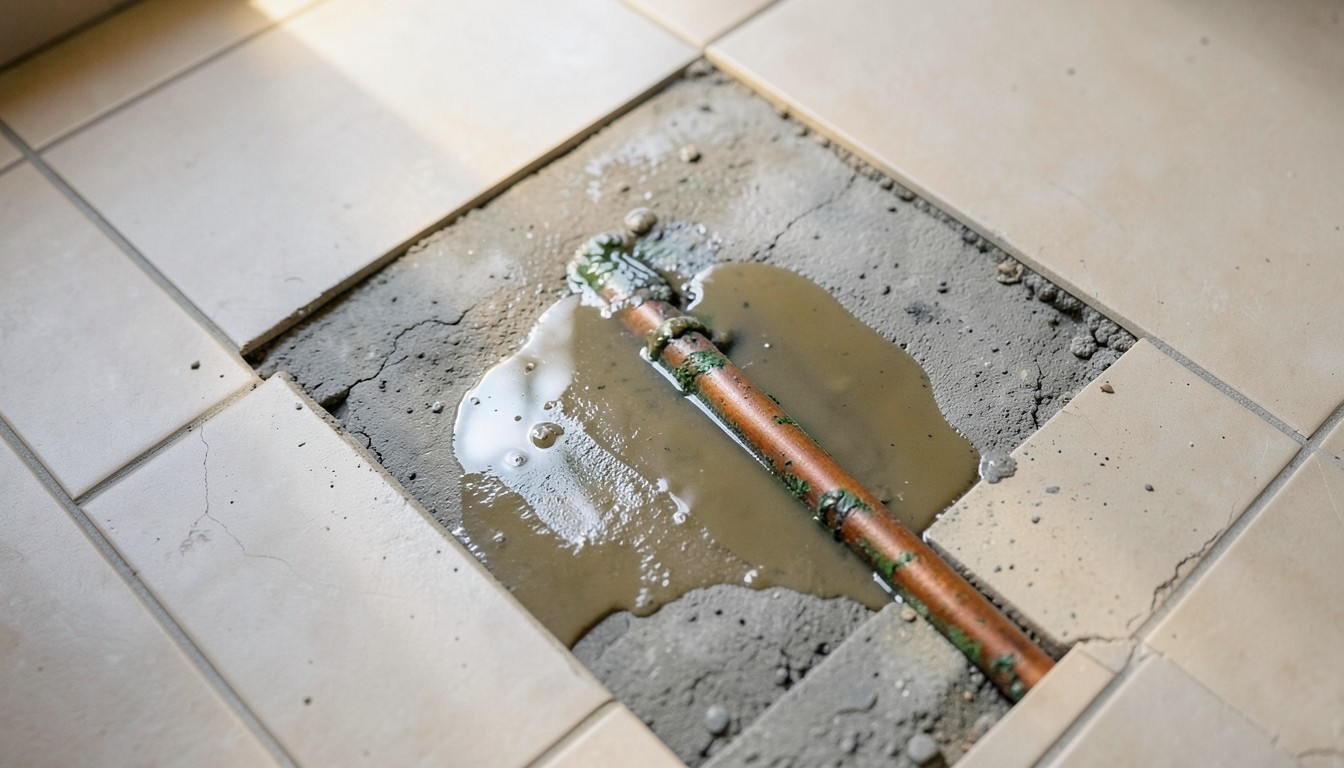
Detects and repairs leaks in pipes beneath the concrete slab foundation. AlertPlumber matches you with a verified OH plumber serving Columbus.
Local plumbing data for Columbus, OH
Climate angle. 1960s-80s suburban tract growth + older 1920s-40s German Village/Clintonville stock. Burst-pipe season Dec-Mar (avg 110 freeze days). Sumppump demand high in low-lying neighborhoods near Olentangy + Scioto rivers.
Slab Leak Repair cost calculator — Columbus
Pre-filled for slab leak repair in Columbus. Adjust the ZIP for a neighboring area, or change the service to compare. Calculator pulls from the city's scraped permit-fee + state plumber-density data.
Slab Leak Repair in Columbus — frequently asked
How much does slab leak repair actually cost in Columbus — and is that the right service for a central Ohio home?
Before pricing: most Columbus calls tagged "slab leak" turn out to be basement-floor or rim-joist freeze-burst, not a true slab pinhole. With a 1973 median build year and 36–42 inch frost line driven by ~110 freeze days per NOAA NWS Wilmington (CMH), central Ohio framing is dominated by full basements over poured-wall foundations. Where a true slab-on-grade pocket does exist — the 1960s–80s ranch tracts in Hilliard, Westerville, and parts of Dublin — typical Columbus pricing runs $1,400–$3,100 for a single spot repair (saw-cut the slab, splice in Type L copper or PEX), $2,100–$4,900 for an overhead reroute through joist bays, and $4,400–$12,800 for a full PEX-A repipe when more than one pinhole has surfaced. The $125 Columbus DBZS permit fee per Columbus Department of Building & Zoning Services applies to any supply-line work. Your matched OH OCILB-credentialed plumber pulls the permit and itemizes it in the written scope.
Are slab leaks even common in Columbus homes?
Honestly — no, not the way they are in Phoenix or Houston. Columbus is a basement-dominant market: German Village, Clintonville, and Short North 1920s–40s historic stock sits on rubble-stone or block basements with no slab supply lines whatsoever, so a true "slab leak" is physically impossible there. Upper Arlington, Bexley, and Worthington 1950s–70s post-war housing is mostly basement-over-crawl with copper run through joist bays — again, not in slab. The genuine slab-on-grade pocket is narrow: 1960s–80s ranch and split-level tracts in Hilliard, Westerville, and Dublin, where builders poured monolithic slabs for cost on starter-home subdivisions. Even there, the failure curve is slow because Olentangy/Scioto blended source water runs ~8 gpg per USGS — moderate, not the aggressive Sun Belt scale that punches pinholes in Type M copper inside 15 years. If your central Ohio plumber is calling everything a "slab leak," ask them to confirm with a static pressure-isolation test before any concrete cutting.
How does Olentangy and Scioto floodplain location change the diagnosis?
This is the central Ohio twist. Neighborhoods inside the Olentangy and Scioto floodplain — Marble Cliff, Grandview Heights riverside, Franklinton, parts of Clintonville east of the Olentangy, and the Scioto bend through downtown — show up with chronic basement moisture that homeowners mistake for slab leaks. The pathology is almost always hydrostatic pressure on the basement footing or a failed sump-pump rather than a pressurized supply pinhole. A matched plumber will run the diagnostic in this order: (1) shut the main and watch the meter for 15 minutes — if the low-flow dial doesn't move, it isn't a pressurized leak at all, (2) check the sump basin for water-table intrusion, (3) inspect the rim joist and basement floor cove for groundwater seepage, (4) only then move to thermal and acoustic detection for an actual slab. Columbus DPU water arrives at ~8 gpg moderate hardness per the Columbus Department of Public Utilities consumer confidence report — the corrosion timeline is decades-slow, so floodplain homes are far more likely to need a sump-pump and drain-tile fix than a slab cut.
Basement leak vs slab leak vs rim-joist freeze-burst — how does my Columbus plumber tell them apart?
This identification step matters more in Columbus than almost anywhere else because the three failure modes look identical from the homeowner's side (water on the floor, bill spike) but the fix prices vary 5x. Rim-joist freeze-burst is the most common in central Ohio at 110 freeze days — a hose bib, exterior-wall branch, or basement-perimeter copper line cracks during a December–February cold snap; the leak is visible with a flashlight along the rim joist; repair runs $280–$640 for a sweat-and-splice. Basement supply-line failure (copper running across joist bays in Upper Arlington/Bexley post-war stock) is visible from below; repair $380–$1,100. True slab leak requires the full diagnostic stack — static pressure test, FLIR thermal pass, acoustic ground-mic — and only applies if the home is on monolithic slab in Hilliard/Westerville/Dublin tracts. If a plumber quotes slab repair without first ruling out the rim joist with a 10-minute visual, get a second opinion.
Does Ohio HO-3 homeowners insurance cover freeze-burst pipe damage in Columbus?
Generally yes for the water damage, no for the failed pipe itself — and the freeze-burst angle matters here because that's the dominant Columbus failure mode at 110 freeze days. Standard Ohio HO-3 policies (State Farm, Allstate, Erie, Nationwide, Westfield) cover sudden water damage from a frozen pipe rupture provided the homeowner maintained reasonable heat — typically 55°F minimum, written into the policy. They cover tear-out and access (drywall, finished basement carpet, cabinetry), drying, and remediation. They exclude the cost of the burst pipe itself as wear-and-tear or freeze-prevention failure. For a true slab pinhole, "sudden and accidental" coverage applies to the access cut and water damage but not the pipe. Document everything: dated photos of the burst section, the matched plumber's written report identifying freeze versus corrosion, and the moisture-mapping if available. Verbal diagnosis alone gets denied. If the home was unoccupied during the freeze without proper winterization, expect a denial regardless.
Why does Columbus 8 gpg water fail copper slowly versus Sun Belt cities?
Olentangy and Scioto blended surface water arrives at Columbus DPU treatment plants at ~8 gpg moderate hardness per USGS, then leaves the plant treated to EPA SDWA Lead and Copper Rule pH/alkalinity targets. The corrosion math: Type M copper in Columbus shows pinhole onset around 35–50 years versus 12–20 years in 16+ gpg Phoenix/San Antonio groundwater. That's why the small Hilliard/Westerville/Dublin slab-on-grade pocket from the 1960s–80s is only now entering the failure window — and why most of those homes will see one or two isolated pinholes rather than the system-wide failure cascade common in Sun Belt slab markets. Per Copper Development Association field data, moderate-hardness copper systems frequently outlive their original 50-year design life. The practical implication: in Columbus, spot repair is statistically more often the right answer than full repipe.
How long does the actual repair take once a Columbus plumber is on site?
Diagnostic and isolation: 60–120 minutes including static pressure test, thermal imaging on a true slab, or rim-joist visual on a basement home. Rim-joist freeze-burst splice: 90 minutes to 3 hours including drain-down and refill. Basement supply-line spot repair: 3–5 hours. True slab spot repair (saw-cut, splice, concrete patch) on a Hilliard or Westerville ranch: 5–8 hours. Overhead reroute through joist bays: 1–2 days. Full PEX-A repipe of a 3-bath Columbus home: 2–3 days. Concrete patch cure: 24–48 hours before flooring resumes. Cold-weather note: if the call is in January or February at sub-20°F, plan an extra 30–60 minutes for thaw access and to verify no secondary freeze-cracks downstream of the primary failure. Your matched plumber confirms the timeline on the callback after reviewing the home's vintage and foundation type.
What about German Village, Clintonville, and Short North historic basements?
This is its own category. The 1900–1940 brick-and-stone housing stock in German Village, Clintonville, Old North Columbus, Short North, and Italian Village sits on rubble-stone, brick, or early-poured-concrete basements with no slab supply runs at all — every line is exposed in the basement ceiling joist bays or behind plaster. The work isn't slab leak repair; it's careful basement-supply replacement that has to respect 80–100 year old framing, knob-and-tube remnants, plaster-and-lath, and in German Village the historic district overlay per Columbus DBZS. Galvanized supply still in service in some untouched homes is at end-of-life and shows pinhole or section failures rather than slab pinholes. The repair pattern: targeted galvanized-to-PEX or galvanized-to-copper replacement section by section, $1,800–$5,400 depending on access and how much plaster has to come down. A matched plumber familiar with central Ohio historic stock will not propose slab cutting in these neighborhoods.
What permit and credential should I confirm for Columbus plumbing work?
Two layers. Credential: Ohio licenses plumbers at the state level through the Ohio Construction Industry Licensing Board — verify your plumber on the state roster of 9,480 active OH OCILB-credentialed plumbers per Ohio Department of Commerce, Division of Industrial Compliance. The state board is the authority — central Ohio cities do not issue separate plumbing credentials. Permit: Columbus DBZS issues the permit at $125 base fee for supply-line work per Columbus Department of Building & Zoning Services; suburbs (Dublin, Westerville, Hilliard, Worthington, Bexley, Upper Arlington, Grove City) issue through their own building departments at comparable fees. The state-credentialed plumber pulls the permit, schedules the rough-in inspection, and includes the fee on the invoice — never pay the homeowner-pull-permit workaround on supply-line work.
When does full PEX-A repipe actually pencil out for a Columbus home?
Rare in Columbus, and that's the honest answer. The case for full repipe ($4,400–$12,800) requires: (1) 2+ true slab pinholes inside 24 months on the same home — almost only seen in the Hilliard/Westerville/Dublin 1960s–80s slab-on-grade pocket, (2) confirmed Type M copper at end-of-life with multiple at-risk hot-side branches per pressure-isolation testing, OR (3) a major remodel where wall-and-ceiling access is already open. PEX-A run through joist bays and basement ceiling — never back through a slab — is the standard repipe path; per PEX Association, PEX-A carries a 25-year manufacturer warranty when installed to spec. Local context. Columbus is basement-dominant: the 905,748-resident metro is built on Olentangy/Scioto-fed continental-climate full-basement housing with a 1973 median build year and ~110 freeze days driving rim-joist and basement-perimeter freeze-burst as the dominant water-line failure mode, not slab pinholes. The narrow true-slab pocket in the Hilliard, Westerville, and Dublin 1960s ranch tracts is the only place where the full-repipe math reliably works. For most Columbus homeowners, spot repair on a confirmed leak — or a sump-pump and drain-tile fix in Olentangy/Scioto floodplain neighborhoods — is the right scope.
Request a slab leak repair callback in Columbus
ZIP, phone, kind of work. AlertPlumber routes to a verified plumber for a free over-phone estimate.