
Emergency Sewer Line Repair in Mesa, Arizona
Repairs broken or root-invaded sewer lines via spot repair, lining, or trenchless methods. AlertPlumber matches you with a verified AZ plumber serving Mesa.
Local plumbing data for Mesa, AZ
Climate angle. East Valley desert climate + 1980s-90s slab tracts with copper supply produce slab-leak patterns matching Phoenix metro. Hard SRP source water (~17 gpg) accelerates pinhole corrosion. No freeze risk; year-round work.
Sewer Line Repair cost calculator — Mesa
Pre-filled for sewer line repair in Mesa. Adjust the ZIP for a neighboring area, or change the service to compare. Calculator pulls from the city's scraped permit-fee + state plumber-density data.
Sewer Line Repair in Mesa — frequently asked
What does sewer line repair cost in Mesa?
Mesa sewer pricing splits five ways and the caliche soil drives every number up. Point repair on a single failed joint runs $2,200–$5,500 here versus $1,800–$4,500 in softer-soil cities — the USGS-mapped caliche layer across the East Valley adds 20–40% to excavation labor because crews need pneumatic breakers instead of standard backhoe work. Trenchless pipe-bursting through a 50–80 ft lateral lands at $7,500–$14,500 (a Mesa-favored method specifically because it skips most of the caliche dig). CIPP cured-in-place lining per ASTM F1216 runs $6,500–$13,500 for a typical Dobson Ranch run. Lateral cleanout install is $850–$2,200. Full open-trench replacement on a 1970s clay lateral hits $9,500–$22,000 once you factor caliche premium plus the $155 Mesa Development Services permit. Camera scope ($175–$400) is mandatory before any of these numbers get firm.
Why does Mesa specifically need so much sewer work?
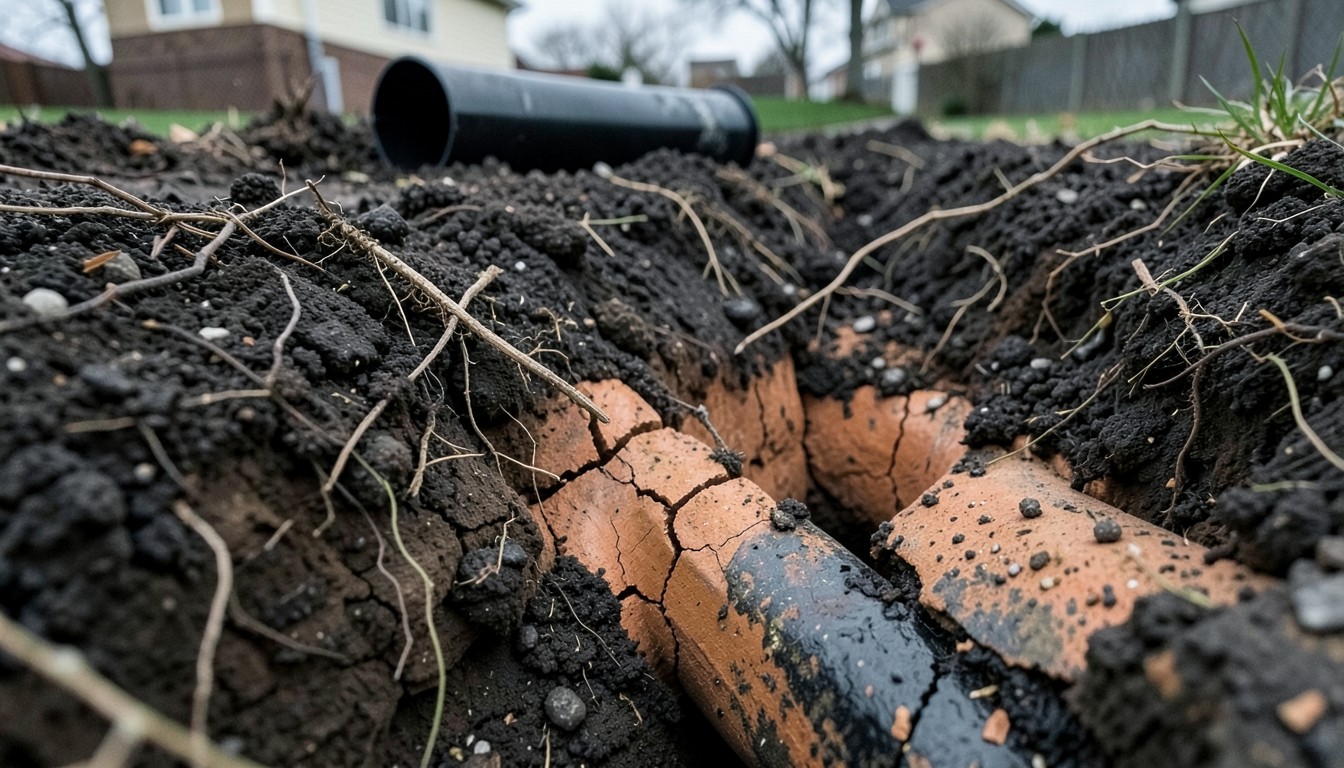
Three pathologies stack on Mesa laterals in a way most cities don't see. First, Dobson Ranch and the 1970s–80s tract belt installed clay-tile sewer laterals that are now at the standard 40–50 year offset-joint failure age — root intrusion at every hub, cracked bells, bellied sections from soil settlement. Second, Mesa's 17 gpg blended SRP+CAP supply per USGS hardness mapping deposits heavy mineral scale on the inside of cast-iron laterals from older Mesa homes, narrowing the bore until backup is constant. Third, the caliche-bound clay soil holds tree roots tight against pipe joints — every Augusta Ranch and Red Mountain homeowner with a mature mesquite or palo verde over the lateral path is on borrowed time. Las Sendas and Eastmark PVC stock from the 1990s+ is structurally fine; the failures are concentrated in pre-1990 clay and cast-iron stock.
Open-trench vs trenchless in Mesa caliche soil?
Trenchless pipe-bursting is the strongly preferred method in Mesa specifically because of caliche. Open-trench excavation through caliche-bound clay adds 20–40% to labor cost and risks fracturing adjacent utility runs when pneumatic breakers hit hard layers. Pipe-bursting only requires two access pits (entry and exit) and pulls the new HDPE through the existing lateral path, displacing the old clay or cast iron radially into the surrounding soil. CIPP lining per ASTM F1216 works on Dobson Ranch 1970s clay if the host pipe is still structurally intact (the camera scope confirms). Open-trench is only the right call when the lateral has bellied beyond what bursting can correct, or when a post-tension slab intersects the run and access is limited. The matched plumber should walk through method selection with the camera footage before quoting — anyone defaulting to open-trench in Mesa without scoping is leaving money on the table.
How do I know my Mesa sewer line is failing?
Mesa sewer failure presents in a recognizable pattern given the local pathology:
- Multiple drains slowing at the same time (kitchen + laundry + downstream bath) — points to lateral blockage, not single-fixture clog
- Recurring backups that snake-clear and return in 60–120 days — classic root intrusion at clay-tile joints
- Sewer odor in the yard along the lateral path, especially after monsoon rain
- Localized lawn dips or sinkholes over the run — bellied or collapsed section
- Gurgling toilets when running the washing machine — venting compromised by partial blockage
Why is the camera scope mandatory before any Mesa sewer work?
Because Mesa laterals split into incompatible repair pathways depending on the host pipe and failure mode, and quoting without scoping is guessing. A 1970s Dobson Ranch clay lateral with offset joints but intact bell sections is a perfect CIPP candidate. The same lateral with a 6-inch belly section needs pipe-bursting or open-trench. A cast-iron lateral with mineral scale buildup from 17 gpg water might need hydro-jetting before any structural decision. A run that intersects a post-tension slab needs careful access planning. Per NASSCO PACP standards, the camera scope ($175–$400) documents pipe material, diameter, slope, root intrusion points, joint condition, and any structural defects. That report is also the basis for any insurance claim under an Arizona HO-3 sewer-backup endorsement. A plumber who skips the scope in Mesa is either inexperienced or upselling toward whichever method has the highest margin that week.
When does a Mesa lateral need full replacement vs CIPP lining?
The decision hinges on host-pipe structural integrity, which the camera scope determines per NASSCO PACP grading. CIPP lining per ASTM F1216 is viable when the existing pipe holds shape — minor offset joints, hairline cracks, root intrusion that can be cut back. The cured liner becomes the new structural pipe. CIPP fails when the host pipe has bellied beyond 2% slope deviation, has missing pipe sections, has collapsed segments, or where lateral connections need re-cutting at angles the liner can't accommodate. Most 1970s–80s Mesa Dobson Ranch clay laterals are CIPP-eligible if caught before structural collapse. Pre-1972 Orangeburg pipe (rare in Mesa but present in some pockets) is never lining-eligible — it must be replaced. Cast-iron laterals with severe channeling at the pipe bottom from 17 gpg mineral scale also typically need replacement, not lining.
What's the time-on-site for Mesa sewer work?
Point repair on a single failed joint: 1 day, longer if hardscape or driveway breakout is needed (Mesa flagstone and stamped-concrete driveways add half a day). Lateral cleanout install: 4–6 hours. Trenchless pipe-bursting through a 50–80 ft Dobson Ranch lateral: 1–2 days plus permit inspection sequencing. CIPP lining: 1 day install plus 4–6 hours cure (steam or UV depending on system). Full open-trench replacement on a 1970s clay lateral: 3–6 days through caliche soil — caliche adds 25–50% to excavation timeline versus equivalent work in Tucson or Phoenix river-valley soils. Mesa Development Services permit + inspection sequencing adds 24–72 hours overhead. The matched plumber confirms the access plan, slab/post-tension considerations, and 811 utility-locate window during the pre-job walkthrough so excavation starts cleanly.
Mesa permit + AZ ROC requirements for sewer work?
Mesa requires a city plumbing permit ($155) from Mesa Development Services for any sewer lateral repair, replacement, or trenchless work that crosses the property line or alters the existing connection. The credentialed plumber pulls the permit on the homeowner's behalf. Arizona requires AZ ROC C-37 plumbing classification per AZ ROC license database, 2024 — there are 3,247 active C-37 plumbers statewide. Sewer lateral work specifically requires the C-37 because the wastewater connection affects shared infrastructure beyond the homeowner's parcel. Arizona Blue Stake (811) utility-locate request is federally mandated 48–72 hours before any excavation, no exceptions. For trenchless work that doesn't break ground past the access pits, 811 still applies because pits are excavation. EPA NPDES rules per EPA NPDES program govern any discharge during the work.
When does a Mesa lateral hit its replacement tipping point?
Pipe material drives the timeline. Vitrified clay tile installed in Dobson Ranch and similar 1970s–80s Mesa tracts has a 40–60 year service life, which means the entire pre-1985 clay-stock inventory is now in or past the failure window. Cast-iron laterals from 1950s–1970s Mesa homes (Falcon Field corridor, original downtown) hit 50–75 years before mineral-scale channeling and bottom-of-pipe corrosion force replacement — Mesa's 17 gpg water accelerates this. Orangeburg fiber-bitumen pipe from 1948–1972 (rare but present in some pockets) fails at 30–50 years and is never repairable, only replaceable. PVC schedule 40 from 1990s+ Las Sendas and Eastmark builds carries a 100-year design life per Plastic Pipe Institute and rarely needs replacement absent installation defects. Camera scope is the only way to confirm material and current condition — Mesa's mixed-vintage housing stock means the lateral material isn't predictable from build year alone.
Will Arizona homeowners insurance cover Mesa sewer repair?
Standard Arizona HO-3 policies treat sewer lateral replacement as maintenance/wear-and-tear and do NOT cover the repair itself. They typically cover the wastewater backup damage to the home (drywall, flooring, mold remediation) IF a sewer-backup endorsement rider is on the policy. For Mesa homes 38+ years old (median build 1986), the rider is critical — typical cost $50–$140/year buys $5,000–$25,000 backup-damage coverage. Document the failure with the plumber's NASSCO PACP-format camera footage, the dated invoice, and any wastewater damage photos for the strongest claim case. Some Arizona carriers also offer a separate service-line endorsement that covers the lateral itself between the home and the city main — worth pricing if the lateral is 1970s clay and inspection shows pre-failure conditions. Verify endorsement language carefully; backup coverage and service-line coverage are different riders.
Request a sewer line repair callback in Mesa
ZIP, phone, kind of work. AlertPlumber routes to a verified plumber for a free over-phone estimate.