
Emergency Leak Detection in Washington, District of Columbia
Locates hidden water and gas leaks using acoustic and thermal equipment. AlertPlumber matches you with a verified DC plumber serving Washington.
Local plumbing data for Washington, DC
Climate angle. Pre-WWII federal-era housing + early-1900s rowhouse stock with cast-iron + lead service lines. DC Water LSL replacement program triggers concurrent supply repipe. Burst-pipe season Dec-Mar; combined-sewer overflow zones (Anacostia + Rock Creek) face elevated backup risk.
Leak Detection cost calculator — Washington
Pre-filled for leak detection in Washington. Adjust the ZIP for a neighboring area, or change the service to compare. Calculator pulls from the city's scraped permit-fee + state plumber-density data.
Leak Detection in Washington — frequently asked
How much does Federal-period rowhouse leak detection cost in Washington, DC?
A non-destructive detection workup on a DC Federal-period rowhouse runs $295–$565 flat, billed before any repair quote — the upper band reflects the extra labor of scanning plaster-and-lath party walls in Capitol Hill, Georgetown, and Dupont Circle. The fee covers FLIR thermal sweep, acoustic ground-microphone listening on the supply manifold, static pressure-isolation on a 7-9 gpg Potomac feed, and party-wall sewer coordination paperwork (DC's row-built stock shares lateral connections, so a leak below grade often involves the neighboring deed). The detection fee is typically credited toward repair if you book the same plumber. Spot repair on a Federal-period plaster wall opening runs $1,650–$3,400 (the lath layer adds restoration cost over modern drywall). Capitol Riverfront and Far Northwest infill (post-2000) prices closer to $250–$420 because the slab-on-grade scanning is straightforward. Always confirm whether the $185 DC DOB plumbing permit is bundled.
How does a hidden leak show up differently in a Capitol Hill rowhouse versus a Capitol Riverfront infill condo?
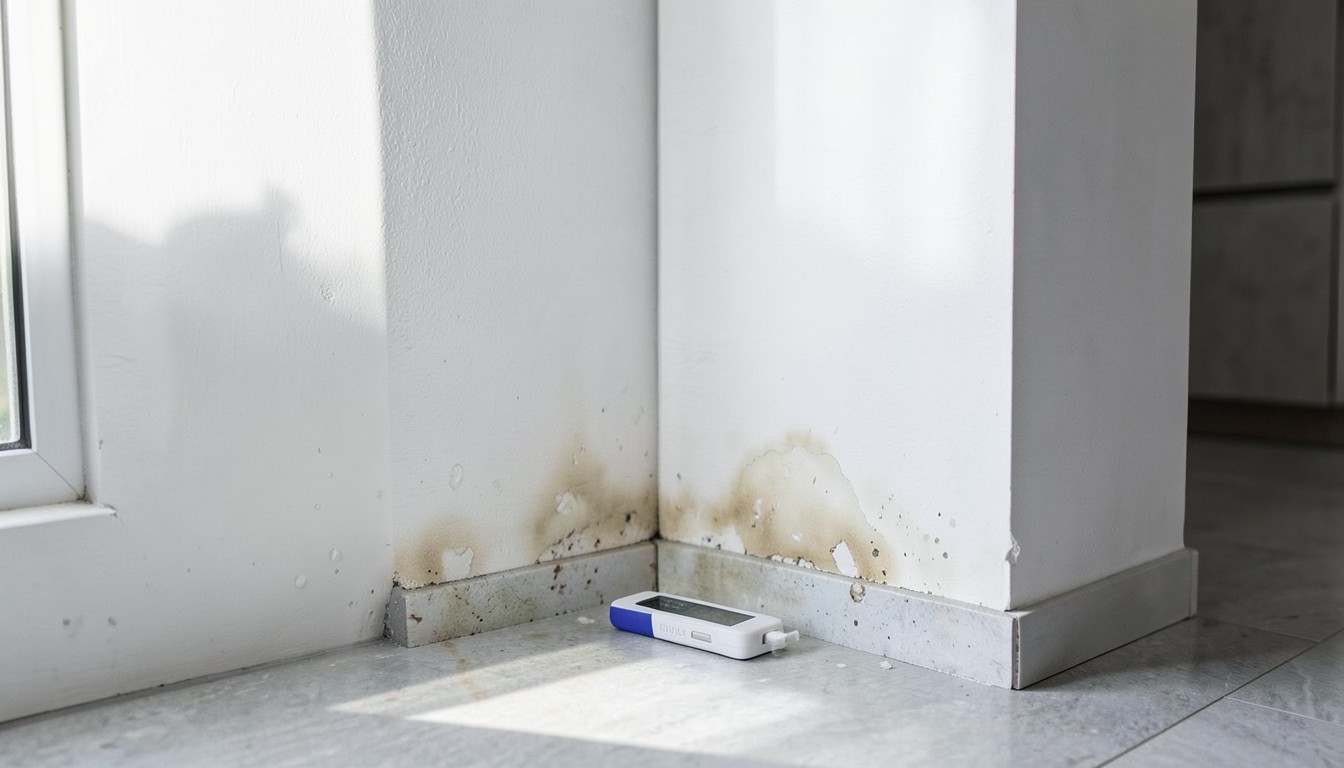
The symptom set splits sharply by build era in DC. Federal-period and Adams Morgan tenement (1800s–1900s): bubbling Federal-period plaster on a party wall, lath staining on the neighbor-side surface (party-wall migration), efflorescence on cellar brick where Potomac-basin groundwater is wicking, faint hissing at the rim joist where original cast-iron meets a copper retrofit. Brookland and Petworth craftsman (1920s–40s): warped oak flooring near radiator returns, ceiling halos under second-floor baths. Capitol Riverfront and Far Northwest infill (2000s+): warm spot on a polished-concrete slab, low-flow indicator drift on the smart meter, drywall taping bands lifting near a manifold. A Dupont Circle rowhouse leak rarely surfaces at the leak — moisture migrates along the lath cavity and the party-wall assembly before showing.
What detection methods does a DC plumber use on Federal-period plaster and party-wall sewer connections?
The DC sequence is built around two constraints: Federal-period plaster-and-lath wall assemblies and shared party-wall sewer laterals. (1) Static pressure-isolation on the supply manifold confirms a leak and isolates hot vs cold on a 7-9 gpg Potomac feed. (2) FLIR thermal scanning across the plaster — the lath horsehair-binder layer attenuates contrast, so the tech runs the scan after a 20-minute hot-side recirculation to amplify the gradient. (3) Acoustic ground-microphone listening through the original wood baseboard (drilling is avoided in historic-overlay zones). (4) Camera-scoped lateral inspection at the party-wall cleanout — DC rowhouse sewers often share a Y-connection with the neighbor before reaching the DC Water tap, so coordination paperwork precedes any excavation. (5) Potomac and Anacostia basin moisture-mapping for cellar-floor anomalies in flood-prone zones below 50 ft elevation.
Will DC HO-3 homeowners insurance cover detection on a diplomatic-zone or embassy-housing property?
Standard DC HO-3 policies cover the detection fee when the underlying leak is "sudden and accidental" — not slow seepage that's been weeping into Federal-period plaster for months. Federal-zone properties (embassy-housing leases, State Department-held townhouses, federally-owned diplomatic residences in Kalorama and Sheridan-Kalorama) carry a different scope: detection on those parcels often requires a State Department OFM coordinator notification before a plumber sets foot inside, and the carrier on a diplomatic-tenant lease may be a foreign government's domestic carrier rather than a US HO-3. For privately-held DC homes adjacent to the diplomatic zone, the standard HO-3 tear-out and access language applies. Submit the plumber's written report with party-wall moisture mapping; verbal diagnosis on a row-built stock claim is almost always denied.
How does the DC Water + DC DOEE combined utility billing reveal a hidden leak?
DC Water bills the supply side and DC DOEE (Department of Energy and Environment) layers the stormwater and Clean Rivers IAC charges on the same statement — so a hidden leak inflates two line items, not one. A 60-psi pinhole loses 70–150 gal/day, which on a typical DC residential bill adds $40–$95/month between the DC Water consumption charge and the DC DOEE-assessed wastewater volumetric charge. The Clean Rivers IAC is fixed by impervious surface area, so it doesn't move — but a 20%+ jump in the DC Water consumption block for two consecutive cycles, with no household-usage change, is the standard threshold for ordering detection. Pull the DC Water online portal hourly-usage graph before the plumber arrives; a flat overnight baseline above 0 gph is diagnostic of a continuous leak.
Can a DC homeowner narrow down the leak before calling a plumber?
Yes — narrow it, don't locate it. Shut every fixture and watch the DC Water smart-meter low-flow indicator for 20 minutes; any movement means water is escaping. Then isolate the water heater (close its cold-inlet shutoff) and re-watch — if the meter stops, the leak is on the hot side, common on Federal-period rowhouse copper retrofits at 7-9 gpg Potomac hardness. If it keeps moving, the leak is on the cold supply or an outdoor hose-bib (DC silcocks freeze-split in the Dec-Feb window even with moderate winters). What you cannot do at home: distinguish a Federal-period plaster cavity leak from a party-wall migration originating in the neighbor's unit. That requires calibrated FLIR plus the party-wall cleanout-camera workflow — leave that step to the verified plumber.
What does the federal-zone embassy-housing detection workflow look like?
Detection inside the federal diplomatic zone — embassy chanceries, ambassador residences, State Department lease properties in Kalorama, Observatory Circle, and parts of Massachusetts Avenue Heights — runs a stricter scope than a standard DC rowhouse. The plumber confirms the property's status (private residence, diplomatic-tenant lease, or federally-held), checks whether OFM (Office of Foreign Missions) coordination is required, and confirms the DC DOB permit pathway since some federal parcels are exempt from local DOB review but still require DC Water tap-coordination. Equipment scope is the same — FLIR through Federal-period plaster, acoustic on the supply manifold, party-wall cleanout camera — but the documentation chain is longer. The verified plumber routed through AlertPlumber confirms whether the address requires the federal-zone workflow before scheduling, since the lead time is typically 5-10 business days longer than a standard Capitol Hill rowhouse call.
How accurate is FLIR thermal imaging through Federal-period plaster-and-lath?
Federal-period plaster-and-lath assemblies are the toughest substrate in DC for FLIR work. The lath layer is sawn wood strips with horsehair-bound lime plaster on top — the horsehair binder scatters infrared, and the wood lath has its own thermal mass that lags behind a leak by 8-15 minutes. A calibrated FLIR T-series camera localizes a hot-side leak in this assembly to a 22-28 inch radius on the first sweep, lower than the 18-inch radius achievable on modern drywall. The tech compensates by running a 20-minute hot-side recirculation cycle before the scan to amplify the thermal gradient, then confirms with acoustic listening through the baseboard joint. On a Capitol Riverfront infill condo with painted drywall over a steel-stud cavity, the same camera lands inside 14-18 inches first scan. Always ask whether the camera output will be paired with acoustic confirmation before any plaster is opened — restoration on Federal-period lath runs $40-85/sq ft.
Should I get a system-wide pressure test on a Federal-period DC rowhouse?
Yes, especially on a Capitol Hill, Georgetown, or Dupont Circle rowhouse where a copper retrofit was layered onto original lead or cast-iron between 1955-1985. A system-wide static pressure test ($175–$310 in DC) isolates supply, hot recirculation, and the party-wall lateral, then holds 80 psi for 15 minutes — any pressure drop flags an additional weak point. DC plumbers report rowhouses with one detected pinhole have a 40-55% probability of a second pinhole within 30 months on the same hot manifold, because 7-9 gpg Potomac hardness at recirculation temperature compounds copper corrosion uniformly across the loop. The test is lower-cost than a second emergency tear-open of plaster-and-lath. Combine the pressure test with the party-wall sewer cleanout camera in the same visit to consolidate the DC DOB permit fee.
Are AlertPlumber-matched plumbers verified for leak detection in DC?
The eLocal partner network requires every plumber routed through AlertPlumber for leak detection in DC to maintain active DC plumber credentialing through the DC Department of Buildings (DOB). DC Department of Buildings, 2025 — the agency was reorganized out of DCRA (DC Department of Consumer & Regulatory Affairs) in the recent restructuring, so older online references still pointing at DCRA reflect the prior org name. The DC plumber pool exceeds 5,000 credentialed individuals and the $185 DOB plumbing permit is the standard pull for a detection-plus-repair scope. Detection on Federal-period plaster, party-wall sewer coordination, and federal-zone diplomatic-property work each carry distinct documentation chains. Local context. Capitol Hill, Georgetown, and Dupont Circle Federal-period rowhouses (1800s–1900s plaster-and-lath party walls), Adams Morgan and Mount Pleasant tenement-style stock, Brookland and Petworth 1920s-40s craftsman, and Capitol Riverfront 2000s+ infill each show distinctive leak signatures. Roughly 700,000 DC homes on a 7-9 gpg Potomac River feed through DC Water, billed jointly with DC DOEE stormwater charges, define the verified-plumber detection workflow. USGS and NOAA NWS Baltimore-Washington, 2025 publish the basin and freeze-day data the matched plumber's workflow draws on.
Request a leak detection callback in Washington
ZIP, phone, kind of work. AlertPlumber routes to a verified plumber for a free over-phone estimate.