
Emergency Leak Detection in San Diego, California
Locates hidden water and gas leaks using acoustic and thermal equipment. AlertPlumber matches you with a verified CA plumber serving San Diego.
Local plumbing data for San Diego, CA
Climate angle. Coastal salt-air corrosion accelerates pipe + fitting wear; 1970s-80s slab tracts (Mira Mesa, Rancho Penasquitos) have copper-in-slab pinhole patterns. Drought-driven low-flow retrofits + greywater systems are common renovation triggers.
Leak Detection cost calculator — San Diego
Pre-filled for leak detection in San Diego. Adjust the ZIP for a neighboring area, or change the service to compare. Calculator pulls from the city's scraped permit-fee + state plumber-density data.
Leak Detection in San Diego — frequently asked
How much does leak detection cost in San Diego — what is the realistic 2026 range?
For a non-destructive workup on a Mission Valley, Clairemont, or La Jolla home, expect $285–$525 flat for the diagnostic stage — FLIR thermal imaging, acoustic ground-microphone listening on the supply manifold, and a static pressure-isolation test producing a written moisture-mapping report. San Diego's $195 city permit (per the San Diego DSD 2024 fee schedule) attaches once a slab cut or wall opening is authorized, not at the detection stage. Most matched plumbers credit the detection fee against repair if you book within 14 days. Repair itself prices separately: single hot-side copper-in-slab spot repair runs $1,650–$3,400 in 1950s-70s tract stock (Clairemont, Allied Gardens, Linda Vista), hidden-wall plaster-and-lath repair in older North Park craftsman runs $425–$1,050 because the lath substrate adds tear-out and finish-restoration time. Coastal La Jolla / Coronado historic stock pricing trends 15-25% higher because of restoration-grade finish work, not the detection itself.
How do I know if I have a hidden leak — and does it look different in Mission Valley vs La Jolla vs Carmel Valley?
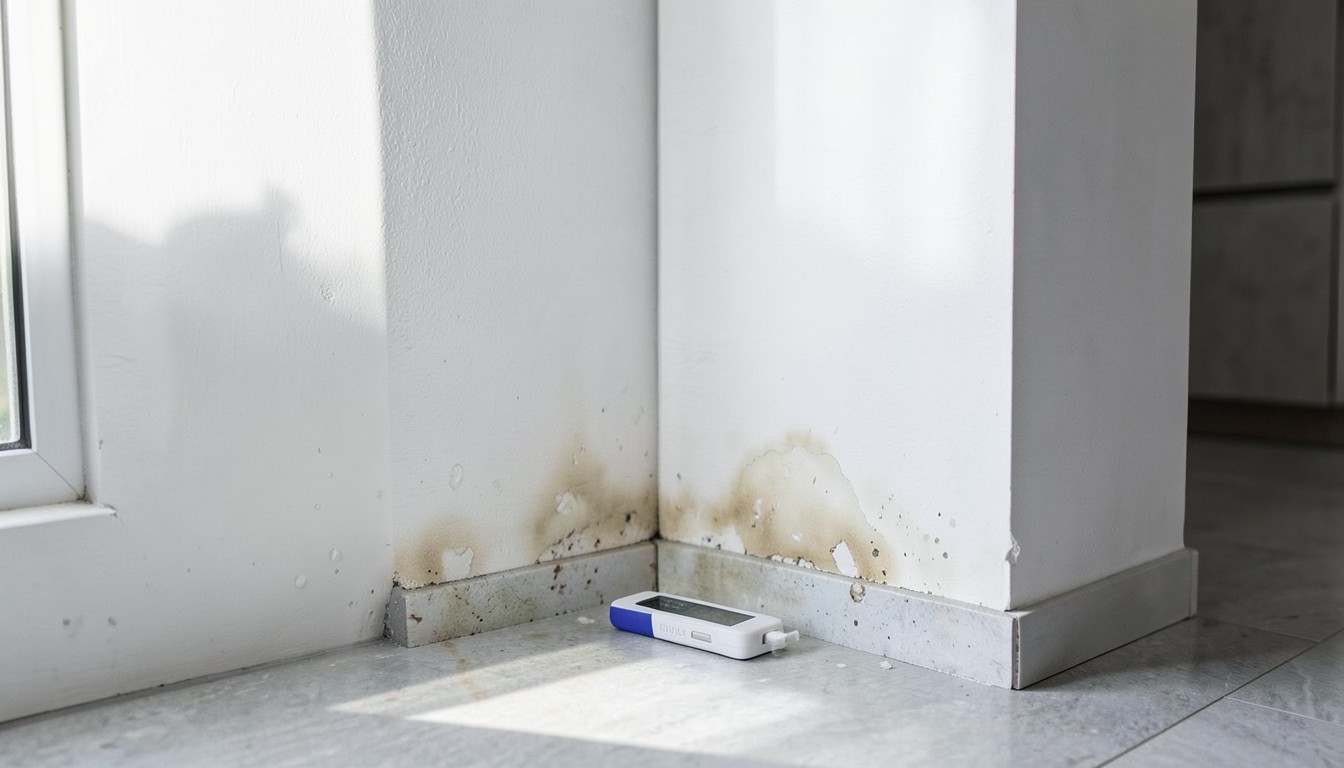
The diagnostic signal differs sharply by neighborhood profile. Mission Valley / Clairemont / Allied Gardens (1950s-70s slab-on-grade, copper-in-slab): warm spot on a tile or LVP floor, faint 2 a.m. hiss near a baseboard, unexplained 20%+ jump on the San Diego Public Utilities bill, hairline grout cracks tracking a hot-line route. La Jolla / Coronado / Mission Hills (1920s-30s craftsman, plaster-and-lath, masonry foundations): rust-streaked plaster at the base of a wall, efflorescence on stucco below a second-floor bath, a musty smell that the Pacific marine layer humidity (60-70% summer dewpoint) refuses to clear. Carmel Valley / 4S Ranch / Otay Ranch (1990s-2010s PEX-A infill): dimpled drywall at a manifold cabinet, a slow drip behind a kitchen kick-plate, brass-fitting weep at a homerun stub. Any single signal across any of those vintages warrants a detection workup before the moisture cascade reaches subfloor or framing.
What detection methods does a San Diego plumber actually use, and how does the marine layer affect FLIR calibration?
The standard four-stage sequence runs: (1) static pressure-isolation test on the supply manifold isolates hot vs cold side and confirms a leak exists, (2) FLIR thermal imaging localizes warm anomalies on slab, walls, or ceiling, (3) acoustic ground-microphone listening triangulates within 12–18 inches, (4) electronic line-tracing maps the pipe route before any concrete cut. San Diego's wrinkle: the Pacific marine layer pushes summer interior humidity to 60-70%, which compresses the thermal contrast FLIR depends on — a hot-line leak that would show as a sharp 4°F delta in dry Phoenix may register as a 1.5-2°F smear in Pacific Beach in July. Calibrated techs run the FLIR pre-dawn (cooler slab baseline) or after running the AC for 90 minutes to widen the delta. For 1920s-30s plaster-and-lath in North Park, FLIR is supplemented with pin-type moisture meters because the lath substrate diffuses surface temperature.
Will California HO-3 insurance cover San Diego leak detection — and what does the earthquake rider actually do here?
Standard California HO-3 policies cover the DETECTION fee when the loss is classified "sudden and accidental" — typically a pinhole burst, a fitting failure, or a pressure-driven joint separation. Gradual seepage (a months-long weep that finally surfaces as a stain) is excluded as wear-and-tear. The HO-3 also covers tear-out + access (slab cut, wall opening, written moisture-mapping report) but excludes repair of the failed pipe itself. The California Earthquake Authority rider matters in San Diego because the Rose Canyon Fault runs through La Jolla / Pacific Beach / downtown — a quake-induced slab shift that fractures a copper line is covered under the CEA rider, not the base HO-3. Submit the matched plumber's written report with FLIR imagery, acoustic location, and pressure-test data. Verbal diagnosis alone is denied at first review by every major California carrier.
Why does the water bill spike — and how does the San Diego County Water Authority 24-agency structure complicate the bill?
San Diego's water billing is unusual: the San Diego Public Utilities Department serves the city proper, but the broader region pulls from the San Diego County Water Authority wholesale system through 24 retail member agencies (Helix, Otay, Padre Dam, Sweetwater, Vallecitos, and 19 others), each with its own rate tier and surcharge structure. A pinhole leak running 70–150 gallons per day at 60 psi line pressure adds roughly 2,100–4,500 gallons per month — at San Diego's $9.85 per 1,000 gallons base rate that translates to $25–$55 in water plus matching wastewater plus drought-tier surcharges that can push the total to $80–$130. If you're on a county member agency rather than San Diego PUD, your tier breakpoints differ. A 20%+ unexplained spike for two consecutive cycles is the standard trigger for ordering detection regardless of which agency bills you.
Can a San Diego homeowner narrow the leak location before calling a plumber?
You can confirm a leak EXISTS and roughly partition it. Step one: shut every fixture and irrigation zone, watch the meter's low-flow indicator (the small triangle or dial). Movement over 15 minutes with everything off confirms a leak. Step two: close the hot-water heater isolation valve and re-watch the meter — if movement stops, the leak is on the hot side (typical Mission Valley / Clairemont copper-in-slab pathology); if movement continues, it's cold-side or irrigation. Step three: shut the irrigation backflow preventer separately — SoCal irrigation leaks at PVC glue joints are common in 1990s+ tract landscapes. You cannot reliably LOCATE the leak without calibrated FLIR plus acoustic triangulation. Consumer-grade IR thermometers don't have the spatial resolution to distinguish a slab leak from sun-warmed grout, and the Pacific marine layer humidity confounds rental moisture meters.
How does leak detection scheduling work for military housing near Camp Pendleton, NAS North Island, or MCAS Miramar?
San Diego County has the highest concentration of US Navy and Marine Corps installations on the West Coast — Camp Pendleton, NAS North Island (Coronado), MCAS Miramar, Naval Base San Diego, and Naval Base Point Loma. Detection scheduling for on-base privatized housing (Lincoln Military Housing, Liberty Military Housing) typically routes through the housing partner's maintenance line first, but tenants in off-base rentals or owner-occupants in nearby communities (Oceanside, Vista, San Marcos, Coronado, Liberty Station) book directly. PCS-cycle move-in / move-out inspections frequently flag suspected leaks that need same-week detection because of orders timing. Matched plumbers in the network familiar with base-gate access procedures (DBIDS, visitor pass, escort requirements) can streamline on-base appointments — confirm the access path when scheduling. Off-base detection follows the standard San Diego workflow with no special scheduling layer.
How accurate is FLIR thermal imaging in San Diego's 60-70% Pacific humidity?
For a hot-line slab leak in dry inland conditions, a calibrated FLIR T-series camera localizes within an 18-inch radius 85–92% of the first-scan attempts. In San Diego's coastal humidity band (60-70% summer dewpoint, marine-layer mornings), accuracy on the first pass drops to 72–82% because the saturated interior air narrows the thermal contrast between the warm leak plume and ambient slab. Calibrated techs compensate three ways: (a) run the scan pre-dawn when slab baseline is coolest, (b) pre-cool the structure with AC for 90 minutes to widen the hot-line delta, (c) supplement FLIR hits with acoustic ground-microphone confirmation before authorizing any concrete cut. Cold-side leaks, leaks under thick carpet or cork, and leaks that have saturated the under-slab soil also degrade FLIR accuracy regardless of climate — the marine layer just adds another variable.
Should I get a system-wide pressure test on my Mission Valley or Clairemont 1960s-70s home?
Yes — this is the highest-yield preventive diagnostic for San Diego's 1950s-70s slab-on-grade tract stock. A system-wide static pressure test ($175–$310) isolates each branch (hot, cold, irrigation), pressurizes to 80 psi, and holds for 15 minutes; any drop signals an additional weak point beyond the leak you just repaired. Mission Valley, Clairemont, Allied Gardens, Linda Vista, and Mira Mesa homes with copper-in-slab tubing show clustered failure: regional plumbers report a 35–50% probability of a second pinhole within 36 months on the same hot manifold once the first one perforates, because the entire run shares thermal cycling, water-chemistry exposure, and original-installation flux residue. The pressure test is far lower-cost than the next emergency slab cut. La Jolla / Coronado / Mission Hills 1920s-30s stock with galvanized-replaced-with-copper retrofits also benefits because retrofit junctions are common failure points.
Are AlertPlumber-matched plumbers verified for leak detection in California?
Every plumber routed through AlertPlumber for leak detection in San Diego maintains active California state-credentialed status under the C-36 plumbing classification. The California Contractors State License Board, 2024 Q4 lists 19,840 active C-36 contractors statewide; you can verify any individual license number through the CSLB online lookup before authorizing work. Leak detection requires specialty equipment (FLIR T-series thermal, acoustic ground-microphone, electronic line-tracer, static pressure manifold) plus trained operator experience reading moisture-mapping data — credential verification matters more here than for routine fixture work. Local context. San Diego's 1.4M residents, 1974 median build year, 13-gpg moderate-to-hard water from the San Diego Public Utilities Department blend (Colorado River + State Water Project + local Lake Hodges + groundwater), and Pacific marine-layer humidity together produce a distinctive leak signature — copper-in-slab pinhole in 1950s-70s Mission Valley / Clairemont tract, plaster-and-lath wall leaks in 1920s-30s North Park / Hillcrest craftsman, PEX-A manifold weeps in 1990s+ Carmel Valley / 4S Ranch infill. The matched detection plumber's workflow targets the highest-probability pathology for your specific neighborhood vintage first.
Request a leak detection callback in San Diego
ZIP, phone, kind of work. AlertPlumber routes to a verified plumber for a free over-phone estimate.