
Emergency Leak Detection in Milwaukee, Wisconsin
Locates hidden water and gas leaks using acoustic and thermal equipment. AlertPlumber matches you with a verified WI plumber serving Milwaukee.
Local plumbing data for Milwaukee, WI
Climate angle. Pre-WWII Polish Flats + Bay View housing stock with 100-year-old cast-iron + lead service lines. Lake Michigan soft water (~7 gpg). Burst-pipe season Nov-Mar (avg 140 freeze days). Active LSL replacement program.
Leak Detection cost calculator — Milwaukee
Pre-filled for leak detection in Milwaukee. Adjust the ZIP for a neighboring area, or change the service to compare. Calculator pulls from the city's scraped permit-fee + state plumber-density data.
Leak Detection in Milwaukee — frequently asked
How much does verified leak detection cost in Milwaukee?
A non-destructive detection workup on a Milwaukee property usually runs $265–$510 flat, billed up front before any repair scope is written. The fee covers FLIR thermal scanning across slab and lath-and-plaster wall planes, acoustic ground-microphone listening on the supply manifold, and a static pressure-isolation hold on hot and cold legs. Detection is typically credited toward the repair if you book the same WI DSPS-credentialed plumber for both visits. Repair pricing is quoted separately — a single slab spot opening on a Bay View Polish Flat or Walker's Point brick duplex runs $1,500–$3,400 because of the pre-1940 4-inch concrete topping over wood-joist sub-floor, while a hidden-wall leak repair behind original lath-and-plaster on a Riverwest two-flat runs $425–$1,050 once protective dust isolation is factored in. The $100 Milwaukee Department of Neighborhood Services permit, when required for the repair scope, is invoiced as a separate line item rather than buried in the detection quote so the homeowner sees the actual municipal cost. WI DSPS Plumber Lookup, 2024
What hidden-leak symptoms show up in pre-1940 Milwaukee brick vs Wauwatosa post-war tract?
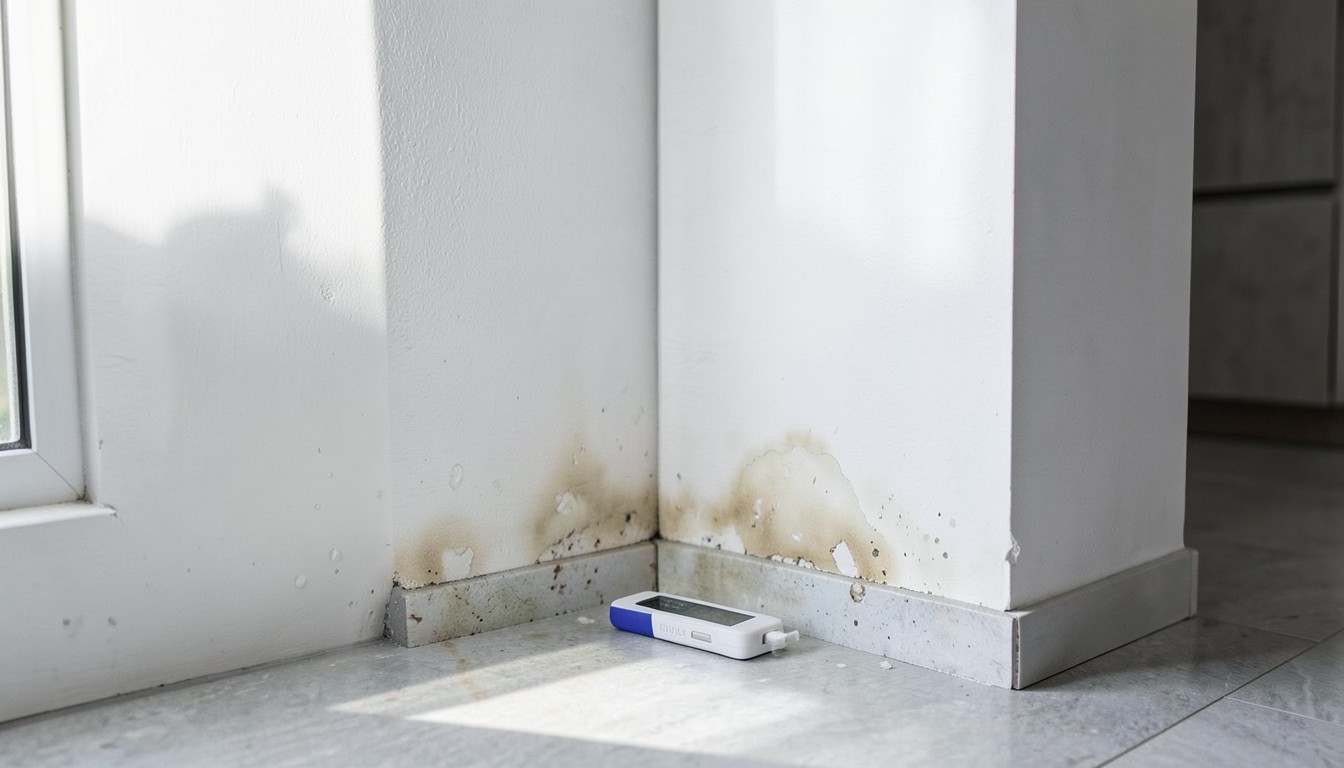
The two dominant Milwaukee-area housing stocks throw very different symptoms. In a pre-1940 Bay View, Riverwest, or Walker's Point Polish-German immigrant brick home, the warning signs cluster around the lath-and-plaster wall envelope — a darkening "tide mark" on plaster baseboard trim, a faint efflorescence bloom on interior brick where a buried supply line weeps behind the wall, hairline cracking at plaster cove returns, or a musty smell near the foundation sill where 80-plus year old galvanized branch lines pinhole at the threading. In Wauwatosa, West Allis, or Brookfield 1950s-70s post-war tract homes, the slab-on-grade pour and copper supply lines flip the signal set — a warm spot on vinyl or carpeted slab over a hot-side pinhole, an unexplained 20%-plus jump on the Milwaukee Water Works bill, the meter low-flow indicator drifting with every fixture off, or condensation lines tracking down poured-foundation walls. Either pattern justifies a detection workup before water tracks farther into framing. NOAA NWS Milwaukee/Sullivan, 2024
What detection methods does a Milwaukee plumber actually run on Polish-German brick?
The Milwaukee detection sequence is calibrated around the city's pre-1940 Polish-German immigrant brick stock and the acoustic-transmission profile that wall assembly creates. A credentialed WI DSPS Master Plumber typically runs (1) a static pressure-isolation test on the supply manifold to confirm the leak is real and to split hot side from cold side, (2) FLIR thermal imaging on accessible slab and exterior brick planes, (3) acoustic ground-microphone triangulation calibrated for the dense brick + lath-and-plaster wall sandwich common to Bay View and Riverwest, and (4) electronic line-tracing to map the original copper or galvanized route before any plaster opening is cut. The Polish-German immigrant brick wall — a triple-wythe load-bearing brick exterior with interior lath-and-plaster — transmits leak acoustics differently than a Wauwatosa post-war drywall-on-stud cavity, so the operator adjusts microphone gain and contact-stethoscope placement accordingly. WI DSPS, 2024
Will a Wisconsin HO-3 policy cover Milwaukee leak detection and lead-pipe issues?
A standard Wisconsin HO-3 policy on a Milwaukee property generally covers the DETECTION fee and the access tear-out (the slab cut, the lath-and-plaster opening, the moisture-mapping report) when the underlying leak is documented as "sudden and accidental" rather than gradual seepage that has been weeping for months. The repair of the failed pipe itself — copper pinhole, galvanized threading failure, brass nipple corrosion — is typically excluded as wear-and-tear. Lead service line questions sit in a separate bucket: WI HO-3 forms generally do not pay to swap out a lead service lateral as a building-material upgrade, but if a covered loss (a freeze-burst, a covered impact event) damages a lead segment, the access and remediation can be partially recoverable. The Milwaukee Water Works lead-service-line replacement program operates on a separate municipal track. Always submit the verified plumber's written report with photos and moisture readings rather than a verbal diagnosis. EPA Safe Drinking Water Act, 2024
How does the Milwaukee Water Works bill expose a hidden leak?
Milwaukee Water Works draws from Lake Michigan and meters every gallon that crosses the curb stop, whether the water lands in your dishwasher or in the soil under a Bay View basement slab. A pinhole on a 60 psi line releases roughly 75–160 gallons per day — invisible at the surface but a 2,250–4,800 gallon-per-month addition to the meter read. On a typical Milwaukee Water Works bill the combined water-plus-sewer charge for that overage runs $35–$95 extra per cycle, and because Milwaukee bills water and sewer together, the sewer side roughly doubles the visible spike. A 20%-plus unexplained increase on two consecutive bills, with no irrigation system, no new occupants, and no seasonal-fill pattern, is the standard trigger for ordering a detection workup. The meter's low-flow indicator drifting with every fixture closed for 15 minutes is the corroborating field check. EPA SDWA, 2024
Can a Milwaukee homeowner narrow down a leak in an older brick home before calling a plumber?
A homeowner on a Riverwest, Bay View, or Walker's Point pre-1940 brick property can confirm a leak EXISTS without specialty equipment but cannot reliably LOCATE it. The DIY confirmation: shut every interior fixture and exterior hose bib, watch the Milwaukee Water Works meter low-flow indicator for 15–20 minutes, and any movement means water is escaping somewhere on the supply side. From there, you can split hot vs cold by closing the water heater inlet valve and re-checking the meter — if the indicator stops, the leak is on the hot manifold. What you cannot do at home: distinguish a buried branch leak inside a triple-wythe brick wall from condensation tracking down lath-and-plaster, or read a slab pinhole through the 4-inch poured topping common to early 20th-century basement floors. Consumer IR thermometers lack the spatial resolution, and rental moisture meters cannot see through brick or concrete. Leave the localization step to a calibrated FLIR and ground-microphone workup.
What is the Lake Michigan freeze-burst detection backlog like January through March?
Milwaukee runs roughly 130 freeze-day-equivalents per winter under the Lake Michigan lake-effect regime, and the detection backlog from January through March reflects that. When a polar-vortex push drops sustained sub-zero air over the lake, exterior-wall supply runs in pre-1940 Bay View and Walker's Point brick homes — where the original galvanized branches sit only a brick-wythe deep — split at the threaded fittings, and Wauwatosa post-war hose bib silcocks weeping behind stucco show up the same week. The Wisconsin Uniform Dwelling Code 42-inch frost line governs service-line depth, but interior branch runs in unheated crawl spaces or cantilevered second-floor bays freeze well above the frost line. Detection scheduling lead times stretch from a same-day post-thaw response in October to 5–10 day queues in late January. Booking a verified plumber early in the thaw cycle, before water visibly tracks, materially shortens repair scope. NOAA NWS Milwaukee, 2024
How accurate is FLIR thermal imaging for a slab leak in cold-ambient Milwaukee conditions?
For a hot-line slab pinhole on a Wauwatosa, West Allis, or Brookfield post-war tract home, a properly calibrated FLIR T-series camera localizes the leak within an 18-inch radius about 84–92% of the time on the first scan during the heating season — the cold-ambient slab in a Milwaukee winter actually amplifies the thermal contrast between the heated leak plume and the surrounding concrete, which improves first-pass accuracy versus a summertime scan. Accuracy drops in three scenarios: (a) cold-side leaks where there is no thermal differential against ambient, (b) thick carpet or insulating cork floor finishes that mute the surface heat signature, or (c) saturated under-slab soil where the leak has been running long enough to spread the thermal plume across the entire room. On pre-1940 brick lath-and-plaster wall leaks the FLIR is necessary but not sufficient — a verified operator confirms every thermal hit with acoustic ground-microphone before recommending where to open plaster.
Should a Milwaukee homeowner run a system-wide pressure test after one detected leak?
Yes if the Milwaukee property is a Wauwatosa, West Allis, or Brookfield post-war tract home with original copper supply or a pre-1940 Bay View brick duplex with original galvanized, and you have already had one pinhole or threaded-joint leak repaired. A system-wide static pressure test runs $165–$310 in the Milwaukee market and isolates each branch — hot, cold, exterior hose bib, irrigation feed where present — holding the system at 80 psi for 15 minutes. Any pressure drop on a single branch flags an additional weak point that has not yet surfaced. Milwaukee-area plumbers consistently report that homes with one confirmed slab pinhole on a 1960s-70s copper hot manifold carry a 35–55% probability of a second pinhole on the same manifold within 36 months. The pressure test is materially lower-cost than a second emergency call plus a second access cut. Copper Development Association, 2024
Are AlertPlumber-matched plumbers verified for leak detection in Wisconsin?
The eLocal partner network requires every plumber routed through AlertPlumber for leak detection on a Milwaukee property to maintain an active Wisconsin DSPS Master Plumber credential rather than a basic apprentice or restricted-scope card. WI Department of Safety and Professional Services, 2024 publishes the public lookup tool to confirm credential status, scope, and any disciplinary record before any work is authorized — the homeowner can search by name or credential number. Leak detection specifically requires specialty equipment (calibrated FLIR thermal imager, acoustic ground microphone, pressure-isolation manifold) plus trained operator experience, so the network screens for diagnostic-equipment ownership in addition to the WI DSPS Master Plumber credential — credentialed status alone does not guarantee detection skill on Polish-German brick stock or post-war slab construction. Local context. A 590,000-resident Milwaukee on Lake Michigan with 7-grain-per-gallon moderately soft Milwaukee Water Works lake-source supply, a pre-1940 Bay View / Riverwest / Walker's Point Polish-German immigrant brick housing core, a Wauwatosa / West Allis / Brookfield post-war 1950s-70s tract ring, a 42-inch Wisconsin UDC frost line, roughly 130 freeze days under lake-effect winters, and a $100 Milwaukee Department of Neighborhood Services permit fee — that pathology is what the matched detection plumber's workflow targets first. USGS Water Hardness, 2024
Request a leak detection callback in Milwaukee
ZIP, phone, kind of work. AlertPlumber routes to a verified plumber for a free over-phone estimate.