
Emergency Leak Detection in Jacksonville, Florida
Locates hidden water and gas leaks using acoustic and thermal equipment. AlertPlumber matches you with a verified FL plumber serving Jacksonville.
Local plumbing data for Jacksonville, FL
Climate angle. Coastal salt-air corrosion + 1970s-90s slab tracts with copper supply produce slab-leak volume. Hard well-source water (~12 gpg) common in suburbs. Hurricane prep + storm-surge backflow drives Jun-Nov sump + check-valve work.
Leak Detection cost calculator — Jacksonville
Pre-filled for leak detection in Jacksonville. Adjust the ZIP for a neighboring area, or change the service to compare. Calculator pulls from the city's scraped permit-fee + state plumber-density data.
Leak Detection in Jacksonville — frequently asked
How much does professional leak detection cost in Jacksonville?
A non-destructive leak detection workup in Jacksonville typically runs $265-$510 flat, billed before any repair quote. The fee is higher than inland Sun Belt metros because Jacksonville's 80%+ summer relative humidity forces an extra calibration step on the moisture-mapping pass — the Tramex meter has to be zeroed against ambient wall moisture before it can flag a true leak signature. The price covers FLIR thermal scanning calibrated for humid-air conditions, acoustic listening on the supply manifold, a static pressure-isolation test, and a written moisture-map suitable for an insurance submission. The Jacksonville Planning and Development Department charges a separate $125 plumbing-repair permit when invasive work follows. The detection fee is usually credited toward repair if you book the same plumber routed through AlertPlumber.
What are the warning signs of a hidden leak in a Jacksonville home?
Jacksonville's coastal humid climate produces a different symptom profile than dry-heat Sun Belt metros. Watch for:
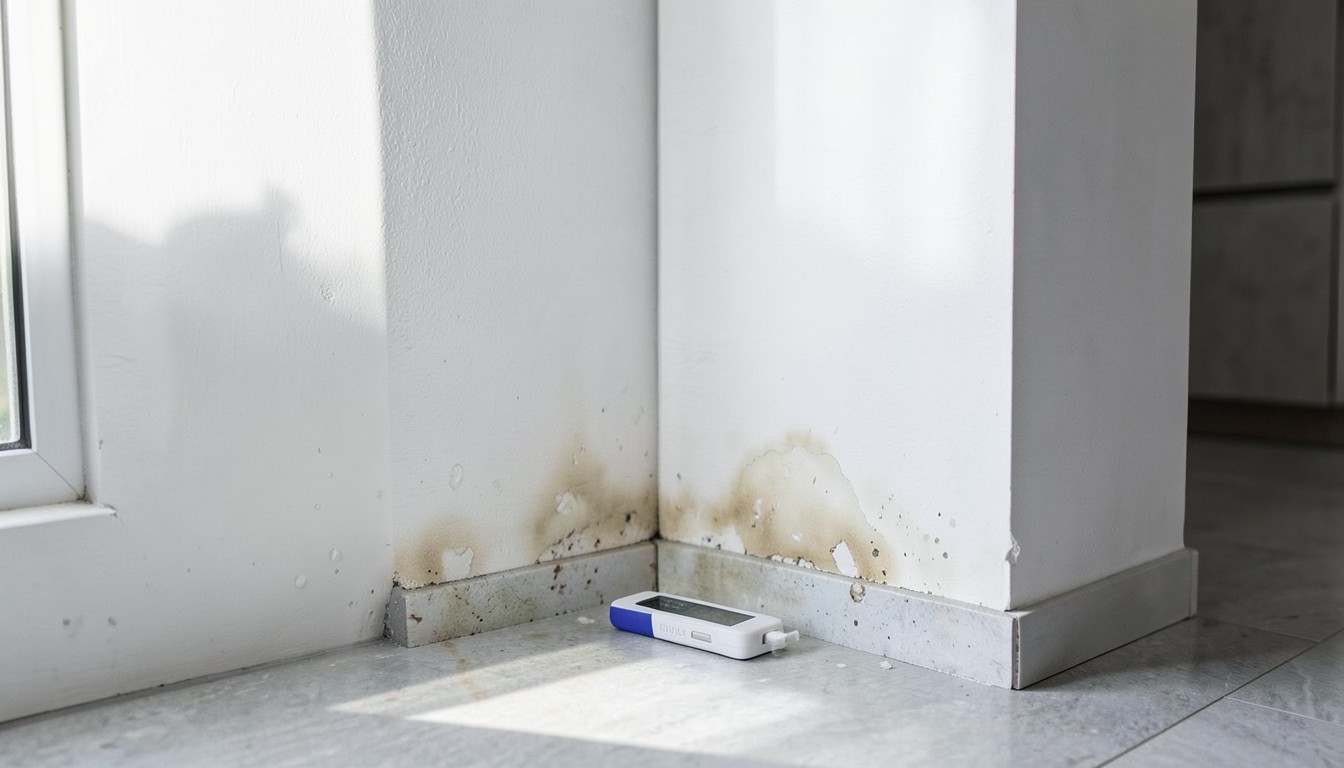
- Persistent musty smell near baseboards on the river-facing side of the house (St. Johns River basin homes get standing humidity that masks early leak odor — once it cuts through, the leak is well established)
- JEA combined bill creeps up without a corresponding electric increase (the water + sewer line on the bill is the diagnostic — JEA bundles electric, water, and sewer, so a pure water spike is easy to miss)
- Tile grout in Mandarin or Arlington slab-on-grade tracts shows hairline darkening along a single line
- Drywall paper bubbling 6-12 inches off the slab in 1970s-80s construction
- Mold blooming on a closet wall behind a shared plumbing chase
Any one of these warrants a detection workup before the wood framing absorbs more moisture.
What detection methods does a Jacksonville plumber actually use?
The Jacksonville standard sequence is: (1) static pressure-isolation test on the supply manifold confirms a leak exists and isolates hot vs cold side, (2) humid-air-calibrated FLIR thermal scan reads the slab or wall surface, (3) Tramex moisture mapping zeroed against ambient 80%+ RH establishes a baseline before flagging the leak signature, and (4) acoustic ground-microphone listening triangulates within 12-18 inches. In post-1982 Duval County construction the tech also runs ground-penetrating radar before any concrete cut to map post-tension cable routes — cutting blind through a tensioned cable in a Mandarin or Southside slab is a serious risk. The detection-side concern is knowing where to scan and where NOT to cut, which differs from the repair-side framing. Older Riverside-Avondale and San Marco housing stock with crawlspace foundations skips the GPR step and goes straight to acoustic on the supply riser.
Will Florida homeowners insurance cover Jacksonville leak detection?
Most Florida HO-3 policies cover the detection fee when the underlying leak is classified as sudden and accidental — not gradual seepage. The Jacksonville-specific trap is the named-storm-deductible vs all-perils-deductible split unique to FL HO-3. If the leak is filed as hurricane-related (storm surge backflow, wind-driven roof penetration above a supply riser), the higher named-storm deductible applies — typically 2% to 10% of dwelling coverage instead of the standard $1,000 to $2,500 all-perils figure. On a $400,000 dwelling that is a $2,000-$40,000 difference. The plumber's written detection report should explicitly tie the failure mode to a non-storm cause when possible (corrosion, age, fixture failure) so the all-perils deductible applies. Submit the moisture-map and pressure-test data with the claim. EPA SDWA defines the pipe-failure categories carriers reference.
Why does the JEA bill make a hidden-leak diagnosis harder in Jacksonville?
Jacksonville is unusual among large US metros because the water utility (JEA, the Jacksonville Electric Authority) issues a single combined bill covering electric, water, and sewer. In most cities a 20%+ water-bill jump triggers an obvious diagnostic flag — in Jacksonville the same jump is buried inside a larger combined total dominated by summer AC electric load. A pinhole leak releasing 100 gallons/day at 60 psi adds roughly 3,000 gallons/month, or about $14.55 in water plus matching sewer at the JEA $4.85 per-1,000-gallon residential rate. That $30 hidden inside a $350-$500 summer bill is invisible without line-by-line review. The diagnostic discipline is to read the water-only meter total and compare quarter-over-quarter at constant occupancy, ignoring the combined-bill summary. JEA's online portal exposes the per-utility breakdown — most customers never click through. Two consecutive cycles of 20%+ water-only increase is the threshold for booking a detection scan.
Can a Jacksonville homeowner narrow down a leak before calling a plumber?
You can confirm a leak exists. Shut every fixture, then watch the JEA meter's low-flow triangle indicator for 15 minutes — any motion confirms water is moving somewhere it should not. You can also walk the slab barefoot at sunrise (before the Florida sun warms the floor) feeling for a warm spot indicating a hot-side slab leak. What you cannot reliably do is locate the leak. Consumer-grade IR thermometers cannot distinguish a slab leak from a sun-warmed grout line in 90°F summer ambient, and rental moisture meters cannot calibrate for the 80%+ relative humidity that saturates Jacksonville interior walls every summer. The FL DBPR lists 8,460 verified plumbers statewide — a credentialed tech with humid-air-calibrated equipment locates the failure faster and at lower cost than the trial-and-error of cutting drywall.
Why does hurricane season change leak-detection scheduling in Jacksonville?
Jacksonville's June-November Atlantic hurricane season compresses the detection-call queue every year. May through October sees a backlog spike as homeowners book pre-storm assessments, post-storm surge inspections, and standard summer slab-leak diagnostic calls all into the same dispatch window. A non-emergency detection appointment that takes 24-48 hours in February can stretch to 5-10 business days in August. Active leak emergencies (water reaching finished floor, pressure dropping below 40 psi at fixtures) still get same-day priority on the network — the queue compression hits the routine moisture-investigation appointments. The dispatch-side workaround: book the diagnostic before the named-storm watch goes up. Once the National Hurricane Center issues a Northeast Florida watch, every credentialed plumber in Duval County triages emergency-only for 72-96 hours. NOAA NHC publishes the seasonal forecast each May.
How accurate is FLIR thermal imaging in Jacksonville's humid summer?
FLIR accuracy in Jacksonville is meaningfully different from the same camera operating in Phoenix. A Phoenix slab scan happens at 20% relative humidity with sharp thermal gradients between leak-warmed concrete and ambient floor — the camera reads a clean differential. A Jacksonville scan at 85% RH sees moisture-saturated air masking small thermal differentials, and evaporative cooling on a leaking surface produces a confused signal. A properly calibrated FLIR T-series in trained hands still localizes a hot-side slab leak within an 18-24 inch radius about 78-85% of the time on the first scan in Jacksonville (vs 85-92% in Phoenix). The compensation is to run the moisture-map and acoustic confirmation as parallel passes rather than sequential — three weak signals triangulated together beat one strong signal alone. Cold-side leaks in Jacksonville almost always require acoustic primary detection because thermal contrast collapses entirely against humid ambient.
Is a system-wide pressure test worth it for an older Jacksonville home?
For Jacksonville housing stock in the 1970-1995 copper-supply era — most of Mandarin, Southside, parts of Arlington, and the Atlantic Beach + Neptune Beach + Jacksonville Beach (East Beaches) coastal stock — a system-wide static pressure test is highly informative. The test runs $165-$295, isolates each branch (hot, cold, irrigation, hose bib), and holds 80 psi for 15 minutes per section. East Beaches homes get an additional consideration: coastal salt-aerosol exposure accelerates copper external pitting, so the failure curve is steeper than inland Mandarin tracts at the same build year. Jacksonville plumbers commonly find that a slab home with one confirmed leak has a 35-55% probability of a second pinhole within 36 months on the same hot manifold. The test data informs whether you spot-repair (lower-cost, $1,400-$3,200 per slab leak) or commit to a $9,500-$18,000 PEX repipe with the $125 Jacksonville Planning permit applied to the repipe scope.
Are AlertPlumber-matched plumbers verified for leak detection in Florida?
The eLocal partner network requires every plumber routed through AlertPlumber for Jacksonville leak detection to maintain active Florida state credentials. FL DBPR, 2024 lists 8,460 active state-credentialed plumbers in Florida. Leak detection requires specialty equipment (humid-air-calibrated FLIR, ground-penetrating radar for post-1982 post-tension slabs, acoustic ground microphones, Tramex moisture mapping) and trained operator experience — confirm credentials via the FL DBPR public lookup before authorizing work. Jacksonville's combination of coastal salt-air exposure, 1970s-90s slab-on-grade tract construction, 12 gpg JEA water, and 80%+ summer humidity produces a distinct detection signature unlike either dry-climate Sun Belt or freeze-belt metros. The matched plumber's workflow targets that pathology — Mandarin slab-on-grade scans, Riverside-Avondale historic-district acoustic-first diagnostics, East Beaches coastal-exposure pressure testing. USGS Hardness Map and Copper Development Association document the pathology drivers.
Request a leak detection callback in Jacksonville
ZIP, phone, kind of work. AlertPlumber routes to a verified plumber for a free over-phone estimate.