
Tankless Water Heater Installation: The Complete Guide
How tankless water heater install works in 2026 — cost, gas vs electric, sizing, payback by gas rate, and per-city pricing with sources.
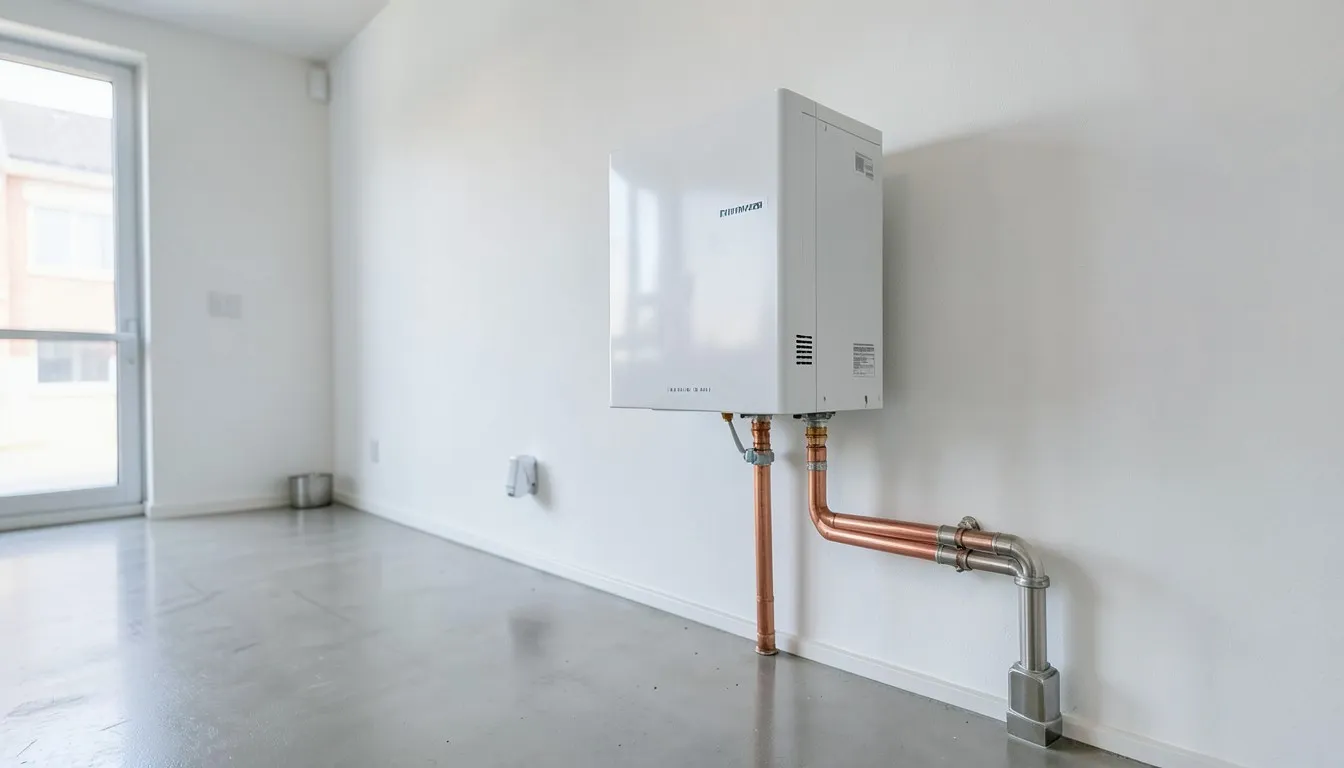
Tankless water heater installation costs $3,200–$6,800 in most US metros for a like-for-like gas replacement (BuildZoom 2024 permit data), with installation premium dropping $800–$1,500 if walls are already open during a remodel. Tankless units deliver 22–34% better energy efficiency than traditional storage tanks per DOE Energy Saver, last 20–25 years versus 8–12 for tanks, and qualify for the IRC §25C federal tax credit (up to $600 for units with ≥0.95 UEF per IRS Energy Efficient Home Improvement Credit). Whether the math works for your household depends on gas rate, demand profile, and ownership horizon.
What is a tankless water heater?
A tankless water heater (also called an "on-demand" or "instantaneous" water heater) heats water only when you turn on a hot-water tap. Unlike a traditional storage tank — which keeps 40 to 80 gallons of water hot 24/7, losing heat continuously to the surrounding air — a tankless unit fires its burner or activates its heating element only when flow is detected at a fixture. The water passes through a finned heat exchanger, gets raised to your set temperature in a few seconds, and travels to the faucet. When you close the tap, the unit shuts off. Standby loss drops to nearly zero per DOE Energy Saver — Tankless Water Heaters.
The technology is mature. Tankless units have dominated residential water heating in Japan and Europe for 50+ years, where small homes and high gas costs made the math obvious decades ago. In the US, adoption accelerated after 2008 when ENERGY STAR began certifying high-efficiency tankless models per ENERGY STAR water heater certification, and again after 2022 when the Inflation Reduction Act expanded the IRC §25C federal tax credit to cover qualifying tankless installations per IRS §25C credit. Per EIA Residential Energy Consumption Survey, water heating represents about 18% of residential energy use — the second-largest end-use after space conditioning — making the efficiency calculation meaningful.
Two fuel types matter for residential whole-house tankless:
- Gas tankless (natural gas or propane) — the dominant residential format. A burner under the heat exchanger fires when flow is detected. Capable of high BTU output (150,000–199,000 BTU/hr typical), which translates to 5–11 gallons-per-minute (gpm) at a 70°F temperature rise per DOE sizing guidance. Requires combustion air, vent termination per IFGC clearance rules, gas supply, and a 120V outlet for the electronics. Roughly 92% of US whole-house tankless installations are gas per AHRI Directory water heater registrations.
- Electric tankless — uses resistance heating elements rather than a flame. Whole-house electric tankless requires extreme amperage (typically 80–120 amps at 240V on a 200A residential panel), which is impractical for many older homes per UL electrical safety standards. Point-of-use electric tankless (under-sink for a single fixture) is common and useful; whole-house electric tankless is a niche product per EIA state electricity profile cost data.
The remaining variants (hybrid heat pump tankless, solar-preheated tankless) are emerging niches. For 2026 retrofit decisions in single-family homes, the practical question is gas tankless versus traditional gas tank. The full economics breakdown is in the tankless vs traditional comparison; this guide focuses on the install side.
Why tankless lasts longer than a tank
A storage tank fails for one of two reasons: (1) the sacrificial anode rod gets fully consumed and corrosion eats through the steel tank wall, typically after 8–12 years per DOE Energy Saver — Selecting a Water Heater, or (2) sediment buildup at the bottom of the tank causes overheating and tank-bottom failure. Tankless units have neither failure mode. There is no tank to corrode and no sediment bed to overheat. Failure modes for tankless are different — heat-exchanger scale, ignition module failure, vent issues — and all are repairable. Replacement of the entire unit is rarely needed before 20–25 years per AHRI manufacturer life-cycle data.
The wall-mount footprint advantage
A tankless unit is roughly 14" wide × 22" tall × 9" deep — it mounts on a wall like a small wall-hung furnace. A traditional 50-gallon tank sits on the floor and occupies a 22" × 22" footprint plus 5 feet of vertical clearance per IRC mechanical clearance rules. In tight mechanical rooms, basements, or garages, that floor space matters. Many remodels free a square of floor for storage, a laundry-room counter, or a furnace-room reorganization simply by going tankless.
Why install a tankless water heater?
Five concrete benefits drive most tankless installation decisions:
1. Energy efficiency: 22–34% lower water-heating bills
Per DOE Energy Saver tankless analysis, gas tankless units use 24–34% less energy than a traditional storage tank for households using under 41 gallons of hot water per day, and 8–14% less for high-use households (86 gallons/day). The savings come from eliminating standby loss — the heat that bleeds out of a tank's walls 24/7. Per ENERGY STAR product comparison, certified tankless units carry Uniform Energy Factor (UEF) ratings of 0.87–0.96, versus 0.55–0.70 for standard storage tanks.
What this means in dollars: a typical 4-person household using 65 gallons of hot water daily spends EIA natural gas pricing approximately $310/year on gas water heating with a standard tank per BLS CPI energy components. Switching to a high-efficiency tankless (UEF 0.95+) drops that to roughly $235/year — a $75 annual savings at national average gas rates. In high-rate metros (Boston, Seattle, Minneapolis where gas runs $1.40+/therm per EIA state energy data), the annual savings can reach $130–$180.
2. Lifespan: 20–25 years versus 8–12 for a tank
Per DOE Water Heating and AHRI manufacturer ratings, gas tankless units that receive annual descaling in hard-water regions routinely operate for 20–25 years. A traditional storage tank averages 8–12 years; tank failures past year 15 are rare. Across a 30-year ownership horizon, a single tankless install replaces 2–3 storage tank replacement events. Each tank replacement runs $1,500–$3,000 installed; avoiding two of those events recovers a meaningful share of the tankless install premium.
3. Endless hot water
A 50-gallon tank stores roughly 30–35 gallons of usable hot water before the cold inflow drops outlet temperature below useful (the "first-hour rating" on the tank's yellow EnergyGuide label per ENERGY STAR labeling). For a household with back-to-back showers in the morning rush, that's the difference between the third person getting a warm shower or a cold one. A correctly sized tankless never runs out — as long as flow stays within its gpm capacity, hot water is continuous per DOE Energy Saver. For households with teenagers, multi-generation living, or rental ADUs, this single benefit often outweighs the cost math entirely.
4. Wall-mount frees floor space
Wall-mounted tankless units free 4–6 sq ft of floor space versus a tank. In a finished basement, a tight mechanical room, a garage, or a laundry-utility combo room, that floor square has practical value — storage shelving, a laundry counter, additional clearance for a furnace service tech per IPC service-clearance rules. Many remodelers install tankless specifically for the layout flexibility, with energy savings as a secondary benefit.
5. IRC §25C federal tax credit ($600 max)
Per IRS Energy Efficient Home Improvement Credit, residential tankless water heaters with UEF ≥ 0.95 qualify for a federal tax credit of 30% of the installed cost, capped at $600. The credit is non-refundable but rolls forward; it applies in the tax year of installation. Combined with state and utility rebates (which vary by location — check with your local gas utility and state energy office), the effective install premium for a qualifying high-efficiency tankless can drop $800–$1,400 versus a standard tank installation.
What tankless does NOT solve
It's worth being clear about the limits:
- It doesn't speed up hot water at the tap. Wait time at distant fixtures is a function of pipe distance + pipe diameter per IPC water distribution chapter, not heater type. A tankless 30 feet from your master bath still has the same 60-second wait as the tank it replaced — the cold "slug" between heater and faucet is identical.
- It doesn't increase shower pressure. Pressure is set by your incoming water service and any pressure-reducing valve. Tankless adds zero pressure.
- It doesn't run during a power outage. The control board, ignition, and venting all need 120V per UL appliance safety. A power-outage day is a cold-shower day even with a "gas" tankless. (Same is true of modern tank water heaters with electronic ignition.)
- It introduces the cold-water sandwich problem. Brief on-off-on tap usage pushes a slug of cold water into the hot-water line — a real annoyance solved by a recirculation pump, covered in section 9 below.
Gas or electric tankless — and what size do you need?
The first install decision is fuel type. The second is capacity. Both have right answers driven by household demand and the existing infrastructure.
Gas vs electric side-by-side
| Factor | Gas tankless | Electric tankless |
|---|---|---|
| Typical capacity | 5–11 gpm @ 70°F rise | 2–8 gpm @ 70°F rise |
| Power draw | 120V outlet for electronics (1A) | 80–120A at 240V (whole-house) |
| Panel requirements | None beyond a 120V outlet | 200A panel min, often 300A+ needed |
| Venting | 4" stainless Cat III/IV vent + intake | None |
| Operating cost (national avg) | $235–$310/yr (4-person home) | $420–$580/yr (4-person home) |
| Install cost (like-for-like) | $3,200–$6,800 | $1,400–$3,200 (point-of-use to whole-house) |
| Lifespan | 20–25 years | 15–20 years |
| Best fit | Whole-house, 3+ person households | Point-of-use (single fixture); ADU; remote outbuilding |
For most 2026 retrofit decisions in single-family homes already on natural gas, gas tankless is the practical option. Per EIA state electricity rates and EIA gas rate data, the kWh-to-therm cost ratio in nearly every US market favors gas for water heating. Electric tankless makes sense in three scenarios: (1) point-of-use under a remote sink (no plumbing-run cost, single faucet load), (2) accessory dwelling units or remote outbuildings where running gas isn't practical, and (3) all-electric new construction with a 300A+ panel and solar offset. Outside those, gas wins on both capacity and operating cost per DOE comparison.
Sizing: BTU/hr capacity and gpm at temperature rise
The single most important install spec on a tankless data plate is gpm at temperature rise per AHRI rating standards. The unit's burner has a fixed BTU/hr output (typically 150,000–199,000 BTU/hr for residential gas tankless). That heat goes into the water flowing through the heat exchanger. Higher flow = less heat per gallon = lower outlet temperature.
The math: gpm × 8.33 lb/gal × temperature rise (°F) ÷ 60 min × 1 BTU/lb·°F = required BTU/min. Multiply by 60 to get BTU/hr.
Example: A 199,000 BTU/hr tankless heating water from 50°F (Northern winter incoming) to 120°F (set point) — a 70°F rise — produces about 5.7 gpm. The same unit heating from 70°F (Sun Belt incoming) to 120°F — a 50°F rise — produces about 8.0 gpm. The same physical unit produces different gpm depending on where you live. Incoming groundwater temperature data per NOAA NWS regional climate offices.
Household demand profile
Add up the simultaneous fixtures your household runs:
- Standard shower: 1.8–2.5 gpm (per EPA WaterSense fixture flow rates)
- Kitchen sink: 1.0–1.5 gpm
- Bathroom sink: 0.5–1.0 gpm
- Dishwasher: 1.0–2.0 gpm (cycle-dependent)
- Clothes washer: 1.5–3.0 gpm (during fill phase)
- Tub fill: 4.0 gpm
A two-shower simultaneous load = 4–5 gpm. Add a kitchen sink running = 5.5–6.5 gpm. A 199,000 BTU tankless in a Northern climate at 70°F rise can handle that. The same two showers in a Sun Belt climate at 50°F rise leave headroom for a dishwasher too.
Common sizing mistakes:
- Sizing to peak fantasy: assuming three showers + two sinks + dishwasher all run simultaneously. They don't. Real-world peak load in a 4-person household is rarely above 6 gpm.
- Sizing to nameplate: a unit's "9 gpm" rating is at a 35°F rise. In Minneapolis with 40°F incoming water and a 120°F set point, that "9 gpm" unit produces 4–5 gpm.
- Sizing too small to save $400: an undersized unit runs at full capacity continuously, shortens its lifespan, and produces lukewarm water during peak. The cost of right-sizing now is far less than upgrading in 3 years.
For 3-bedroom houses with 1–2 baths
140,000–160,000 BTU/hr (Rinnai RU130, Navien NPE-180, Rheem RTGH-84) is typically the right range per AHRI Directory listings. Cost: $1,000–$1,600 for the unit itself.
For 4-bedroom houses with 2.5–3 baths
180,000–199,000 BTU/hr (Rinnai RU199, Navien NPE-240, Rheem RTGH-95) is typically right per AHRI residential ratings. Cost: $1,500–$2,400 for the unit itself.
For larger homes or multi-unit buildings
Two parallel tankless units in cascade configuration, sharing a manifold. Each unit handles roughly half the load and one operates as backup per IFGC multi-unit installation rules. Cost: $3,000–$5,500 for two units plus manifold hardware. Common in 5,000+ sq ft homes and small multi-family installations.
What do you need for gas, venting, electrical, and water?
Tankless install costs vary by 3x between two homes the same age in the same city — and the variance comes almost entirely from the four infrastructure dependencies below. Whether your existing setup matches what tankless requires determines whether you pay $3,200 or $6,800.
1. Gas line sizing (often the largest line item)
A 199,000 BTU/hr tankless unit needs roughly 200 cubic feet per hour (CFH) of natural gas at full fire. Most existing residential 1/2" gas lines feeding a 40,000 BTU storage tank cannot deliver that volume — they were sized for 40 CFH, not 200. Per International Fuel Gas Code (IFGC) Chapter 4, supply pipe sizing tables require 3/4" minimum and often 1" black iron or CSST (corrugated stainless steel tubing) for full residential tankless capacity over typical run lengths.
What this means in practice:
- If your tank is fed by a short run of 3/4" line (rare, but possible in small homes), the existing line may be sufficient per IFGC sizing tables.
- If your tank is fed by 1/2" line — the typical case — the plumber needs to upsize from the meter or the nearest tee with adequate capacity. Run length of 25–60 ft is common; cost runs $400–$1,400 in materials and labor per BLS plumber labor rates.
- If your home's overall gas service is undersized (small meter, small house regulator) for tankless + furnace + range simultaneous load, the gas utility may need to upgrade the meter — usually free, but takes a separate scheduling step.
Always have the plumber perform a gas pressure and capacity calculation before quoting. The IFGC tables per IFGC § 402 give pipe-diameter-by-distance values; the plumber should show you which row applies to your installation. A plumber who quotes tankless without this calculation either gets it wrong (undersized line = unit doesn't fire at full capacity = lukewarm water) or hides a $400–$1,400 change order until install day.
2. Venting: 4" stainless Category III/IV
Tankless units fall into venting Categories III or IV per IFGC Chapter 5:
- Category III (non-condensing): vent gas exits the unit hot (300–500°F). Requires special-alloy stainless steel vent (typically AL29-4C) rated for the temperature and any acidic condensate. Vents through a sidewall or roof per manufacturer's stated termination clearances.
- Category IV (condensing): vent gas is cooled by a secondary heat exchanger (extracting more BTU per cubic foot of gas burned) and exits at 100–140°F. PVC or polypropylene venting is allowed, which is much lower-cost than stainless. Condensate (water + mild acid) drips from the secondary exchanger and needs a drain. Condensing units are typically the higher-UEF models eligible for the §25C tax credit.
Vent termination has clearance rules per IFGC § 503: typically 4 feet from any operable window, 1 foot above grade or snowline (substantially more in snow country per NOAA snow climatology), 4 feet from gas regulators, and clear of building corners that could cause recirculation. Improper vent termination is a documented source of CO incidents per CPSC carbon monoxide alerts. Many install delays come from realizing on day 1 that the obvious vent path violates clearance.
Cost of venting:
- Condensing PVC vent through a sidewall (10–15 ft run): $200–$500 in materials
- Non-condensing stainless vent through a roof (15–25 ft run): $700–$1,500 in materials
- Concentric (2-pipe-in-1) PVC kit through a single sidewall penetration: $250–$400
- Labor for cutting the wall/roof penetration and installing the vent: $400–$800
3. Electrical: 120V outlet for the controls
Even gas tankless units need 120V power for the ignition module, the flow sensor, and the control board. The unit draws under 1 amp continuously per AHRI electrical specs. A standard 120V outlet within 6 feet of the unit satisfies the requirement. Per UL safety standards for residential heating equipment, the outlet should be GFCI-protected if it's in a wet location (basement, garage exposed to floor flooding).
If no outlet exists in the install location, the electrician adds one — typically $150–$300 for a 25-ft run from the panel per BLS electrician labor rates. Most homes have an outlet within reach of the existing tank's location, so this is rarely a major line item.
4. Condensate drain (condensing units only)
Category IV condensing units produce 0.5–1.5 gallons of condensate per hour of operation per DOE condensing equipment overview. The condensate is mildly acidic (pH 3.5–5.5) and must drain to a code-approved location. Per IPC § 312, condensate should NOT drain directly to a soil/storm sewer without neutralization in some jurisdictions; a small acid-neutralizer cartridge (limestone media) installed inline neutralizes pH before discharge.
Drain options:
- Gravity drain to a floor drain or laundry standpipe: cleanest, $50–$150 in PVC + neutralizer
- Condensate pump if no gravity drain available: $150–$300 installed
- Drain into the wash basin standpipe: code-allowed in most jurisdictions; verify locally
5. Water hardness pre-treatment (regions >7 grains per gallon)
Per USGS water hardness map, large portions of the US — Phoenix, Las Vegas, much of Texas, parts of the Midwest — exceed 7 grains per gallon (gpg) hardness. Hard water deposits calcium carbonate scale on the inside of the heat exchanger, reducing efficiency by 1–2% per millimeter of scale and ultimately damaging the exchanger. Per AHRI installation guidelines, manufacturers void warranty for units installed in >7 gpg water without descaling pre-treatment or annual descaling service.
Two pre-treatment paths:
- Whole-house water softener — the comprehensive solution. Removes hardness throughout the home (also extends life of dishwasher, washing machine, fixtures per ASSE plumbing standards). Cost: $1,500–$3,500 installed. Worth it if you don't already have one and live in a >10 gpg region.
- Inline scale-prevention cartridge dedicated to the tankless (sold by every major brand) — protects the tankless only, doesn't soften whole-house water. Cost: $300–$600 installed; cartridge change every 6–12 months at $40–$80.
If neither pre-treatment is in place, annual professional descaling service becomes mandatory to maintain warranty per AHRI warranty terms. That's $150–$250 a year forever — manageable, but it should be in the long-run cost picture.
What does tankless installation cost in 2026?
National install cost ranges (per BuildZoom 2024 permit data + BLS plumber wages OES 47-2152 + AHRI manufacturer pricing):
- Standard like-for-like gas tankless install (replacing a gas tank): $3,200–$6,800
- High-efficiency condensing tankless install (UEF 0.95+, qualifying for §25C): $3,800–$7,500
- Cold-climate retrofit with gas line upsize + new vent run: $5,500–$8,400
- New construction or remodel-with-walls-open install: $2,400–$4,800 (saves $800–$1,500)
- Tank-to-tankless conversion in an unfinished basement (good access): $3,800–$5,800
- Tank-to-tankless conversion in finished mechanical closet (limited access): $5,200–$8,200
- Whole-house electric tankless (200A panel exists): $2,800–$5,400
- Point-of-use electric tankless (single-fixture under-sink): $400–$900
- Cascade dual-tankless system (large home or small multi-family): $7,500–$13,000
- Permit fees: $85–$425 depending on city (see per-city table below)
- Recirculation pump add-on (eliminates cold-water sandwich): $300–$700 hardware + $150–$400 install labor
- Whole-house water softener (hard water regions): $1,500–$3,500
- Annual descaling service (after install): $150–$250/yr
What drives the variance
Two tankless installs at $3,500 and $6,800 in the same city differ on these factors:
- Gas line upsize required. Adds $400–$1,400 per IFGC sizing math (sometimes $2,000+ for long runs through finished walls). Largest single variance driver.
- Vent type and length. Condensing PVC vent through a sidewall: low-cost. Non-condensing stainless through a roof: $700–$1,500 more.
- Wall opening / drywall work. Going from a closet location to a wall-hung installation in an unfinished basement: simple. Doing the same in a finished room: drywall removal + patching + paint = $400–$1,200 in additional labor per BLS construction-labor data.
- Unit selection. Standard non-condensing tankless: $1,000–$1,500 for the unit. High-efficiency condensing tankless: $1,400–$2,400. Premium concentric-vent units with built-in recirculation pump: $2,000–$2,800.
- Permit + inspection fees. Per the city table below.
- Removal + disposal of the old tank. $75–$200 typical, sometimes bundled in the install quote.
- Pre-treatment requirements. Hard water region without softener (>7 gpg per USGS hardness map): add $300–$600 for inline scale cartridge minimum.
The "remodel-with-walls-open" advantage
If you're already opening walls for a kitchen or bathroom renovation, the install premium for tankless drops $800–$1,500 per BLS labor cost data. The reason: gas line upsize, vent run, and condensate drain are dramatically lower-cost when the wall cavity is already exposed and the carpenters are already on site. If a tankless install is in your 5-year horizon AND you have a renovation planned, push to coordinate them — it's often the single biggest cost saver.
Federal and utility incentives reduce net cost
Per IRS §25C credit, tankless units with UEF ≥ 0.95 qualify for 30% of installed cost up to $600 in federal credit. Many state energy offices and gas utilities (Xcel, National Grid, NSTAR, SoCalGas, Dominion, etc.) offer additional rebates of $100–$500 for qualifying high-efficiency installations. Combined: $700–$1,100 in incentive value reducing the net install cost. Verify with your specific utility — incentives change yearly per ENERGY STAR rebate finder.
For a ZIP-localized estimate, the AlertPlumber cost calculator incorporates per-city labor rates, permit fees, and known utility rebates.
What does tankless installation cost by city in 2026?
Permit fees, labor rates, gas rates, and climate-driven sizing requirements all push install costs around. AlertPlumber tracks per-city data across major US metros:
| City | Permit fee | Standard install | High-eff condensing | Source |
|---|---|---|---|---|
| Phoenix, AZ | $165 | $3,400–$5,800 | $4,200–$6,800 | Phoenix Development Services |
| Boston, MA | $110 | $4,400–$7,400 | $5,200–$8,200 | Boston ISD |
| Atlanta, GA | $125 | $3,600–$6,200 | $4,400–$7,200 | Atlanta City Planning |
| Seattle, WA | $185 | $4,200–$7,000 | $5,000–$7,800 | Seattle SDCI |
| Dallas, TX | $145 | $3,500–$6,000 | $4,200–$7,000 | Dallas SDC |
| Chicago, IL | $225 | $4,200–$7,200 | $5,000–$8,200 | Chicago Buildings |
| Houston, TX | $135 | $3,400–$5,900 | $4,200–$6,900 | Houston Public Works |
| Minneapolis, MN | $95 | $4,500–$7,600 | $5,400–$8,400 | Minneapolis Regulatory Services |
Why cold-climate cities cost more
Boston, Minneapolis, Chicago, and Seattle all push tankless install costs higher than Sun Belt metros. Three reasons:
- Larger BTU sizing required. A Minneapolis install needs a 199,000 BTU/hr unit to handle a 70°F+ temperature rise per NOAA winter water-temperature data. A Phoenix install runs comfortably at 160,000 BTU/hr. Bigger units cost $400–$700 more.
- Vent termination snowline clearance. Per IFGC § 503.8, vent termination must clear typical snow accumulation. In Boston and Minneapolis that's typically 24"+ above grade per NOAA snow data; in Phoenix it's the standard 12". The longer vent run adds $200–$500.
- Freeze-protection accessories. Cold-climate installs typically include a freeze-protection kit (heat tape on exposed water lines + insulated condensate routing) to prevent winter freeze damage. $150–$400 added.
Why Sun Belt cities trend lower
Phoenix, Atlanta, Dallas, and Houston benefit from warmer incoming water (50–70°F vs 35–45°F in winter for Northern cities), allowing smaller BTU units to deliver the same gpm. Year-round work with no winter access constraints. Higher water hardness in Phoenix and Dallas (per USGS hardness map) does add $300–$600 in pre-treatment, but the overall install math still favors the Sun Belt.
Why Seattle is its own thing
Mild climate suggests Seattle should match Phoenix on cost. It doesn't, for two reasons: (1) Seattle's labor market and BLS plumber wages for Western Washington both run high, and (2) Seattle SDCI permit + inspection process is more rigorous than most cities. Net: Seattle install costs typically run 15–20% above national average even on simple jobs.
Per-city quote process
The matched plumber on the AlertPlumber call back has live access to per-city permit fees, gas-rate-driven payback math, and licensed-contractor rosters. Get a written estimate before any work, or use the cost calculator for a ZIP-localized number first.
Payback math: when does tankless ROI make sense?
The honest answer: tankless pays back fast for some households and never pays back for others. The math hinges on three variables — gas rate, household demand, and ownership horizon. Per EIA natural gas residential pricing, US natural gas rates ranged $0.85–$2.10 per therm across major metros in 2024, a 2.5x spread. That spread is the single largest determinant of tankless ROI.
The base calculation
Tankless install premium over a like-for-like tank replacement is typically $1,500–$3,000 per BuildZoom permit cost analysis. That premium has to be earned back through annual fuel savings before the unit pays for itself. Annual fuel savings = (annual therms used for water heating) × (gas rate $/therm) × (efficiency improvement, typically 20–30% per DOE efficiency comparison).
Payback by gas rate (4-person household, 65 gal/day hot water)
| Gas rate ($/therm) | Example metro | Annual savings | Premium recovery (yr) | Net 20-yr value |
|---|---|---|---|---|
| $0.85/therm | Texas (low NG cost) | $48 | ~42 yr | Negative — won't pay back |
| $1.10/therm | Phoenix, AZ | $72 | ~28 yr | Marginally negative |
| $1.30/therm | Atlanta, GA | $95 | ~21 yr | Roughly breakeven |
| $1.55/therm | Chicago, IL | $128 | ~16 yr | +$700 net positive |
| $1.80/therm | Boston, MA | $165 | ~12 yr | +$1,400 net positive |
| $2.05/therm | Seattle, WA / NYC | $205 | ~9 yr | +$2,300 net positive |
Source: EIA Natural Gas Prices to Residential Consumers, applied to a baseline of 240 therms/year for water heating in a 4-person household with a 0.62 UEF tank replaced by a 0.93 UEF tankless.
What the table tells you
- If your gas rate is below $1.20/therm, tankless rarely earns its install premium back through fuel savings alone. The decision becomes about non-financial benefits: endless hot water, lifespan, floor space, lifestyle.
- If your gas rate is $1.20–$1.50/therm, payback lands 14–22 years out — close to the unit's expected lifespan. Marginal call; lean toward tankless if you also value endless hot water or are doing a remodel.
- If your gas rate is above $1.50/therm, tankless pays back in 9–16 years and produces meaningful net positive value over a 20-year horizon. Strong choice.
- If your gas rate is above $1.80/therm (Boston, Seattle, NYC, much of New England), tankless is essentially a no-brainer purely on financial terms.
The lifespan factor magnifies the math
The tables above only count fuel savings. They DON'T count avoided tank replacements. A traditional tank lasts 8–12 years per DOE Water Heating; a tankless lasts 20–25 years per AHRI life-cycle data. Across a 25-year horizon, the tankless household installs ONE water heater; the tank household installs THREE. Each tank replacement adds $1,500–$3,000 to lifetime cost. Including avoided replacements, tankless adds $3,000–$6,000 of lifetime value beyond just the fuel savings — which dramatically improves the payback math even at low gas rates.
Household size matters too
The tables assume 4-person households per US Census ACS household-size data. For 1–2 person households, hot water demand is 30–35 gal/day; annual fuel use drops to 100–130 therms; annual savings drop proportionally; payback stretches by 1.5x–2x. For 5+ person households or homes with rental ADUs, demand exceeds 100 gal/day and savings grow faster — payback can land in 6–9 years even at moderate gas rates.
The remodel-coordination shortcut
If you're already doing a kitchen or bathroom renovation, the install premium drops $800–$1,500 because gas line and vent work are dramatically lower-cost with walls open. That single factor can move payback from 14 years to 8 years — fundamentally changing the answer per BLS construction labor productivity. Always check whether a tankless install can be coordinated with planned construction.
Brand selection and AHRI certification
Five manufacturers dominate residential tankless in the US market. All five maintain AHRI Directory certification, meaning their published gpm, BTU, and UEF specs are independently verified. Reputable plumbers stock and warranty units from these brands; off-brand or import-only units risk parts-availability and warranty problems down the line.
Major residential brands
- Rinnai — Japanese-origin, US-assembled. Largest US market share per AHRI Directory market data. Strong dealer network for parts and service. Range from RU130 (140K BTU) through RU199 (199K BTU). Condensing models in the SE+ series qualify for §25C credit per IRS guidance.
- Navien — Korean-manufactured. Known for high-efficiency condensing units and integrated recirculation pump options (NPE-S series). NPE-180A, NPE-240A2 are popular residential picks. Strong for technology features (integrated WiFi, app monitoring).
- Rheem — US-manufactured. Strong dealer network through plumbing wholesalers nationwide. RTGH-95DVLN (condensing) and RTG-84XLN (non-condensing) are common. ENERGY STAR certified models qualify for §25C.
- Noritz — Japanese, US-distributed. Compact form factor. NRC and NRCB series cover residential range. Strong reputation for build quality per CSA certification listings.
- Bosch / Bosch Thermotechnology — German-engineered. Greentherm series is the residential condensing line. Strong fit for European-style installations.
What AHRI certification means
AHRI (Air-Conditioning, Heating, Refrigeration Institute) is the industry's third-party performance verification body. Manufacturers submit units for testing; AHRI publishes certified gpm-at-rise, BTU input, and UEF ratings. Two reasons this matters:
- Apples-to-apples comparison. A "9 gpm" claim from manufacturer A and a "9 gpm" claim from manufacturer B are only comparable if both are tested under the same conditions. AHRI specifies the test protocol, so AHRI-certified specs are directly comparable.
- Tax credit + utility rebate eligibility. Most §25C and utility rebate programs require AHRI certification + ENERGY STAR listing. Buying off-brand from an unverified source disqualifies you from $600+ in incentive value.
Safety certifications: UL + CSA
Beyond performance certification, residential tankless units need safety certification to UL or CSA standards (typically UL 174 + ANSI Z21.10.3 for gas tankless per ASSE referenced standards). Local code inspectors check for the certification mark on the data plate during install inspection. All major-brand units carry this; off-brand imports sometimes don't, and the inspector will fail the install.
What to avoid
- Direct-import units sold through generalist online marketplaces without US service network
- Units without an AHRI certificate visible on the manufacturer's product page
- Models more than 2 years past the manufacturer's "current" product line — replacement parts get hard to source
- "Rebadged" or private-label units sold under retailer house brands without AHRI listing
What is the cold-water sandwich, and how do you fix it?
The single biggest tankless usability complaint isn't efficiency — it's the "cold-water sandwich." Understanding what causes it and how to fix it should be part of any tankless install conversation.
What the cold-water sandwich is
You turn on the kitchen faucet for 10 seconds to rinse a dish. The unit fires, hot water flows. You shut off the faucet. The unit shuts off, but the hot water in the pipe between the unit and the faucet stays in place. 30 seconds later, you turn the faucet back on. The first water out is the slug that was sitting in the pipe (still warm). Then comes a brief slug of cold water (the "sandwich filling") because the unit needed 1–3 seconds to detect flow, fire the burner, and reheat. Then hot water resumes.
For continuous use (long shower, sustained dishwashing), the cold-water sandwich never appears. For short on-off cycles (rinsing, hand-washing, brief faucet use), it's a real annoyance. The temperature drop is small (15–25°F) but noticeable per DOE on-demand water heating overview.
Three solutions
1. Recirculation pump (most effective)
A recirculation pump continuously moves a small flow of hot water through the supply lines, keeping the line between the tankless and the farthest fixture hot at all times. When you turn on a tap, hot water arrives immediately and there's no sandwich.
Two recirc configurations:
- Dedicated return line — the gold standard. A separate small-diameter pipe runs from the farthest fixture back to the tankless unit. The pump moves water in a continuous loop. Works for any plumbing layout. Requires running a new return line (easy in new construction or remodel; expensive retrofit in finished homes).
- Crossover valve at the farthest fixture — uses the cold-water line as the return path. A thermostatic valve at the farthest fixture allows hot water to bleed into the cold line until the hot line is at temperature; then the valve closes. Doesn't require new piping; works in any home. Slightly less effective than a dedicated return line.
Cost: $300–$700 for the pump and valve hardware, $150–$400 install labor per BLS plumber labor data. Many high-end tankless models (Navien NPE-S series, Rinnai SE+ series) include the pump integrated into the unit, simplifying install and saving labor cost.
The energy trade-off: a recirc pump that runs continuously consumes fuel to keep the pipe hot 24/7 — which partially defeats the standby-loss advantage of tankless. The mitigation: smart recirc pumps with motion sensors or scheduled run times (only run during morning + evening peak windows) recover most of the energy benefit while still delivering the no-sandwich experience.
2. Built-in mini-tank tankless models
Some Rinnai SE+ models and Navien NPE-S models include a small (0.5–1.5 gallon) buffer tank inside the unit. The buffer holds enough hot water to absorb short on-off cycles without the heat exchanger needing to fire. Eliminates the cold-water sandwich entirely for short-use cases. Usually adds $200–$400 to the unit price; no extra install labor.
3. Behavior change (free)
For households on a budget, the simplest "fix" is to keep brief uses brief (don't turn the tap off and back on within 30 seconds for short tasks) and accept the occasional cold slug for what it is. Not a real fix, but it's free.
Recommendation
For households where multiple people do dishes throughout the day or use brief hot-water tasks frequently, spec the tankless install with a recirc pump from day one. Adding it later costs more than including it in the original install. For households where hot water is mostly used in extended bursts (showers, baths, dishwasher cycles), the sandwich is rare enough that the recirc pump may not be worth the added cost.
How do you maintain a tankless water heater and avoid failures?
A tankless water heater isn't "install and forget." It rewards minor annual attention and punishes neglect — particularly in hard-water regions. The good news: maintenance is straightforward and the failure modes are repairable, not "buy a new unit" events.
Annual descaling: the single most important maintenance task
Per AHRI maintenance recommendations and every major manufacturer's warranty terms, tankless units in regions with water hardness above 7 grains per gallon (gpg) require annual descaling. Per USGS, that includes most of the West (Phoenix, Las Vegas, Denver), much of Texas (Dallas, San Antonio, Austin), and pockets of the Midwest (Indianapolis, Wichita, Omaha). Hard-water scale also reduces dishwasher and clothes-washer life per DOE appliance maintenance.
Descaling is a 45–90 minute procedure:
- Shut off cold supply, gas, and 120V power to the unit.
- Connect a small pump to the service ports (most modern tankless units have isolation valves and service ports built in for exactly this purpose).
- Circulate 1–2 gallons of food-grade white vinegar (or commercial descaler) through the heat exchanger for 45–60 minutes.
- Flush with clean water for 5–10 minutes to remove residual descaler.
- Restore service.
Cost:
- DIY: $0 (vinegar from kitchen) to $30 (commercial descaler kit)
- Plumber service call: $150–$250 typical
If you're handy and your unit has the standard isolation valves + service ports, DIY is straightforward — there are clear manufacturer videos for every major brand. If you're not, the $200/year service call is the price of avoiding a $1,500 heat-exchanger replacement at year 8.
Annual visual inspection (free, 5 minutes)
Once a year, look at:
- Vent termination outside — clear of debris, snow, leaves, nests per IFGC vent maintenance
- Combustion air intake (if separate from vent) — same check
- Condensate drain line — verify it's clear and flowing freely
- Inline filter (most units have a small filter on the cold inlet) — clean if dirty
- Any error codes on the front display — note and look up in the manual
Freeze protection (cold climate critical)
In sub-freezing climates, tankless units (and especially their condensate drains and exposed water lines) need active freeze protection. Per IFGC requirements and per CPSC residential heating safety guidance, options include:
- Install location indoors with ambient temperature above 40°F at all times (basement, conditioned mechanical room — ideal)
- Heat tape on exposed water lines + insulating wrap (for garage or unheated basement installs)
- Built-in freeze-protection electric resistance heaters (most modern units include these — they fire if the unit detects internal water below 38°F)
- Insulated routing of condensate drain to prevent line freeze (a frozen condensate line backs up condensate into the unit and shuts it down)
Common failure modes (and fixes)
1. Scale buildup in heat exchanger
The most common long-term failure. Calcium carbonate deposits inside the heat exchanger reduce heat transfer efficiency, then eventually narrow the water passages enough to trigger overheat shutdowns. Caught early via annual descaling: prevented entirely. Caught late: heat-exchanger replacement is $400–$1,200 in parts plus 2–4 hours of labor — manageable, but the kind of bill that makes you wish you'd descaled.
2. Ignition module failure
Symptoms: the unit clicks but doesn't fire; error code on display referring to ignition fault; intermittent ignition that gets worse over weeks. Cause: dirty flame sensor, failed igniter, or failed ignition control board. Replacement parts are available from manufacturer parts distributors; cost runs $150–$400 in parts + 1–2 hours of labor.
3. Vent system problems
Symptoms: unit shuts off intermittently with vent-related error codes; condensate inside the vent line; visible water staining at vent termination. Cause: vent obstruction (animal nest, ice dam, debris), improper slope (condensate not draining), or deteriorating vent sealant at joints. Inspection + cleanout: 1–2 hours plumber labor; vent re-pitching: 2–4 hours plus materials. Important: do NOT continue to operate a unit with vent problems — incomplete combustion can produce CO per CPSC carbon monoxide warnings.
4. Flow sensor failure
The flow sensor tells the unit when to fire. If it fails, the unit doesn't fire when you turn on the tap. Low-cost part ($30–$80) but requires opening the unit. 1 hour labor.
5. Cold-water sandwich getting worse over time
A worsening sandwich often indicates the flow sensor's responsiveness is degrading or scale buildup is slowing flow detection. Descaling often resolves; if not, flow sensor replacement does.
What permits do you need, and what happens on install day?
Tankless installations always require a city plumbing permit + gas permit + a verified plumber. Most US jurisdictions follow International Fuel Gas Code (IFGC) for the gas/venting side, International Plumbing Code (IPC) for the water side, and International Residential Code (IRC) Chapter 28 for residential mechanical systems generally. West Coast and Mountain states often follow Uniform Plumbing Code (UPC) instead.
What a permit does for you
- Inspection at completion — a city inspector verifies gas line sizing, vent termination clearances, condensate drain, AHRI/UL certification, and proper combustion air supply
- Insurance protection — un-permitted gas work voids most homeowners insurance claims related to fire, CO incidents, or gas leaks per Insurance Information Institute
- Tax credit eligibility — the §25C federal credit per IRS guidance requires evidence of proper installation; closed-out permits + the manufacturer's AHRI certificate are the documentation
- Resale disclosure — closed-out permits show on title searches and prove to future buyers that the work was done correctly
- Safety — vent clearances and gas-line sizing exist because shortcuts kill people; the inspection is the third-party check that the install actually meets code
Examples of local requirements
- Phoenix, AZ: $165 plumbing + gas permit through Phoenix Development Services; plumber must hold active C-37 license verified through AZ ROC; condensate drain code-compliant per IPC.
- Boston, MA: $110 permit through Boston ISD; plumber must hold MA master plumber license verified through MA Board; vent termination per IFGC + Massachusetts amendments (often 4 ft from any opening, 3 ft from forced air intake).
- Minneapolis, MN: $95 permit through Minneapolis Regulatory Services; license verified via MN DLI; freeze protection mandatory; vent termination minimum 24" above grade for snow clearance.
- Atlanta, GA: $125 permit through Atlanta City Planning; gas-line sizing calculation submitted with permit application.
- Seattle, WA: $185 permit through Seattle SDCI; energy-code compliance documentation required (Seattle has stricter-than-state energy code).
- Dallas, TX: $145 permit through Dallas SDC; plumber must hold active state license verified through TSBPE.
- Chicago, IL: $225 permit through Chicago Buildings; combined plumbing + gas permit; pre-work + final inspection both required.
- Houston, TX: $135 permit through Houston Public Works; gas-line capacity calc submitted with permit.
What to expect on install day
An experienced tankless installer follows roughly this sequence:
- Arrival + walk-through (15-30 min). Confirm install location, confirm gas line + vent path + electrical outlet. Lay drop cloths.
- Drain + remove old tank (45-90 min). Shut off water supply, drain the tank to a hose run outside or to a floor drain, disconnect gas + water + flue, remove the unit.
- Gas line work (1-3 hours). Run new 3/4" or 1" black iron / CSST gas line per the load calc. Pressure test the new line per IFGC § 406.
- Vent installation (1-3 hours). Cut wall or roof penetration; install vent and intake (or concentric kit); seal weatherproof terminations.
- Mount tankless unit (45-90 min). Wall-mount with manufacturer-supplied bracket; connect water lines (with isolation valves + service ports for future descaling).
- Condensate drain (30-60 min). Run condensate from the unit to the floor drain or condensate pump; install neutralizer cartridge if local code requires.
- Power + commissioning (30-60 min). Plug in the 120V power, set water temperature, run flow tests at multiple fixtures, verify burner ignites cleanly, walk you through controls.
- City inspection (separate appointment, 1-3 days later). Inspector verifies gas pressure test, vent clearances, condensate drain, code compliance. Approve = permit closes out.
Total install: 5-9 hours typical for a like-for-like replacement; 8-14 hours if gas line upsize or new vent path is involved per BLS plumbing-trade time studies. Most homes go 4-8 hours without hot water during install.
Verifying the plumber
Verify the plumber's license with the appropriate state board — CSLB (California), TSBPE (Texas), AZ ROC (Arizona), DBPR (Florida), MA Board, MN DLI — BEFORE signing the work agreement. Per BLS, there are roughly 458,000 licensed plumbers in the US; verifying takes 30 seconds and protects against contractor fraud.
What to ask before signing the quote:
- "Have you done the gas line load calculation? Can I see it?"
- "What brand and model are you installing? Is it AHRI certified? Is it ENERGY STAR rated for §25C?"
- "What permits are you pulling, and what's the fee?"
- "What's the vent path?" (should match what you walk together)
- "What's the warranty?" (industry standard: 12-year heat exchanger, 5-year parts, 1-year labor)
- "Do you carry contractor liability insurance? Can I see the certificate?" ($1M minimum standard)
- "Will you handle the §25C tax-credit documentation, including the AHRI certificate and product specification sheet?"
- "What's your cold-water sandwich solution — recirc pump, mini-tank model, or accept the sandwich?"
A plumber who answers all of these in 30 seconds with documentation in hand is the right plumber. AlertPlumber's network only matches you with plumbers who pass license verification, carry $1M+ insurance, and can document their tankless install experience. Request a callback for a over-phone diagnostic.
Need a tankless water heater installation callback?
ZIP, phone, kind of work. AlertPlumber routes to a verified plumber for an over-phone estimate.
Tankless Water Heater Installation by city
City-specific pricing, code references, climate-driven pathology, and frequently-asked questions for the 12 cities where AlertPlumber ships tankless water heater installation pages today.
- Tankless Water Heater Installation in Phoenix, AZ →
- Tankless Water Heater Installation in Boston, MA →
- Tankless Water Heater Installation in Minneapolis, MN →
- Tankless Water Heater Installation in Atlanta, GA →
- Tankless Water Heater Installation in Seattle, WA →
- Tankless Water Heater Installation in New York, NY →
- Tankless Water Heater Installation in Los Angeles, CA →
- Tankless Water Heater Installation in Chicago, IL →
- Tankless Water Heater Installation in Dallas, TX →
- Tankless Water Heater Installation in Houston, TX →
- Tankless Water Heater Installation in Philadelphia, PA →
- Tankless Water Heater Installation in San Jose, CA →
What else do people ask about tankless water heater installation?
How long does tankless water heater installation take?
For a like-for-like gas replacement (existing gas tank being swapped out, gas line and vent already adequate): 5-7 hours typical. For a retrofit requiring gas line upsize and a new vent path: 8-14 hours, sometimes spread across 2 days. The home is without hot water for the duration of the install plus the time required for the unit to come to temperature on first fire (a few minutes).
Is a tankless water heater worth it?
It depends on three things: (1) your gas rate, (2) household size, and (3) how long you plan to live in the house. Per EIA gas pricing, gas rates above $1.50/therm produce 9-16 year payback for a 4-person household. Below $1.20/therm, tankless rarely pays back through fuel savings alone — but the lifespan advantage (20-25 years vs 8-12 for tanks per DOE) and avoided second-tank-replacement still adds $3,000-$6,000 of lifetime value. The full math is in the tankless vs traditional comparison.
How much does it cost to install a tankless water heater?
$3,200-$6,800 typical for a like-for-like gas replacement in most US metros per BuildZoom 2024. High-efficiency condensing units add $400-$700. Cold-climate retrofits with gas line upsize and new vent run can reach $8,400. Sun Belt installs typically run on the lower end. Use the cost calculator for a ZIP-localized estimate.
Do I need to upsize my gas line for a tankless?
Almost always, yes. A 199,000 BTU/hr tankless needs roughly 200 cubic feet per hour of gas — far more than a 40,000 BTU storage tank. Per IFGC Chapter 4 sizing tables, most existing 1/2" residential gas lines are inadequate. Upsizing to 3/4" or 1" line costs $400-$1,400 typically. Have the plumber run the gas-line load calculation BEFORE the install — finding out mid-job that the line is undersized is a costly surprise.
What size tankless water heater do I need for a family of four?
For a 4-person household with 2.5 baths in a Northern climate (40-50°F incoming water), a 199,000 BTU/hr unit (Rinnai RU199, Navien NPE-240, Rheem RTGH-95) is right. For the same household in a Sun Belt climate (60-70°F incoming), 180,000 BTU/hr (Rinnai RU180, Navien NPE-210) is sufficient. Always check gpm at YOUR temperature rise — the unit's nameplate gpm assumes a specific rise that may not match your situation.
Can I install a tankless water heater myself?
Strongly inadvisable, and illegal in most jurisdictions. Tankless installation involves gas-line work that requires a verified plumber + city permit. DIY voids manufacturer warranty, voids homeowners insurance, and risks CO poisoning if vent termination clearances are wrong. Per CPSC residential gas safety, improperly vented gas appliances are a top cause of residential CO incidents. Hire a verified plumber; verify them on your state board (CSLB, TSBPE, AZ ROC, etc.) before signing the contract.
How long does a tankless water heater last?
20-25 years for gas tankless units that get annual descaling in hard-water regions per AHRI manufacturer life-cycle data. That is roughly 2x the lifespan of a traditional tank (8-12 years per DOE Water Heating). The lifespan advantage is the biggest factor in long-term ROI; across a 25-year horizon, the tankless household installs ONE unit, the tank household installs THREE.
What is the federal tax credit for tankless water heaters?
Per IRS Energy Efficient Home Improvement Credit (§25C), residential tankless units with UEF ≥ 0.95 qualify for 30% of installed cost up to $600 in non-refundable federal credit. Combined with state and utility rebates ($100-$500 typical), the effective install premium for a qualifying high-efficiency unit can drop $700-$1,100. The unit must be ENERGY STAR certified and AHRI listed to qualify; the plumber should provide certificates.
What's the cold-water sandwich problem?
When you turn hot water on briefly and then back on (typical washing dishes), the water sitting cold in the pipe between the tankless and the faucet comes out first, then hot, then a brief cold "slug" before hot again. This is the cold sandwich. It's solved by adding a recirculation pump ($300-$700 add-on plus $150-$400 install labor) or by ordering a tankless with a built-in mini-tank (some Rinnai SE+ and Navien NPE-S models include this). For continuous use like a long shower, the sandwich never appears.
Can a tankless water heater handle two showers at once?
Yes, in nearly all cases. Most residential gas tankless units flow 5-8 gpm at typical temperature rise. A standard shower per EPA WaterSense uses 1.8-2.5 gpm. Two simultaneous showers = 4-5 gpm — well within unit capacity. Three simultaneous showers + a dishwasher will exceed most residential units; for that load, spec a cascade dual-tankless system or a commercial-grade 250,000+ BTU unit.
Do I need to descale my tankless every year?
If your water hardness is above 7 grains per gallon per USGS hardness map: yes, annually. Most of the West, much of Texas, and pockets of the Midwest qualify. Skipping annual descaling in hard-water regions voids the warranty and shortens the heat-exchanger lifespan. The procedure takes 45-90 minutes; cost is $0 DIY (vinegar) to $150-$250 if a plumber does it. In soft-water regions (much of New England, Pacific Northwest, Florida), descaling is recommended every 2-3 years.
Can I run a tankless on propane?
Yes — most major-brand gas tankless units are sold in either NG (natural gas) or LP (propane) configuration, and conversion kits exist. Propane tankless has slightly lower BTU output than the same model on natural gas, so size up by 10-15%. If propane price is above $3.50/gallon, the operating-cost math gets less favorable than natural gas, and payback often stretches past 15 years per EIA propane pricing.
What's wrong with whole-house electric tankless?
Two things: (1) the wattage required is huge — a whole-house electric tankless pulls 80-120 amps at 240V, which often requires a 200A panel with serious headroom or a panel upgrade per UL safety standards; and (2) electric is more expensive per BTU than natural gas in most US markets per EIA state electricity profiles. Electric POINT-OF-USE tankless (under-sink for a single faucet) is fine and useful — but whole-house electric tankless is rarely the right answer for a home with natural gas service available.
What is venting Category III vs Category IV?
Per IFGC Chapter 5, Category III tankless units exhaust gas hot (300-500°F) and require special-alloy stainless steel vents. Category IV ("condensing") units cool the exhaust through a secondary heat exchanger and exit at 100-140°F, allowing PVC or polypropylene venting. Condensing units are more efficient (UEF 0.93-0.96 vs 0.82-0.87 for non-condensing) and qualify for the §25C tax credit, but they produce condensate that needs a drain. PVC venting is also significantly lower-cost to install.
Will a tankless work during a power outage?
No. Even gas tankless units require 120V power for the ignition module, flow sensor, and control board. Power outage = no hot water. Note: modern tank water heaters with electronic ignition have the same limitation. If power-outage hot-water reliability matters (rural areas, frequent storm-related outages), consider a small generator that can power the tankless unit's ~1A draw, or a tank with standing-pilot ignition.
How does AlertPlumber match me with a tankless installer?
The matched plumber on the AlertPlumber call back has tankless installation experience, holds an active state license verified through the appropriate board (CSLB, TSBPE, AZ ROC, DBPR, MA Board, etc.), carries $1M+ contractor liability insurance, and is familiar with local permit + inspection process. AlertPlumber matches you with a verified plumber typically within 2-4 hours of a callback request; they do a over-phone diagnostic and provide a written quote before any work.
Are there utility rebates for tankless installation?
Yes, in many markets. Major gas utilities including Xcel Energy, National Grid, NSTAR, SoCalGas, and Dominion offer rebates of $100-$500 for ENERGY STAR certified high-efficiency tankless installations. Many state energy offices add additional rebates. Check with your specific gas utility's energy efficiency program and your state energy office. Rebates change yearly; the ENERGY STAR rebate finder is a good starting point.
Will a tankless help my home value?
Modestly, yes. Real-estate appraisers don't typically itemize tankless on appraisal forms, but home buyer surveys consistently rate "modern, efficient water heater" as a positive factor. The bigger value driver is the closed-out permit + AHRI certificate + manufacturer warranty documentation, which becomes a marketing asset on the listing. For homes where the existing tank is past 10 years old, replacing with a tankless before listing typically returns 60-80% of install cost in higher list price + faster sale per Census housing data renovation ROI patterns.
What about Legionella risk in tankless systems?
Per CDC Legionella water management guidance, Legionella bacteria thrive in tepid water (77-108°F) — exactly the conditions of an under-set storage tank. Tankless heats water on demand to the set temperature, eliminating the long-residence-time storage condition that grows Legionella. For households with immunocompromised members, tankless is generally a Legionella-risk reduction versus a traditional tank, particularly versus a tank set below 122°F. Set tankless temperature at 120-122°F for the right balance of scald safety and bacterial control.
How do I find a reputable plumber for tankless installation?
Three filters: (1) state license verified — look up the plumber on your state contractor board (CSLB CA, TSBPE TX, AZ ROC AZ, DBPR FL, MA Board); (2) carries $1M+ contractor liability insurance with proof on request; (3) provides AHRI/ENERGY STAR documentation with the quote and runs the gas-line load calculation up front. AlertPlumber matches you with plumbers who pass all three filters. Request a callback or use the cost calculator.
Sources
- DOE Energy Saver — Tankless Water Heaters
- DOE Energy Saver — Selecting a Water Heater
- EPA ENERGY STAR water heater certification
- EPA WaterSense fixture flow rates
- EIA — US Energy Information Administration
- EIA Natural Gas Prices to Residential Consumers
- EIA State Electricity Profiles
- BuildZoom 2024 water heater install permit data
- BLS Plumbing/Pipefitting wage statistics 2024 (OES 47-2152)
- AHRI Directory — water heater certified ratings
- CSA Group — water heater safety certifications
- UL Safety Standards for residential heating equipment
- International Plumbing Code (IPC) 2024
- Uniform Plumbing Code (UPC) 2024
- International Residential Code (IRC) Chapter 28
- International Fuel Gas Code (IFGC) 2024
- USGS Water Hardness Map
- IRS Energy Efficient Home Improvement Credit (§25C)
- Insurance Information Institute — water damage coverage
- CDC Legionella water management
- CPSC residential gas appliance safety
- US Census ACS housing-vintage data
- Boston Inspectional Services Division
- Phoenix Development Services
- Minneapolis Regulatory Services
- Atlanta City Planning
- Seattle SDCI
- Dallas Sustainable Development
- Chicago Buildings Department
- Houston Public Works
- Arizona Registrar of Contractors (AZ ROC)
- California Contractors State License Board (CSLB)
- Texas State Board of Plumbing Examiners (TSBPE)
- Massachusetts Board of Examiners of Plumbers + Gas Fitters
- Minnesota DLI plumbing license database